
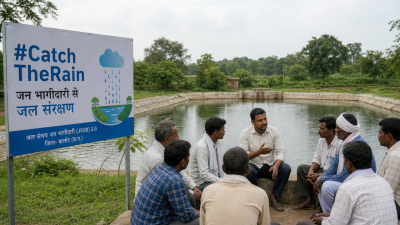
Balod district’s Jan Bhagidari Jal Sanchay (JSJB) 2.0 has constructed 2,84,917 water‑conservation and recharge structures between June 2025 and May 2026 under the #CatchTheRain campaign. Combined with JSJB 1.0 (1.06 lakh structures), the district reports nearly 3.91 lakh interventions, including a 14.3 km Tawera Nala rejuvenation expected to replenish 6.5 crore litres and raise groundwater by 5–10 feet.
What is the development
- Scale: 2,84,917 structures in one year (JSJB 2.0); earlier JSJB 1.0 added 1.06 lakh structures.
- Key interventions: recharge pits, check dams, recharge shafts in defunct borewells, contour trenches, community check dams; Tawera Nala: >6,250 structures over 14.3 km.
- Institutions: Gram Panchayats, district administration, local communities, Ministry of Jal Shakti’s #CatchTheRain framework.
Why it matters for governance, society and environment
- Governance: Model shows decentralised implementation and Panchayati Raj participation in natural resource management.
- Society: Improves local water security, supports livelihoods and agricultural resilience, builds community ownership.
- Environment: Increases rainwater capture, reduces runoff, conserves soil moisture, and raises groundwater levels—a direct climate‑adaptation measure.
Key features and operational approach
- Jan Bhagidari: Community labour, local decision‑making and stewardship of structures.
- Decentralisation: Gram Panchayats identify sites and supervise execution; district provides technical and logistical support.
- Mix of interventions: site‑specific structures (recharge pits, trenches, check dams, shafts) matched to topography and hydrogeology.
- Phased scaling: JSJB implemented in rounds (1.0 then 2.0) with monitoring and expansion of successful tactics.
Implementation and achievements
- Aggregate output: ~3.91 lakh structures across JSJB 1.0 and 2.0.
- Tawera Nala: >6,250 structures across 14.3 km; estimated additional storage 6.5 crore litres and groundwater rise of 5–10 ft.
- Local results: Reduced surface runoff, improved soil moisture, enhanced recharge near borewells and defunct wells, visible monsoon‑time gains.
- Recognition: Earlier national acknowledgement under #CatchTheRain; Ministry of Jal Shakti publicised recent outputs.
Environmental and socio‑economic impact
- Hydrological: Enhanced aquifer recharge, stabilised water table, reduced dependency on deep wells and tanker water.
- Agricultural: Better soil moisture for Rabi/monsoon crops, potential yield gains, lower input costs where groundwater access improves.
- Ecological: Support for plantation and biodiversity along watersheds; reduced erosion from contour measures.
- Social: Strengthened community institutions, skill development in watershed works, shorter distances and time for water collection.
Governance and institutional role
- Local governance: Gram Panchayats led site selection, labour mobilisation and maintenance responsibilities—effective exercise of Panchayati Raj functions.
- District administration: Technical guidance, funds coordination, monitoring and linkages to state/central schemes.
- Central alignment: Implemented under national #CatchTheRain messaging; Ministry of Jal Shakti provided visibility and aggregate data.
Factors underpinning success
- Community ownership: “Jan Bhagidari se Jal Sanrakshan” created local incentives for construction and maintenance.
- Targeted interventions: Site‑appropriate measures—recharge pits near borewells, check dams in nala stretches, trenches in slopes.
- Administrative coordination: District‑level planning, Gram Panchayat execution and central campaign support.
- Measurable targets: Quantified structure counts allowed monitoring and public recognition, sustaining momentum.
Challenges in replication and sustainability
| Challenge | Implication |
|---|---|
| Hydro‑geological diversity | One design does not fit all; requires local hydrogeology and soil surveys. |
| Sustained community engagement | Initial enthusiasm may wane without continued incentives and maintenance funds. |
| Funding and technical capacity | Smaller districts may lack skilled manpower and flexible finance for scaling. |
| Monitoring and maintenance | Structures require long‑term upkeep; weak M&E leads to deterioration. |
Way forward and policy implications
- Institutionalise local planning: State guidelines should mandate hydro‑geological assessment and Gram Panchayat water budgets.
- Capacity building: Train panchayat functionaries, masons and watershed committees in construction, M&E and O&M.
- Flexible finance: Combine MGNREGA labour funding, state watershed funds and performance‑linked grants for maintenance.
- Technology use: GIS and remote sensing for site selection, mobile apps for monitoring and public dashboards for transparency.
- Knowledge transfer: Document protocols (design, cost norms, maintenance schedules) and set inter‑district peer learning platforms.
- Integration: Align local water works with crop planning, watershed management, and climate adaptation strategies.
Model Questions
1. Assess the significance of Balod’s Jan Bhagidari model for decentralised water governance in India. [GS-II: Governance]
Balod demonstrates decentralised planning, Gram Panchayat leadership, and community labour in water conservation. Key gains include rapid creation of structures, improved aquifer recharge and local ownership. Replicable elements: site‑specific interventions, district facilitation, measurable targets and blended financing. Limitations: need for hydro‑geological assessments, sustained maintenance funding and capacity building to convert initial success into long‑term water governance reform.
2. Examine environmental and socio‑economic benefits of community‑led water conservation using Balod as an example. [GS-III: Environment & DM]
Community measures (recharge pits, check dams, contour trenches) increase rainwater capture, reduce runoff and raise groundwater (Tawera Nala: 6.5 crore litres; 5–10 ft rise). Environmental benefits include soil moisture retention and watershed restoration. Socio‑economic gains are improved water security, agricultural stability, reduced extraction costs and strengthened local institutions—contributing to climate resilience and rural livelihoods.
3. Identify and analyse the key factors that contributed to the success of Balod’s JSJB initiatives and draw lessons for national water management. [GS-II: Governance]
Success factors: strong community participation, district administrative coordination, targeted site‑specific interventions, measurable targets and national campaign alignment. Lessons for national policy: decentralise decision‑making, mandate hydro‑geological surveys, incentivise maintenance, combine labour and funds (e.g., MGNREGA), and use performance metrics for scaling. Replication requires local adaptation rather than uniform application.
4. Discuss challenges in scaling community‑based water conservation models and propose a framework for nationwide replication. [GS-III: Environment & DM]
Challenges: varied hydrogeology, uneven administrative capacity, funding gaps, and sustaining local engagement. Framework: baseline hydro‑geological mapping, capacity building for panchayats, flexible financing (labour + performance grants), tech‑enabled site selection and monitoring, standardised maintenance protocols, and district‑to‑district knowledge exchange to adapt designs to local conditions.
Last Modified: July 11, 2026