
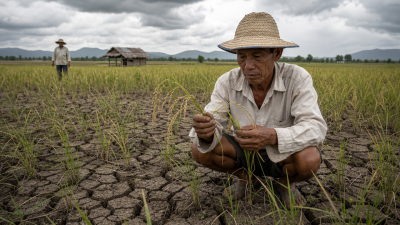
A strengthening El Niño, now forecast to become strong-to-very-strong, threatens global rice supply by disrupting Asian monsoons, water inflows and planting schedules. Price and input shocks, compounded by higher fertiliser costs and trade risks, raise governance, food security and international stability concerns.
What is the current issue?
- Intensity: Forecasters expect the present El Niño to intensify; NOAA gives a 63% probability of an extremely strong event by late 2026–early 2027.
- Market signals: Rice prices were 12.82 USD/cwt on 1 July 2026, up 1.26% month‑on‑month and 1.63% year‑on‑year amid supply concerns.
- Production outlook: IGC projects global rice production for 2026/27 at 545 million tonnes, slightly below the previous season; stronger El Niño tends to lower yields by about 1–1.5% according to recent analysis.
Why it matters for governance and security
- Food security: Over half the world’s population relies on rice; India and China supply more than half of global output. Several low‑income countries obtain a large share of calories from rice.
- Political risk: Concurrent shocks can provoke export restrictions and panic buying, repeating past episodes that triggered price spikes and social unrest.
- Economic stress: Fertiliser price surges caused by geopolitical disruptions (Iran conflict; Strait of Hormuz) increase production costs and reduce farmers’ capacity to respond.
El Niño mechanism and amplification by climate change
Physical effect
- Ocean–atmosphere coupling: Pacific SST anomalies modify global circulation, altering monsoon timing, intensity and regional rainfall patterns.
- Hydrology: Irrigated lowland paddies (≈75% of world rice) depend on rivers, reservoirs and snowmelt that El Niño can reduce or delay.
Role of climate change
- Baseline warming: Higher baseline temperatures increase evapotranspiration and drought likelihood, amplifying El Niño impacts and causing hotter, drier conditions across much of Asia in 2026.
- More extreme outcomes: Climate change raises the chance of compound extremes (heat plus water deficit) that harm rice at critical growth stages.
Impact on rice production, supply chains and prices
- Planting and yields: Delayed planting and water shortages have already reduced area and yield expectations in several countries. Empirical work indicates yield declines of ~1–1.5% in strong events; worst‑case agribusiness analyses project far larger agricultural losses.
- Input constraints: Fertiliser cost spikes raise per‑hectare expenses and can prompt lower nutrient application, reducing productivity.
- Trade and logistics: Simultaneous regional hits may stress exporters, induce export curbs, and strain global supply chains, especially for import‑dependent poorer nations in Southeast Asia and West Africa.
Socio‑economic vulnerabilities
- Import‑dependent states: Philippines, several West African countries and small island states face high exposure to price and supply shocks.
- Domestic poverty and nutrition: In rice‑dependent economies (Bangladesh, Vietnam, Cambodia) price rises directly affect caloric intake and household budgets.
- Rural producers: Smallholders face higher input costs, reduced yields and income loss; weaker access to credit and insurance amplifies distress.
Global preparedness and inventory ambiguity
- Inventories: Reports conflict: some point to near‑record cereal inventories (~196.16 million tonnes) that could buffer shocks; others report lower effective stocks and tighter cost conditions than in past crises.
- Predictability: Strong El Niños produce more consistent regional patterns, aiding early response, but concurrent multi‑region impacts complicate national responses and trade coordination.
Policy options for national resilience
- Early warning and advisories: Strengthen meteorological services, agro advisories and real‑time water monitoring to guide sowing dates and irrigation scheduling. Integrate NOAA/IGC forecasts with national extension systems.
- Buffer stocks and market interventions: Maintain strategic reserves (e.g. FCI buffers), calibrated procurement and release policies to stabilise domestic markets. Avoid abrupt export bans; prefer targeted, transparent measures.
- Input support and credit: Provide targeted fertiliser subsidies or vouchers, crop loans and emergency credit to smallholders to sustain production during high input‑price episodes.
- Risk transfer: Scale up crop insurance schemes (PMFBY enhancements), index‑based insurance and public emergency funds to cushion farmer income loss.
- Water management: Invest in efficient irrigation (drip, alternate wetting and drying), reservoir operation reforms and watershed conservation to reduce vulnerability of irrigated paddies.
- Seed and varietal strategy: Accelerate distribution of drought‑ and heat‑tolerant rice varieties developed by ICAR, IRRI and national programmes. Support seed systems for rapid multiplication.
- Diversification: Promote crop diversification and nutritional substitution in high‑rice diets to reduce household exposure to rice price shocks.
Policy options for international cooperation
- Trade coordination: Encourage pre‑agreed multilateral arrangements to minimise disruptive export bans; use WTO and FAO platforms for information sharing and market transparency.
- Shared early warning: Institutionalise timely exchange of climate and stock data among NOAA, IGC, FAO and national agencies to coordinate buffer releases and aid.
- Fertiliser supply stability: Diversify supply chains, invest in regional fertiliser storage and explore strategic diplomatic channels to protect maritime chokepoints.
- Development assistance: Target aid for import‑dependent low‑income countries to finance emergency imports, support smallholders and strengthen market infrastructure.
Implementation and governance priorities
- Targeting: Use socio‑economic and agro‑climatic risk maps to target interventions to the most vulnerable geographies and households.
- Fiscal planning: Pre‑position contingency budgets and release criteria for timely market interventions and farmer support.
- Monitoring and evaluation: Establish indicators for stock adequacy, market functioning and farmer livelihood metrics; review policy triggers post‑event.
- Coordination mechanisms: Create inter‑ministerial taskforces (agriculture, finance, water, external affairs) and engage state governments where decentralised agriculture is dominant.
Model Questions
1. Analyse the multifaceted threats posed by the anticipated strong El Niño in 2026 to global rice security, particularly highlighting India’s position and the socio‑economic implications for vulnerable nations. [GS-III: Economic Development]
India and China supply over half of global rice; a strong El Niño disrupts monsoons and water inflows, delaying planting and reducing yields. Fertiliser price surges raise costs, shrinking smallholder margins. Export restrictions and panic buying risk price spikes that hurt import‑dependent Philippines and West African states. Policy response requires buffer stocks, targeted farmer support, irrigation efficiency, varietal rollout and coordinated trade measures to protect food security and livelihoods.
2. Critically examine how the current El Niño event, intensified by climate change and geopolitical factors, exacerbates challenges for global food systems, with specific reference to rice production and supply chains. [GS-III: Environment & DM]
Climate change has raised baseline heat and drought risk; El Niño amplifies monsoon failure and water shortages for irrigated rice. Geopolitical disruptions to fertiliser supply have elevated input costs, reducing nutrient use and yields. Simultaneous regional impacts strain logistics and trade, creating cascading supply chain failures. Strengthened forecasting, resilient agronomy, diversified input sources and international coordination are required to reduce systemic risk to rice systems.
3. Discuss the economic implications of El Niño‑induced rice supply disruptions, including price volatility and trade restrictions. Suggest policy measures and international cooperation strategies to build resilience. [GS-III: Economic Development]
Supply disruptions raise global prices and volatility, harming consumers and triggering social stress. Export curbs amplify shocks. Economic measures include strategic reserves, calibrated procurement and release rules, targeted subsidies, and index insurance for farmers. International measures require transparency via IGC/FAO, pre‑agreed trade restraint frameworks, coordinated emergency shipments, and financial support to vulnerable importers to stabilise markets and prevent panic.
4. In light of the projected extremely strong El Niño and inventory discrepancies, evaluate global preparedness to avert a major rice crisis. What comprehensive strategies are required to ensure long‑term rice security? [GS-II: Governance]
Preparedness is mixed: some apparent near‑record cereal stocks exist, but effective usable stocks and cost pressures are uncertain. Governments need integrated strategies: strengthen early warning and contingency planning, maintain targeted buffer stocks, invest in water and seed resilience, expand social protection and insurance, and negotiate multilateral trade safety nets. Good governance demands clear triggers, fiscal contingencies, and coordinated international mechanisms to manage simultaneous shocks.
Last Modified: July 1, 2026