
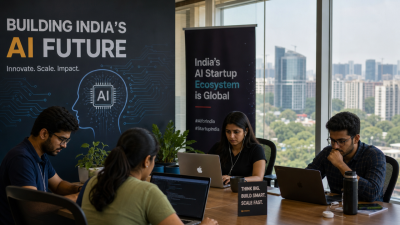
Bengaluru-Karnataka has emerged as a leading AI-native startup hub, ranked Asia’s second-best and 15th globally in the GSER 2026. India also leads the 2026 Global Outsourcing AI Readiness Index and ranks highly in AI performance and digital economy measures, affecting governance, economy, security and international engagement.
What is the current issue?
The core issue is India’s rapid rise in AI entrepreneurship and R&D capacity, centred on Bengaluru, and the policy challenge of converting this momentum into sustainable, sovereign and inclusive national AI capability.
Why it matters
- Governance: Government AI procurement and vendor panels will shape public services and regulatory practice.
- Economy: High venture funding, exits and projected revenue gains from AI alter growth trajectories and employment patterns.
- Security & sovereignty: Dependence on foreign models poses strategic risks for critical systems and data control.
- International relations: Global partnerships create market access but require safeguards for data and IP.
Current status and global positioning
Bengaluru-Karnataka is Asia’s second-best AI-native startup hub and ranked 15th among global ecosystems in the GSER 2026. The cluster is in the global top 10 for startup performance and for R&D, and outperforms a leading US region in R&D metrics. The ecosystem is valued at approximately USD 153 billion, with USD 46 billion in exits and USD 39 billion in venture capital funding during 2021–2025. Karnataka receives 58% of India’s AI-focused venture funding. National indices show India at the top of the 2026 Global Outsourcing AI Readiness Index (score 84.55). The SIDE 2026 report ranks India 4th in AI performance and 5th in the digital economy.
Key drivers of growth
- Talent pool: Large base of AI-skilled professionals and deep tertiary education capacity.
- R&D intensity: Concentrated research in private startups, academic institutions and corporate labs.
- Capital availability: Strong venture funding and notable exits that recycle capital into new ventures.
- Enterprise readiness: Indian firms show readiness to adopt AI, leading to domestic market demand.
- DeepTech clustering: Bengaluru’s ecosystem combines IT, biotechnology and hardware startups to support AI applications.
- Global market access: Programmes linking startups to international accelerators and universities expand opportunities.
Government initiatives and policy support
- IndiaAI Startups Global Acceleration Program: MeitY launched the second cohort to provide global market access through partnerships with Station F and HEC Paris.
- Common AI vendor panel: The government selected six companies, including TCS and NEC Corporation India, to develop next-generation AI systems for ministries, PSUs and citizen services and to form a procurement panel.
- Public procurement as demand signal: Government adoption can scale domestic solutions and create standards for accountability.
- Regulatory environment: Ongoing work on data protection and sector-specific AI governance remains central to adoption pathways.
Economic impact and potential
- Direct value: Ecosystem valuation (USD 153 billion) and capital flows support startup formation and tech employment.
- Revenue uplift: A CMO survey shows 53% expect AI to add 5–9% incremental revenue, above the global average of 43%.
- Exports and services: India’s top rank in outsourcing AI readiness positions it to expand AI services exports.
- DeepTech industrialisation: R&D strength can shift India from IT services to product and platform development.
Challenges and strategic risks
| Challenge | Implication |
|---|---|
| AI sovereignty | Reliance on foreign foundational models and cloud infrastructure can limit control over critical systems and data. |
| Data governance and privacy | Weak or fragmented rules reduce public trust and complicate cross‑border data flows. |
| Infrastructure gaps | Insufficient local compute, data centres and high-speed networking raise costs for training large models. |
| Skill mismatch | Demand for specialised AI skills outpaces supply in many regions and sectors. |
| Geographic concentration | Majority of funding and R&D is concentrated in Karnataka, increasing regional imbalances. |
| Ethics and accountability | Limited standards risk biased outcomes, legal disputes and reputational cost for adopters. |
Measures for technological resilience and AI sovereignty
- Invest in indigenous models: Fund public–private R&D to develop local foundational models and domain-specific variants.
- National datasets: Build curated, privacy-preserving domestic datasets for public interest domains (health, agriculture, governance).
- Local compute capacity: Scale sovereign data centres and high-performance computing through incentives and strategic investments.
- Procurement policy: Use the common vendor panel to prefer certified domestic solutions where feasible and require audit trails and explainability.
- Regulation and standards: Implement clear data protection rules, AI standards for safety and auditing, and sectoral compliance norms.
- Human capital: Expand targeted fellowships, industry–academic programmes and regional upskilling to broaden the talent base.
- Regional diffusion: Support incubation and funding in other states to reduce concentration risks.
- International engagement: Combine global partnerships for market access with technology transfer clauses and IP safeguards.
Policy actions for inclusive growth and social applications
- Public service use-cases: Deploy AI in healthcare triage, agricultural advisories, education adaptive learning and disaster response with clear governance rules.
- Access and affordability: Subsidies or shared infrastructure for social-sector AI to ensure access beyond top-tier firms and cities.
- Ethics-by-design: Mandate bias testing, transparency labels and grievance redress for AI systems used in public services.
- Monitoring outcomes: Establish metrics to assess distributional impact of AI on employment, incomes and service access.
Future outlook
India can convert current strengths in talent, R&D and enterprise demand into durable global competitiveness if policy blends market incentives, sovereign infrastructure and rule-based governance. Strategic public procurement, targeted R&D support, and wider geographic diffusion of funding will determine whether growth is broad-based and resilient.
Model Questions
- Analyse the factors contributing to the rapid emergence of Bengaluru-Karnataka as a leading AI startup hub and evaluate India’s overall global competitiveness in AI. [GS-III: Science & Technology]
- Examine the strategic initiatives undertaken by the Indian government to scale the AI startup ecosystem and assess their likely economic effects. [GS-II: Governance]
- Discuss the concept of AI sovereignty for India and recommend measures to achieve technological resilience in the AI sector. [GS-III: Internal & External Security]
- With Bengaluru positioned as a global DeepTech and AI innovation hub, analyse opportunities and challenges in using the AI startup ecosystem to promote inclusive growth. [GS-III: Economic Development]
Answer must cover GSER 2026 rankings, ecosystem valuation and capital flows, R&D performance, talent and enterprise readiness, India’s scores in international indices, role of DeepTech clustering, and limits such as regional concentration and infrastructure gaps.
Answer must describe IndiaAI acceleration, common AI vendor panel and government procurement, implications for startup market access, expected revenue gains, export potential, risks to competition, and need for regulatory safeguards and capacity building.
Answer must define AI sovereignty, identify risks from foreign model dependence, propose indigenous model development, domestic datasets, local compute and secure supply chains, legal and procurement instruments, and international cooperation with safeguards.
Answer must outline opportunities in health, education and agriculture, job creation and exports; challenges in ethics, data privacy, skill gaps and regional imbalance; and policy measures for affordable access, ethics-by-design, upskilling and regional incubation.