
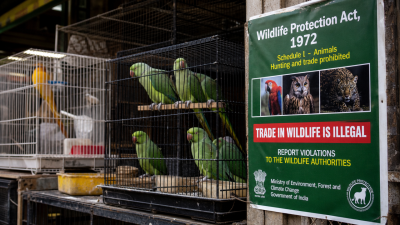
India recently received a policy report — “Safeguarding Biodiversity and Public Health: A Policy Analysis of Exotic Pet Trade in India” (published 1 July 2026) — showing gaps in regulation, growing illegal trafficking, zoonotic risks and the spread of invasive species. The report calls for a national regulatory framework and stronger oversight of digital markets.
Overview and market dynamics
- Market size: Valued at about USD 42.6 million in 2024; projected to reach USD 75.8 million by 2030 (CAGR 10.2%).
- Ownership: 2020 Voluntary Disclosure Scheme recorded over 40,000 exotic pet owners across 30 states and union territories; actual numbers are likely higher.
- Species traded: Reptiles (green iguanas, royal ball pythons), birds (African grey parrots, blue-and-gold macaws), with rising demand for mammals and invertebrates.
- Roles: India acts as both consumer market and transit hub for thousands of exotic animals trafficked via domestic and international networks.
Legal and regulatory framework: current gaps
- Primary statutes: Wildlife (Protection) Act, 1972 (WPA) and Biological Diversity Act, 2002 (BDA) remain the main statutes but were not drafted for large-scale exotic pet commerce.
- Non-CITES gap: National regulation for non-CITES species is fragmented despite reforms for CITES-listed species. Many traded species fall outside clear national controls.
- Enforcement weaknesses: Multiple agencies (state forest departments, Customs, Wildlife Crime Control Bureau) operate with poor data-sharing, no central registry and inconsistent permitting.
- Digital oversight: Online platforms and encrypted messaging are used to bypass permits and inspection; existing laws offer limited tools for platform-level traceability and seller verification.
Environmental implications
- Biodiversity loss: Illegal collection and international demand reduce wild populations and may drive local extinctions.
- Invasive species: Escaped or released exotics can establish breeding populations. Ecological impacts include competition, predation and habitat alteration.
- Conservation enforcement: Trade in non-native species diverts enforcement resources from protected native fauna and complicates species recovery plans.
Public health risks
- Zoonotic pathogens: Reptiles, birds and primates sold in the trade commonly carry pathogens such as Salmonella, psittacosis and herpesviruses.
- Surveillance gap: India lacks a cohesive post‑importation disease surveillance and quarantine framework for exotic pets. Early detection and response are fragmented.
- One Health failure points: No standardised link between wildlife import controls, public-health agencies (NCDC) and veterinary/quarantine services for shared data or outbreak protocols.
Economic aspects and organised crime
- Profit motive: Rising demand and high margins drive supply chains that mix licit trade with illegal sourcing.
- Criminal networks: Trafficking networks use layered consignments, falsified permits and money-movement techniques to launder proceeds and exploit weak checkpoints.
- Employment and livelihoods: Illegal collection affects local communities; sustainable livelihoods are rarely provided as alternatives.
Modus operandi and trafficking routes
- Major routes: Overland flows through Northeast borders (Myanmar, Bangladesh); air routes via Chennai, Bengaluru and Mumbai international airports.
- Transport methods: Concealment in luggage, courier consignments, mis-declaration as aquarium/ornamental consignments, and transit through domestic brokers.
- Digital facilitation: Listings on social media, classified sites and encrypted apps arrange sales, payments and delivery, reducing paper trails.
Institutional gaps and inter-agency coordination
- Fragmented mandates: MoEFCC (wildlife policy), WCCB (crime investigation), Customs (border control), State forest departments, MeitY (digital governance) and health agencies lack a dedicated coordinating mechanism.
- Technical capacity: Shortage of quarantine facilities at ports, limited diagnostic capacity for exotic pathogens, and scarce trained wildlife forensic teams.
- Data systems: Absence of a national registry for exotic pets, no traceability mechanism, and poor real-time intelligence sharing between agencies.
| Aspect | Present law/practice | Key gap |
|---|---|---|
| Species coverage | WPA (native/CITES focus), BDA (access and benefit-sharing) | Non-CITES exotic species not uniformly regulated |
| Import control | Customs + CITES procedures | No standard post-import quarantine/surveillance for exotics |
| Digital trade | General IT laws; intermediary liability rules | No mandatory traceability or seller verification for wildlife listings |
Recommendations and way forward
Legal and regulatory measures
- National regulatory framework: Enact a statute or national policy that defines exotic pet ownership, a graded permit system, breeder registration and seizure/rehabilitation protocols.
- Expand species lists: Create a risk-based list to include high-risk non-CITES species under stricter controls and mandatory quarantine.
- Amend enforcement laws: Provide clearer powers for WCCB, Customs and state agencies to act on digital evidence and cross-border consignments.
Health and biosecurity measures
- Post-import surveillance: Establish mandatory quarantine at ports of entry and protocolised pathogen screening for imported exotics.
- One Health coordination: Formalise data-sharing between MoEFCC, NCDC, veterinary services and state health departments.
- Diagnostic capacity: Strengthen laboratory networks for wildlife pathogens and create SOPs for outbreak investigation from exotic-pet sources.
Digital and technological interventions
- Platform obligations: Mandate traceability, seller verification and takedown obligations for listings involving live wildlife. MeitY to issue sector-specific rules.
- Technology tools: Use AI web-scraping to detect listings, blockchain for chain-of-custody records and a national registry with microchip/ID requirements.
Enforcement and capacity building
- Specialised task force: Create a multi-agency task force with WCCB, Customs, state forest divisions and police for coordinated investigations and prosecutions.
- Training and resources: Invest in forensic science, K9 units, port quarantine facilities and judicial sensitisation for sentencing deterrents.
- Community alternatives: Support livelihood programmes for source communities and incentivise captive-breeding compliance where ecologically appropriate.
International cooperation
- Regional engagement: Strengthen border cooperation and intelligence-sharing with Bangladesh and Myanmar.
- Global mechanisms: Use CITES processes, INTERPOL and World Customs Organization channels for cross-border investigations and repatriation of trafficked animals.
- Capacity support: Seek technical assistance for quarantine, diagnostics and digital monitoring from international partners.
Model Questions
1. Examine the multi-dimensional challenges posed by the exotic pet trade in India, including environmental, public health and security aspects. Recommend legal and administrative measures to regulate the trade effectively. [GS-III: Environment & DM]
India faces biodiversity loss, invasive species risk and zoonotic threats (Salmonella, psittacosis, herpesviruses). Trafficking links to organised crime exploit air and land routes and digital platforms. Immediate measures: a national regulatory framework with a risk‑based species list, mandatory quarantine and post‑import surveillance, digital market traceability, enhanced powers for WCCB and Customs, and One Health data-sharing among MoEFCC, NCDC and veterinary services.
2. “India’s fragmented regulatory approach to the exotic pet trade creates governance gaps that increase risks to public health and biodiversity.” Discuss and suggest institutional reforms for a cohesive framework. [GS-II: Governance]
Fragmented mandates across MoEFCC, state wildlife departments, Customs, WCCB and health agencies impede coordinated action. Reforms: designate a nodal authority or inter‑ministerial steering group; create a national exotic‑pet registry and standard permits; integrate NCDC and wildlife surveillance via One Health protocols; assign MeitY responsibilities for digital oversight; build a unified data platform for real‑time intelligence and standard operating procedures for seizures and quarantine.
3. Analyse the economic drivers and modus operandi of the exotic pet trade in India, its links to organised crime and the role of digital platforms. How can enforcement and technology address these problems? [GS-III: Internal & External Security]
High demand and profit margins (market projected to grow to USD 75.8 million by 2030) feed legal and illegal supply chains. Traffickers use Northeast land routes and airports, falsified documents and encrypted apps to trade. Responses: strengthen Customs and WCCB investigations, financial-tracking, platform monitoring using AI scraping, mandatory seller verification, blockchain traceability, and specialised task forces to dismantle organised networks and prosecute facilitators.
4. Critically evaluate India’s role as both consumer market and transit hub for exotic animals and recommend domestic and international policy adjustments to protect biodiversity and public health. [GS-II: International Relations]
India’s consumer demand and strategic transit position enable large flows of exotics through air and land routes. Domestic adjustments: national regulation for non‑CITES species, port quarantine and post‑import surveillance, digital marketplace rules and cross‑agency coordination. International steps: regional border cooperation with Bangladesh and Myanmar, use of CITES processes, INTERPOL/WCO collaboration, and bilateral MOUs for repatriation, intelligence exchange and capacity building.
Last Modified: July 3, 2026