
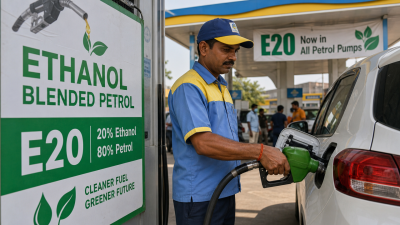
The Centre has slowed plans to increase ethanol content in petrol beyond the mandatory E20. The rollout to E20 was completed nationally; higher blends remain under technical review while policy signals (excise exemption, BIS standards, transport-permit relief) continue to shape the roadmap for biofuels and alternative fuels.
Current status and stakes
- Phased rollout: E15 introduced, then E19; E20 became operational and its nationwide rollout was formally implemented, achieving the target ahead of the original timeline.
- Recent policy signals: BIS issued specifications for 22–30% ethanol blends; Finance Ministry exempted those blends from excise duty; government denied any decision on E25 rollout pending vehicle compatibility tests.
- Regulatory ease for alternatives: Commercial vehicles running on ethanol, methanol, hydrogen and battery-electric power are exempt from transport-permit requirements for seven years to accelerate adoption.
- Evidence and concerns: A recent PLOS One study draws attention to trade-offs between biofuel expansion and food/water security. Motorist and compatibility concerns persist, especially for older vehicles.
Objectives and achievements of the Ethanol Blending Programme (EBP)
- Primary objectives: reduce oil imports and fiscal pressure; enhance energy security; lower greenhouse gas emissions from road transport; augment farmer incomes through alternative markets.
- Agricultural and rural aims: provide demand for surplus feedstocks, boost rural employment and investment in rural processing units.
- Achievement: E20 nationwide rollout completed ahead of earlier targets, demonstrating delivery capacity in procurement, supply-chain expansion and fuel distribution adaptation.
Reasons for the pause and persisting challenges
- Vehicle performance: Ethanol has lower calorific value than petrol; users report reduced fuel economy at higher blends.
- Compatibility and durability: Ethanol is hygroscopic and can corrode fuel-system components in vehicles not designed for higher blends. Compatibility testing across manufacturers is ongoing.
- Resource trade-offs: Increased demand for feedstock crops can pressurise food availability and water resources, particularly where sugarcane or paddy are used.
- Consumer choice and trust: Limited consumer options at pumps and information gaps on vehicle compatibility have reduced public confidence.
- Policy coherence: Technical standards (BIS) and fiscal signals (excise exemption for 22–30% blends) exist, but operational rollout for higher blends awaits test results and mitigation measures.
Economic and environmental implications
| Dimension | Potential benefits | Trade-offs / risks |
|---|---|---|
| Macro-economy | Lower crude import bill; foreign-exchange savings; rural income support. | Subsidy or fiscal burden if procurement prices rise; market distortions in crop allocation. |
| Environment | Reduced lifecycle CO2 emissions if feedstocks and processing are low-carbon; lower particulate emissions. | Water stress and land-use change risks if water-intensive or food crops are expanded; possible biodiversity loss. |
| Energy security | Domestic fuel supply diversification; strategic resilience against oil price shocks. | Over-reliance on a limited set of feedstocks creates new vulnerabilities. |
Policy options and a pragmatic roadmap
Short-term (implementation and risk mitigation)
- Complete compatibility testing: Fast-track standardised tests across manufacturers and vehicle age cohorts. Publish compatibility lists and guidance for vehicle owners.
- Consumer safeguards: Mandatory pump labelling, price transparency, and public information campaigns on mileage trade-offs and vehicle suitability.
- Targeted exemptions: Phase-in or opt-out mechanisms for older fleets until retrofits or replacement options are feasible.
Medium-term (sustainable feedstock and supply-chain shifts)
- Promote low-water feedstocks: Incentivise sweet sorghum, bajra, millets and agricultural residues for ethanol feedstock through crop-specific procurement windows and extension services.
- Agricultural safeguards: Link ethanol procurement to sustainable agriculture criteria—water-use norms, no-net-expansion of irrigated area for biofuel crops, and food-security monitoring.
- Value-chain investment: Support second-generation (cellulosic) ethanol R&D and financing for rural distillation units with pollution controls.
Long-term (regulatory, fiscal and institutional)
- Standards and testing: Strengthen BIS standards and institute an independent certification regime for blend compatibility and fuel quality.
- Fiscal design: Use excise and subsidy signals to encourage blends that meet sustainability criteria. Maintain transparent pricing to avoid hidden subsidies.
- Monitoring and metrics: Establish an inter-ministerial dashboard tracking feedstock cropping patterns, water use, food-price impacts and lifecycle emissions.
Diversified approach to alternative fuels in transport
- Policy mix: Alongside ethanol, the government is promoting methanol, hydrogen and battery-electric technologies. Regulatory relief for commercial vehicles aims to accelerate deployment.
- Benefits of diversification: Reduces strain on any single feedstock, spreads technology risk, and improves overall resilience of the transport energy mix.
- Implementation priorities: Invest in hydrogen and methanol supply chains, EV charging infrastructure, and fuel-flexible engines. Align incentives with lifecycle emission reductions and local resource availability.
Model Questions
1. Analyse the objectives and achievements of India’s Ethanol Blending Programme, and discuss its economic and environmental implications. [GS-III: Economic Development]
EBP aims to reduce oil imports, enhance energy security, lower transport emissions, and raise farmer incomes. Achievement: nationwide E20 rollout ahead of schedule. Economic effects include import-bill savings and rural income support; risks include fiscal costs and crop-market distortions. Environmental gains depend on feedstock and processing; water stress and land-use impacts can offset emission benefits if water-intensive crops expand.
2. Examine reasons behind the pause on increasing ethanol blends beyond E20 and suggest measures to address the challenges. [GS-III: Economic Development]
Pause reflects lower mileage, corrosion and compatibility concerns in older vehicles, and resource trade-offs affecting food and water security. Measures: complete manufacturer-led compatibility tests, publish vehicle guidance, promote low-water feedstocks (sorghum, millets), strengthen BIS standards, support R&D for retrofits and cellulosic ethanol, and ensure consumer choice and clear pump labelling.
3. Critically evaluate the trade-offs between energy security and resource sustainability in India’s national biofuel policy. [GS-III: Environment & DM]
Biofuels improve energy security and can reduce CO2 when feedstocks and processing are low-carbon. However, scaling using water-intensive or food crops risks water stress, reduced food availability and land-use change emissions. Policy must balance targets with sustainable feedstock selection, irrigation efficiency, land-use safeguards and lifecycle emission accounting to avoid net environmental harm.
4. Beyond ethanol, assess India’s policy measures to promote alternative fuels in transport and their likely benefits. [GS-III: Science & Technology]
Measures include regulatory relief for commercial alternative-fuel vehicles, fiscal incentives and standards for higher blends, and support for EV, hydrogen and methanol supply chains. Benefits: diversified energy mix, lower oil dependence, emission reductions and technology development. Challenges: infrastructure build-out, supply-chain maturity and ensuring low-carbon feedstocks and electricity for genuine emission gains.
Last Modified: July 9, 2026