
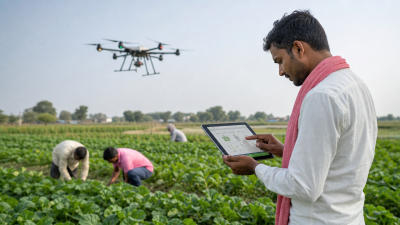
Artificial Intelligence and agri-startups are entering India’s farm economy at scale. Recent policy launches, private funding and field models now link AI, satellites, drones and precision farming with entrepreneurship programmes aimed at raising yields, incomes and climate resilience across smallholder systems.
What is the current issue?
AI is estimated to add nearly ₹70,000 crore annually to India’s agriculture economy and can save an average farmer about ₹5,000 per year through better decision-making and resource use. Agri-startups have expanded sharply — from roughly 350 in 2015 to over 2.3 lakh — making agriculture a strategic sector for innovation and rural employment.
Why this matters for governance and economy
- Economy: Higher productivity and cost savings can raise farm incomes and value added in agri-food chains.
- Governance: Programmes such as PRAGATI target 20,000 agri-entrepreneurs and 2 million smallholders, linking public policy with private funding and foundations.
- Environment & resilience: Digital tools improve climate-resilience through precise irrigation, weather advisories and early pest detection.
- International relations: Technology cooperation with partners (for example, Indonesia) spreads best practices and builds market and diplomatic linkages.
Potential of AI and agri-startups in the agriculture economy
- Direct economic addition: National estimate of ~₹70,000 crore annually from AI-driven optimisation and innovation.
- Farmer-level impact: Average savings of ~₹5,000 per farmer via improved inputs, timing and logistics.
- Value-chain effects: Startups offer demand forecasting, route optimisation, grading, post-harvest services and market access (example: Doodhvale Farms using AI for demand forecasting and routing).
- Scale potential: Rapid startup growth increases supply of context-specific digital solutions for diverse agro-ecologies.
Digital technologies enabling climate-resilient agriculture
- Satellite & remote sensing: Crop area mapping, biomass indices and large-scale drought/flood monitoring for planning and insurance.
- Weather forecasting & advisories: Localised forecasts reduce crop losses and time inputs effectively.
- Drones & sensors: Pest surveillance, nutrient surveys and targeted pesticide application reduce input use and losses.
- Precision farming & AI models: Optimise irrigation, fertiliser and seed choice; AI models convert multisource data into prescriptive actions.
- Outcomes: Targeted programmes (PRAGATI) aim for 15–20% yield increases in key crops and better resource efficiency across eight states.
Agri-startups as catalysts for rural entrepreneurship and livelihoods
- Job creation: Startups create agronomy, logistics, processing and retail jobs in rural areas.
- Entrepreneurship models: Examples include CSIR Aroma Mission’s Purple Revolution (lavender cultivation) which created 8,000–9,000 young entrepreneurs with annual enterprise incomes reported at ₹60–70 lakh; the model is being replicated in other Himalayan and north-eastern states.
- Incubation and funding: PRAGATI and private foundations provide training, market linkages and seed support; private funding (e.g. USD 1 million to Doodhvale) fuels scaling of AI solutions.
Policy and institutional framework
- National initiatives: PRAGATI — a government-supported initiative to develop 20,000 agri-entrepreneurs and directly reach 2 million smallholders with climate-resilient and regenerative practices.
- Multi-stakeholder support: PRAGATI is backed by public and private partners including the PepsiCo Foundation, State Bank of India Foundation and the Gates Foundation.
- Conclaves and dialogue: The 17th Agriculture Leadership Conclave provided a platform for government, industry and startups to coordinate policy, research and deployment.
- International cooperation: India is sharing sustainable farming expertise, including AI, IoT, drones and sensors, with partner countries to support regional food security and technology diffusion.
Operational examples and delivery models
- PRAGATI model: Combine training, demonstration plots, market linkages and finance to achieve 30% income gain targets and 15–20% yield gains in specified crops.
- CSIR Aroma Mission: Crop diversification into high-value aromatic crops to create entrepreneurial clusters in fragile hill ecologies.
- Supply-chain AI: Doodhvale and similar firms apply AI for demand forecasting, cold-chain planning and last-mile logistics to reduce wastage and improve farm prices.
Challenges and policy actions required
| Challenge | Policy / Institutional Response |
|---|---|
| Digital infrastructure gaps | Expand rural broadband, public Wi‑Fi nodes and power reliability; leverage Common Service Centres for last-mile access. |
| Digital literacy and skills | Targeted training through extension services, agri-entrepreneur skilling under PRAGATI and public-private training partnerships. |
| Affordability of solutions | Subsidy design for service access, pay-per-use models, and aggregation via farmer-producer organisations to reduce unit costs. |
| Data governance and privacy | Clear rules on farm-data ownership, consent, interoperable standards and secure cloud frameworks. |
| Scaling viable business models | Incubation, blended finance, outcome-linked procurement by government agencies and anchor buyers to de-risk scale-up. |
Way forward: prioritized interventions
- Strengthen extension systems to integrate AI outputs with field advice and demonstrations.
- Promote aggregator models (FPOs, cooperatives) to improve affordability and uptake of AI-enabled services.
- Set interoperable data standards and farmer consent frameworks to enable trustworthy data markets.
- Target public funding to blended-finance instruments that scale proven agri-tech pilots into commercial operations.
- Embed climate-resilience metrics in programme evaluation to ensure long-term sustainability of interventions.
Model Questions
1. Critically examine the potential of Artificial Intelligence (AI) and agri-startups to fundamentally transform the Indian agriculture economy, particularly in enhancing productivity and farmer incomes. [GS-III: Economic Development] AI can add an estimated ₹70,000 crore annually and save ~₹5,000 per farmer through improved input use, timing and logistics. Agri-startups (2.3 lakh ecosystem) supply demand forecasting, precision advisories and market linkages. Policy support (PRAGATI), private funding and replicable field models (CSIR Aroma Mission, Doodhvale) are needed to scale impact. Constraints include infrastructure, affordability and data governance which must be addressed for inclusive gains. 2. Discuss how the integration of advanced digital technologies, including Artificial Intelligence, satellite technology, and drones, contributes to climate-resilient agriculture and efficient resource management in India. [GS-III: Environment & DM] Satellites and drones provide crop and stress mapping; local weather forecasts and AI advisories enable timely planting, irrigation and pest control. Precision irrigation and nutrient management reduce water and fertiliser use. Programmes like PRAGATI target yield increases (15–20%) and income gains through climate-resilient and regenerative practices. Challenges include data quality, connectivity and absorptive capacity of extension services to convert advisories into field action. 3. Analyze the role of agri-startups as catalysts for rural entrepreneurship and livelihood creation in India, highlighting the support mechanisms and successful models. [GS-III: Economic Development] Agri-startups create jobs across agronomy, logistics, processing and retail. Startup growth from ~350 to 2.3 lakh expands solution diversity. Models such as CSIR Aroma Mission’s lavender clusters show high-value enterprise creation; PRAGATI aims to develop 20,000 agri-entrepreneurs and benefit 2 million farmers. Support mechanisms include incubation, blended finance, foundation partnerships and demand aggregation through FPOs. 4. Evaluate the policy and institutional framework supporting the integration of AI and agri-startups in Indian agriculture, outlining the challenges that need to be addressed for inclusive growth. [GS-II: Governance] Framework elements include national initiatives (PRAGATI), multi-stakeholder partnerships, conclaves and international cooperation. Support by foundations and banks enables pilots and scale. Remaining gaps: rural digital infrastructure, skill deficits, affordability of services, and absence of robust farm-data governance. Policy must prioritise extension linkages, interoperable standards, targeted finance and legal safeguards for farmer data to ensure equitable adoption.
Last Modified: July 9, 2026