
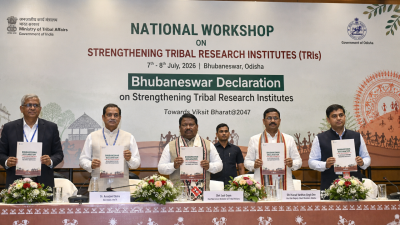
The Bhubaneswar Declaration was adopted on 8 July 2026 at the close of a two-day National Workshop on Strengthening Tribal Research Institutes in Bhubaneswar. It sets a national roadmap to convert TRIs into centres of excellence for research, cultural preservation and evidence-based policy, aligned with the vision of Viksit Bharat@2047.
Genesis and purpose
The Declaration emerged from a workshop jointly organised by the Ministry of Tribal Affairs and the Government of Odisha. Core purpose: reposition Tribal Research Institutes (TRIs) as Knowledge and Cultural Resource Centres that produce policy-relevant evidence, document and preserve indigenous culture, and support tribal development goals within a national framework.
Key objectives
- National roadmap: Standardise governance, staffing, research quality and data systems across TRIs.
- Research alignment: Set common research priorities to inform policy through the National TRI Research Agenda 2027–2032.
- Cultural documentation: Systematic recording of languages, oral traditions, music, cuisine and endangered art forms with tribal youth participation.
- Technology integration: Use AI, GIS and digital platforms for research, documentation and dissemination; launch of the TribeX digital learning platform.
- Mentoring and capacity building: Revived Nodal TRI system to mentor state TRIs and build institutional capacity.
Institutional reforms and governance
Model TRI Framework 2030: Provides templates for organisational structure, staffing norms, financial management, research ethics and performance metrics. It aims to reduce inter-state variability and enable TRIs to function as specialised Centres of Excellence. Nodal TRI system: Designated TRIs to mentor regional institutes, coordinate training, and support multi-state research projects. The system includes periodic peer review and technical assistance.
Research quality, standards and data systems
- National TRI Research Agenda 2027–2032: Identifies shared priorities linked to national development goals and policy needs (health, education, livelihoods, forest rights, climate resilience, cultural economies).
- Research Standards Framework: Introduces peer review, ethical clearances, community consent protocols, data-management standards and archiving norms to improve comparability and policy utility of TRI outputs.
- Evidence synthesis: Emphasises applied research and translational outputs (policy briefs, toolkits, localised interventions) to inform state and central schemes for tribal welfare.
Cultural preservation and youth engagement
The Declaration prioritises systematic documentation of tribal languages, oral histories, music, rituals, cuisine and endangered crafts. It mandates active participation of tribal youth in documentation, curation and dissemination to promote intergenerational transmission, livelihood linkages and cultural entrepreneurship.
Technology and digital platforms
Recommendations include adoption of AI for language processing, GIS for mapping cultural and resource landscapes, and interoperable data platforms. TribeX—a digital learning platform launched during the workshop—will host curricula, archives and community-generated content to increase access and pedagogic use.
Centres of Excellence and knowledge networks
TRIs are to be developed as specialised Centres of Excellence with subject-focused clusters (language, anthropology, public policy, livelihoods). Centres will form a national network under the Nodal TRI architecture to enable pooled resources, shared methodologies and joint funding proposals.
Examples and recognition
- Certificates of appreciation: Seven TRIs from Chhattisgarh, Odisha, Tripura, Maharashtra, Kerala, Telangana and Jharkhand were recognised for work in tribal research and cultural heritage preservation.
Implementation challenges and mitigations
| Challenge | Mitigation |
|---|---|
| Variable institutional capacity across states | Targeted capacity building through Nodal TRIs; phased implementation of Model TRI Framework 2030. |
| Funding constraints for long-term research and archiving | Dedicated central and state budget lines, public–private partnerships, and project-based grants linked to the National Research Agenda. |
| Human resource gaps (researchers, archivists, technologists) | Fellowship programmes, academic partnerships, short-term trainings and incentives for tribal youth employment. |
| Data standardisation and interoperability | Adoption of Research Standards Framework, common metadata norms and a national data repository with access protocols. |
| Digital divide in remote tribal areas | Offline-capable tools, mobile data collection units, local language interfaces and digital literacy drives. |
| Community trust and intellectual property concerns | Community consent protocols, benefit-sharing mechanisms and legal safeguards for traditional knowledge. |
Way forward: operational priorities
- Short term: Roll out Model TRI Framework 2030 pilot, operationalise Nodal TRI mentorship, launch capacity-building modules on research ethics and digital methods.
- Medium term: Implement National TRI Research Agenda projects, integrate TribeX content with school and vocational programmes, establish archival centres with multilingual access.
- Long term: Institutionalise sustained funding, embed TRI outputs into policy cycles, and strengthen legal frameworks for protection of tribal intellectual property and cultural rights.
Model Questions
1. Analyse the significance of the Bhubaneswar Declaration in transforming Tribal Research Institutes into centres of excellence for evidence-based policymaking and cultural preservation, aligned with Viksit Bharat@2047. [GS-II: Governance]
The Declaration provides a national roadmap to standardise TRI governance, staffing and research quality, and to create Centres of Excellence. It links TRI outputs to policy via the National TRI Research Agenda and Research Standards Framework. Technology (AI, GIS) and TribeX support documentation and dissemination. The Nodal TRI system ensures mentoring and capacity building, enabling TRIs to feed reliable evidence into tribal welfare programmes under Viksit Bharat@2047.
2. Examine the institutional reforms and research-enhancement mechanisms proposed by the Bhubaneswar Declaration for strengthening tribal welfare and development. [GS-II: Social Justice]
Reforms include the Model TRI Framework 2030 for standard governance and staffing; a revived Nodal TRI system for mentoring; and the National TRI Research Agenda 2027–2032 to set shared priorities. The Research Standards Framework mandates peer review, ethics and data protocols. Together these measures aim to professionalise TRI research, improve policy relevance, enable inter-state collaboration and support evidence-based interventions for tribal welfare.
3. Discuss the role of technology and youth engagement envisaged by the Bhubaneswar Declaration in documenting and preserving tribal heritage. [GS-III: Science & Technology]
The Declaration recommends AI for language processing, GIS for cultural-resource mapping, and interoperable data systems. TribeX provides a digital repository and learning environment. Tribal youth are central to documentation, digitisation and content creation, linking cultural preservation with skills development and local livelihoods. Measures include digital literacy, community consent protocols, and training to ensure ethical, participatory and sustainable use of technology.
4. Evaluate potential challenges in implementing the Bhubaneswar Declaration’s recommendations across diverse tribal regions and suggest measures for effective execution. [GS-II: Governance]
Challenges: uneven TRI capacity, funding shortfalls, HR gaps, data standardisation, digital access and community trust. Measures: phased roll-out via Nodal TRIs, dedicated budget lines and external grants, fellowships and training, adoption of common data standards, offline-capable digital tools, and legal and benefit-sharing frameworks to protect traditional knowledge while ensuring community participation and ownership.
Last Modified: July 9, 2026