
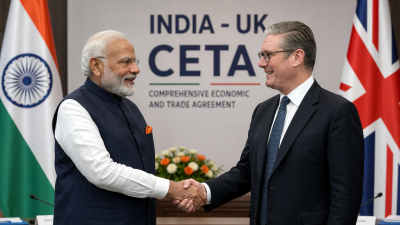
The India–UK Comprehensive Economic and Trade Agreement (CETA) and the Double Contribution Convention (DCC) come into force on 15 July 2026. The pact removes tariffs on about 99% of Indian tariff lines and provides near-complete market access, while preserving exclusions for sensitive agricultural sectors.
What is at issue and why it matters
Current scope
CETA eliminates tariffs on roughly 99% of tariff lines, covering nearly 100% of bilateral trade value. The DCC extends exemption from dual social-security contributions for Indian professionals in the UK from three to five years. The package reduces trade costs, widens services mobility and affects agriculture, manufacturing, MSMEs and professionals.
Governance and strategic importance
The agreement advances India’s external economic engagement and export diversification. It offers preferential access to a premium market, creates space for services and professional mobility, and forms part of policies aimed at export growth, employment generation and higher foreign investment aligned with Viksit Bharat 2047 objectives.
Implementation and key provisions
- Tariff liberalisation: Immediate duty-free access on ~99% of tariff lines; UK tariffs cut on clothes, footwear and some food products; Indian duties on UK salmon and cod fall from 33% to zero.
- Agricultural market access: Duty-free entry for turmeric, pepper, cardamom, mango pulp, pickles and pulses; sensitive items excluded (dairy, cereals, millets, apples, oats, cooking oils).
- Services and mobility: Annual mobility quota for 1,800 Indian professionals (chefs, yoga instructors, classical musicians and others).
- Double Contribution Convention (DCC): Extends social-security exemption to five years for temporary postings; benefits estimated over 75,000 professionals and 900 companies.
Economic impact
Agriculture
- Export opportunities: Duty-free access can expand market share for spices, mango pulp, pickles and pulses. Higher margins possible in niche and ethnic-food segments.
- Supply-side requirements: Need for standards compliance (SPS, MRLs), cold-chain upgrades, packaging and traceability to meet UK retail and food-safety norms.
- Risks: Excluded staples protect domestic producers but may displace demand patterns for substitute goods; price volatility and quality shortfalls could limit gains.
Manufacturing, artisans and MSMEs
- Market access: Removal of tariffs benefits labour-intensive sectors—textiles, footwear, handicrafts—and regional clusters aiming for export-led growth.
- Competitiveness needs: Firms must meet rules of origin, product standards and private-buyer specifications; access to finance, quality upgrades and logistics are critical.
- Policy linkages: Schemes such as Make in India, PLI, MSME market-development support, DGFT export facilitation and sectoral export promotion councils must be mobilised.
Services and professionals
- Mobility gains: Quota for cultural and service professionals increases employment and cultural exchange opportunities.
- Cost and compliance relief: DCC reduces dual social-security outgo for temporary assignments, lowering hiring costs and administrative burden for businesses.
- Skill certification: Recognition of qualifications, visas, accreditation and professional standards will determine uptake.
Stakeholder analysis
| Stakeholder | Primary benefits | Concerns |
|---|---|---|
| Farmers (spice, mango, pulses) | Duty-free access; premium realisation for niche crops; export scale-up | Standards compliance, market concentration, logistics gaps |
| MSMEs & artisans | Tariff-free entry, larger orders, cluster growth | RoO compliance, credit, upgradation costs, competition |
| Professionals & cultural workers | Mobility quota; longer social-security exemption; more assignments | Visa procedures, recognition of credentials, temporary nature of stays |
| Industry & large exporters | Tariff savings, tariff preference chains, potential FDI | Non-tariff barriers, regulatory divergence, supply-chain adjustments |
Standards, rules and implementation challenges
- Sanitary and phytosanitary (SPS) and technical barriers (TBT): Exporters must meet UK/EU-derived MRLs, labelling and traceability. Agencies involved: APEDA, FSSAI, state agriculture departments.
- Rules of origin (RoO): Compliance will determine tariff eligibility. Clear guidance, authorised economic operators and certification processes are necessary.
- Logistics and infrastructure: Cold-chain, container availability, port efficiency and inland transport affect competitiveness.
- Regulatory coordination: DGFT, Commerce Ministry, MEA, Home Ministry (visas) and Ministry of Labour (DCC implementation) must coordinate operational rules.
Policy measures to capture gains
- Export readiness: Targeted APEDA and DGFT programmes for spices, mango pulp and pulses; market-entry assistance and quality-certification grants.
- MSME support: Credit lines, export credit insurance, design-technology centres, cluster-level common facilities and PLI linkage for scale-up.
- Skills and standards: Certification for chefs, musicians and yoga instructors; recognition frameworks and short-term training tied to mobility quotas.
- Institutional mechanisms: Joint working groups with UK on SPS, standards, fintech, trade facilitation and technology cooperation, including AI and emerging technologies.
Risks, mitigation and implementation priorities
- Market concentration: Over-reliance on a few commodities or buyers may expose exporters to demand shocks; diversify products and buyers.
- Non-tariff constraints: Invest in laboratories, accreditation and compliance assistance to reduce rejections and refusals.
- Adjustment for excluded sectors: Strengthen domestic support for dairy, cereals and millets through price stabilisation, producer organisation and tariff-rate quotas if needed.
- Monitoring and evaluation: Real-time trade data, sectoral impact assessments and feedback loops to calibrate policy response.
Emerging cooperation beyond trade
- Technology and innovation: Recent discussions between Indian and UK officials signal collaboration in AI, research and emerging technologies under CETA frameworks.
- Investment and R&D: Preferential access may attract UK investment into agro-processing, logistics and skill-training; joint R&D in agri-tech and value-chain efficiency is feasible.
Model Questions
1. Evaluate the economic ramifications of the India–UK Comprehensive Economic and Trade Agreement (CETA) for India’s agricultural and manufacturing sectors, in the context of the Viksit Bharat 2047 mission. [GS-III: Economic Development]
CETA’s duty-free access for spices, mango pulp and pulses will raise export potential and margins. Manufacturing—textiles, footwear, handicrafts—gains from tariff removal. Success requires SPS and RoO compliance, logistics upgrade, MSME finance and skill upgradation. Combined with PLI, APEDA and DGFT measures, CETA can boost exports, employment and investment, contributing to growth targets under Viksit Bharat 2047.
2. Analyse the assertion that CETA is a ‘people-centric pact’ and its strategic significance for India’s foreign trade policy. [GS-II: International Relations]
CETA’s mobility provisions and the DCC extend social-security relief and quotas for cultural and service professionals, directly benefitting workers and SMEs. Strategically, it diversifies India’s export markets, strengthens ties with a key partner and attracts investment. The pact aligns trade policy with economic diplomacy to raise India’s global market presence and support domestic competitiveness.
3. Beyond tariff cuts, which provisions in CETA and the Double Contribution Convention facilitate deeper engagement by Indian professionals and businesses, and what impact are they likely to have? [GS-II: Governance]
Key provisions: annual mobility quota for 1,800 professionals and DCC extending social-security exemption to five years for temporary postings. These lower operational costs, ease short-term deployments and promote cultural services. Impact includes higher services exports, more contractual assignments, growth of service-linked MSMEs, and improved bilateral people-to-people economic ties, subject to visa and credential-recognition rules.
4. Examine the benefits and challenges CETA poses for different Indian stakeholders—farmers, MSMEs and the technology sector—given the agreement’s exclusions and safeguards. [GS-III: Economic Development]
Benefits: farmers of spices and pulses gain premium UK market access; MSMEs and artisans access tariff-free entry; tech sector may attract R&D and investment through cooperation. Challenges: excluded staples protect domestic producers but limit some export gains; exporters must meet SPS/TBT norms; MSMEs face RoO and finance constraints. Mitigation needs targeted schemes, standards support and infrastructure upgrades.
Last Modified: June 24, 2026