
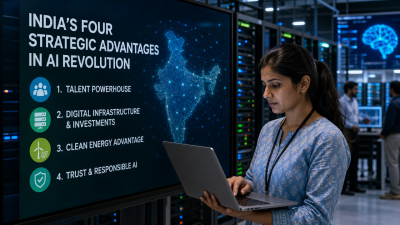
Recent large investments and capacity additions have accelerated India’s role in the global AI revolution. Private capital, a deep AI-skilled workforce, pragmatic regulation and fast-growing non-fossil power together create conditions for scaled AI deployment and domestic innovation.
What is the current issue
India is consolidating four strategic advantages — human capital, light-touch regulation, massive private investment in AI infrastructure, and expanding clean energy supply — that together reduce costs of AI deployment and attract global AI activity to India.
Why this matters for governance and economy
- Governance: Policy choices will determine risks from misuse, bias and misinformation while shaping research priorities and public service use of AI.
- Economy: Lower deployment costs and large infrastructure investment can spawn new firms, increase exports of AI services, and create high-value jobs.
- Security & environment: Data-centre scale raises energy and cyber-security needs; clean energy capacity mitigates emissions risk.
Human capital advantage
Evidence
- Skill penetration: India ranks first globally in AI skill penetration at 2.8 times the global average.
- Organisational confidence: 39% of Indian organisations report confidence in sourcing AI talent (Aon study), above Asia‑Pacific and global averages.
- Adoption: 43% of India’s workforce used AI in their organisations last year; 88% of employees with enterprise AI also use personal AI tools (Gartner).
- Domestic absorption: Global capability centres, startups and large firms are hiring and investing locally (HCL’s stake in Sarvam AI is an example).
Implications
- Large trained cohorts enable rapid product development, deployment and localised solutions for Indian markets.
- Domestic absorption reduces brain drain and builds institutional memory in applied AI.
- Demand for continuous reskilling and regulatory training for public servants will rise.
Regulatory advantage: feather-touch approach
Features
- Principles-based governance: India AI Governance Guidelines (November 2025) set high-level norms instead of heavy prescriptive rules.
- Existing legal tools: IT (Intermediary Guidelines & Digital Media Ethics Code) Amendment Rules, 2026 address synthetic content without a standalone AI statute.
- Regulatory sandboxes and innovation frameworks: Financial and markets regulators use sandboxes and proportionate rules to test AI applications.
Benefits and risks
- Benefit: Low compliance friction accelerates experimentation and capital inflows.
- Risk: Principles alone may leave gaps on liability, safety standards, data governance and cross-border data flows unless backed by sector rules and enforcement capacity.
- Policy need: Clear sectoral obligations, audit requirements and capacity building for regulators and courts.
Investment and infrastructure advantage
Capital flows and projects
- Scale of commitments: Private sector commitments exceed USD 160 billion for data centres, semiconductors, cloud and HPC (includes Google USD 15 billion in Visakhapatnam; Microsoft USD 17.5 billion).
- Major pledges: Reliance announced Rs 10 trillion to build an AI ecosystem with gigawatt-scale AI‑ready data centres in Jamnagar; Amazon committed an additional USD 13 billion for AI and cloud expansion to 2030.
- Investor interest: Brookfield plans to expand its Indian renewables/data‑centre portfolio towards USD 100 billion by 2030.
- Venture activity: HCL’s ₹1,427 crore investment in Sarvam AI shows corporate participation in startups and product-led AI.
Operational implications
- Large domestic capacity reduces latency and cost for AI services and attracts global workloads.
- Concentrated infrastructure requires robust energy planning, grid resilience and cybersecurity measures.
- Policy tools: tax incentives, land and power facilitation, data‑centre zoning and standards for cooling and waste heat recovery.
Sustainable energy advantage
Capacity and relevance
- Clean power build-up: India added 55.3 GW of non‑fossil capacity in FY 2025–26 and reached 283.46 GW total non‑fossil installed capacity by March 2026.
- Green powering of data centres: Reliance’s Jamnagar data centres will be backed by up to 10 GW of green energy capacity.
Strategic value
- Availability of affordable clean power reduces carbon intensity of AI infrastructure and improves attractiveness to global firms with ESG mandates.
- Renewable-heavy grids require investment in storage, grid management and long‑term power purchase agreements (PPAs) for reliability.
Economic and technological implications
- Cost of compute: Rapid decline in model-query costs makes AI integration financially viable across firms and services.
- New industries: AI-driven products, cloud services, chip design, edge computing and green data‑centre services can become export items.
- Employment: Net employment will depend on skill creation, redeployment policies and support for SMEs to adopt AI.
- R&D ecosystem: Sustained private capital plus skilled labour can boost applied R&D and India‑developed models tuned for local languages and contexts.
Governance and policy framework
- Regulatory mix: Combine principles-based national guidelines with sectoral rules (finance, health, telecom) and clearer liability norms.
- Data governance: Clarity on cross-border flows, data localisation thresholds and consent mechanisms is required to support commercial AI while protecting privacy.
- Capacity building: Equip regulators, judiciary and public servants with technical skills and access to certified independent auditors.
- Standards and certifications: Mandatory model documentation, transparency registers and third‑party testing for high‑risk AI systems.
Social and workforce dynamics
- Reskilling demand: Widespread AI adoption requires structured skilling at scale—vocational institutes, Higher Education and industry partnerships.
- Inclusion risks: Uneven access to AI tools may widen urban‑rural and sectoral divides; public provisioning of AI tools for education and public services can mitigate this.
- Ethics and bias: Public procurement norms should require bias audits and multilingual evaluation to protect marginalised groups.
Policy priorities and gaps
- Priority actions: Strengthen sectoral regulation, deploy PPAs and storage for reliable green power, expand skilling programmes, and create a national AI safety testing facility.
- Gaps: Enforcement bandwidth, clear liability regimes, standardised model audit protocols and rural access to compute and training resources.
Model Questions
1. Evaluate India’s four strategic advantages in the AI revolution and analyse their combined impact on the country’s technological and economic prospects. [GS-III: Economic Development]
India’s advantages are: superior AI skill penetration (2.8× global average), a principles-based regulatory approach, over USD 160 billion in private commitments for AI infrastructure, and growing non‑fossil capacity (283.46 GW). Combined, these reduce deployment cost, attract global workloads, enable exportable AI services, and spur applied R&D. Risks include regulatory gaps, energy reliability and uneven skill distribution needing targeted policy and skilling interventions.
2. Critically examine India’s ‘feather-touch’ regulatory approach to AI. Discuss how it balances innovation with ethical and safety concerns. [GS-II: Governance]
India’s approach uses principles-based India AI Governance Guidelines and existing IT Rules to avoid prescriptive constraints. This lowers compliance costs and eases experimentation. However, it can leave gaps on liability, safety standards, model audits and enforcement. A balanced strategy requires sectoral rules, mandated transparency for high‑risk systems, audit capacity, and clearer data‑governance norms to protect rights without stifling innovation.
3. Analyse how large private investments and record non‑fossil energy additions together strengthen India’s competitiveness in building AI infrastructure. [GS-III: Economic Development]
Private commitments (USD 160+ billion, including Reliance Rs 10 trillion, Google USD 15 billion, Microsoft USD 17.5 billion, Amazon USD 13 billion more) supply capital for data centres and HPC. Record non‑fossil additions (55.3 GW in FY 2025–26) enable low‑carbon power for energy‑intensive AI operations. Combined, they lower operating costs, meet ESG requirements, and attract global firms; but require PPAs, storage and grid upgrades for reliability.
4. Discuss factors behind India’s lead in AI skill penetration and assess measures needed to convert skills into sustained innovation and inclusive growth. [GS-III: Science & Technology]
Factors: large engineering talent pool, active domestic hiring by MNC centres and startups, and high organisational confidence in sourcing AI talent. To convert skills into innovation, policies should fund applied R&D, scale vocational and higher‑education skilling, support startups with infrastructure credits, promote regional centres of excellence, and ensure inclusive access to tools and training to prevent urban‑rural disparities.
Last Modified: July 1, 2026