
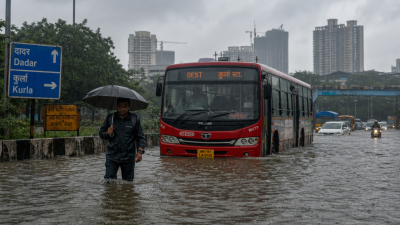
Mumbai is experiencing severe monsoon flooding caused by intense rain, high tides and inadequate urban drainage. The event has caused fatalities, submerged roads and halted transport and schools, exposing gaps between rapid urbanisation and infrastructure capacity.
Issue and significance
What is the problem?
- Flooding trigger: High-intensity rainfall coinciding with high tides overwhelms drainage and causes backflow from the sea.
- Human impact: Deaths, transport disruption, school closures and economic losses across households and businesses.
- Governance reach: Flooding tests municipal capacity, inter-governmental coordination and disaster response readiness.
Current causes and infrastructure failures
Immediate hydrological and technical causes
- Rainfall intensity: Very high short-duration rainfall exceeds design limits.
- Drainage capacity: Existing drains were designed for roughly 25 mm/hour and cannot handle present storm intensities.
- Gravity dependence and tides: Sea-level outfalls rely on gravity; high tides block drainage and cause backflow.
Historical and systemic contributors
- Reclamation and low elevation: Much of the city sits on reclaimed land, with many areas only a few metres above sea level.
- Loss of natural buffers: Creeks, wetlands and open absorptive areas have been reduced or encroached upon.
- Unplanned growth: Illegal construction and inadequate enforcement in peri-urban zones aggravate flood risk.
Government responses and proposed measures
- BRIMSTOWAD master plan: State announced accelerated implementation of remaining drainage works, with key components targeted within two years.
- Large-scale proposal: A ₹13,000-crore flood mitigation plan for 370 flood-prone locations has been submitted to the Centre; goal is to drain floodwaters within 30 minutes even during high tide.
- Restoration plans: Municipal agencies plan lake restoration and related blue-green projects.
Criticisms and expert recommendations
- Development vs buffer loss: Redevelopment proposals for open areas (for example the Mahalaxmi Racecourse) face criticism for removing natural flood buffers.
- Approach shift: Experts argue for accommodating and storing water locally rather than relying only on rapid removal to sea.
- Design standards: Infrastructure must be planned using future climate projections and higher intensity rainfall scenarios.
International models and transferability
| Model | Core features | Applicability to Mumbai |
|---|---|---|
| China: Sponge City | Permeable pavements, rain gardens, detention ponds, decentralised storage. | High relevance; requires retrofitting, policy incentives and municipal capacity for maintenance. |
| Netherlands: Water squares & green roofs | Public spaces designed to store water temporarily; roofs and open areas used for retention. | Useful in dense zones as multi-use public infrastructure; needs land-use integration and community acceptance. |
Governance, policy and implementation challenges
- Integrated planning deficit: Fragmented responsibilities across municipal, state and port authorities impede unified drainage action.
- Implementation delays: Long-pending projects face land, funding and procedural hurdles.
- Financial constraints: Large capital needs (example: ₹13,000-crore proposal) require central-state financing mechanisms and private participation models.
- Regulatory failures: Weak enforcement permits encroachment on floodplains and wetlands.
- Public opposition and local trade-offs: Redevelopment of open spaces meets resistance when it reduces natural buffers.
- Capacity gaps: Urban local bodies need technical skills for nature-based solutions and climate-proof design.
Socio-economic and environmental implications
- Economic cost: Business disruption, transport losses and infrastructure damage reduce productivity and tax revenues.
- Health risks: Prolonged waterlogging raises waterborne disease risk and strains public health services.
- Vulnerability of the poor: Informal settlements face displacement, loss of livelihoods and slower recovery.
- Ecosystem degradation: Further loss of wetlands and creeks reduces natural flood attenuation and biodiversity.
Way forward: technical and policy measures
- Design standard reform: Update drainage design criteria to reflect extreme rainfall projections and sea-level trends.
- Blue-green infrastructure: Implement permeable pavements, rain gardens, green roofs, detention parks and restored wetlands at scale.
- Decentralised storage: Promote rooftop harvesting, local detention basins and community tanks to reduce peak runoff.
- Protect natural buffers: Legally secure wetlands, mangroves and creeks; prohibit encroachment and allow controlled restoration.
- Integrated water management: Combine surface runoff, groundwater recharge and wastewater reuse in urban water plans.
- Governance reforms: Create single-window coordination cells, strengthen enforcement, and use performance-linked funding for ULBs.
- Finance and incentives: Blend central grants, state funds, municipal bonds and PPPs; provide incentives for private retention (e.g. stormwater credits).
- Pilots and scaling: Begin pilots in high-risk wards to demonstrate sponge-city elements, then scale with monitoring and maintenance plans.
- Community engagement: Involve residents in local storage, maintenance and early warning to improve resilience and equity.
- Data and monitoring: Use urban hydrological models, real-time tide and rainfall monitoring, and GIS mapping of flood-prone zones.
- Legal framework: Strengthen laws to prevent construction on floodplains and mandate retention measures in new developments.
Model Questions
1. Analyse the systemic failures in urban planning and infrastructure that contribute to severe flooding in Indian mega-cities like Mumbai. Suggest a multi‑pronged governance approach for climate‑resilient urban water management. [GS-II: Governance]
Urban flooding results from reclaimed low‑lying land, loss of wetlands, inadequate drainage (≈25 mm/hr), gravity‑only outfalls and encroachment. Governance response should include integrated master planning, single‑window coordination, strict enforcement against encroachment, climate‑proof design standards, performance‑linked funding, community participation, capacity building for urban local bodies and a mix of central‑state financing to fast‑track projects such as BRIMSTOWAD and decentralised retention measures.
2. Critically examine the ‘Sponge City’ concept and nature‑based solutions for urban flood management. Evaluate their applicability to Indian cities with reference to global examples. [GS-III: Environment & DM]
‘Sponge City’ uses permeable surfaces, rain gardens, detention ponds and green roofs to retain and infiltrate rainwater. China’s pilots and Dutch water squares show reduced peak flows and co‑benefits for urban amenity. Applicability in India is high but constrained by land scarcity, retrofitting costs, maintenance needs and governance gaps. Recommend targeted pilots, regulatory incentives, hybrid grey‑green systems and financing for long‑term maintenance.
3. Discuss the challenges in implementing large‑scale urban drainage projects, using the Mumbai floods as a case study. What paradigm shift is required in India’s urban flood mitigation policy? [GS-III: Economic Development]
Challenges include delayed projects (administrative and land issues), large funding needs (₹13,000‑crore proposal), inter‑agency coordination, tidal constraints on outfalls and public opposition to loss of open buffers. Policy must shift from rapid removal to intelligent accommodation: combine large drains with decentralised retention, protect wetlands, update design norms to future climates, ensure sustainable finance and mandate multi‑use public spaces that store stormwater.
4. Beyond immediate disruption, evaluate the long‑term socio‑economic and environmental consequences of recurrent urban flooding in coastal mega‑cities. How can sustainable and inclusive urban development mitigate these impacts? [GS-I: Indian Society]
Recurrent floods cause economic loss, health emergencies, displacement, livelihood erosion and ecosystem decline, increasing inequality. Mitigation requires climate‑resilient housing for vulnerable groups, nature‑based infrastructure, inclusive land‑use planning, social protection and insurance, livelihood support, community disaster preparedness and investments in green public spaces that double as water storage to reduce future harm and enable faster recovery.
Last Modified: July 8, 2026