
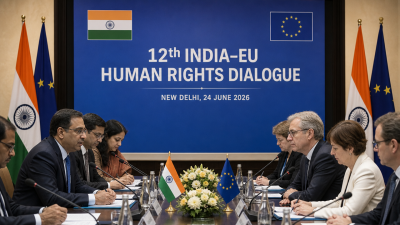
India and the European Union held the 12th India‑EU Human Rights Dialogue in New Delhi on 24 June 2026, co‑chaired by Piyush Srivastava (MEA) and Hervé Delphin (EU Ambassador). The meeting reaffirmed shared commitments from the January 2026 India‑EU Summit and covered a wide rights agenda and new cooperation on human‑centric AI.
Overview
What occurred
- Event: 12th India‑EU Human Rights Dialogue, New Delhi.
- Co‑chairs: Piyush Srivastava (Additional Secretary, Europe West, MEA) and Hervé Delphin (EU Ambassador to India).
- Framework: Built on the 16th India‑EU Summit joint statement (January 2026) to elevate the Strategic Partnership.
Why it matters
- Governance: Provides a formal channel to discuss domestic rights implementation and institutional reform.
- International relations: Reinforces value alignment and practical cooperation on global forums (UNHRC, UN processes).
- Technology and rights: Adds human‑rights framing to AI governance, linking ethics to regulation and trade.
- Trade and business conduct: Ties corporate responsibility and UN Guiding Principles on Business and Human Rights to bilateral economic relations.
Reaffirmation of core principles
- Shared commitments: Democratic values, human rights, pluralism, rule of law, and a rules‑based international order with the UN at its core.
- Multilateral engagement: Ongoing cooperation in UNHRC and other UN mechanisms emphasised.
Spectrum of rights discussed
- Civil and political rights: Freedom of expression; protection of journalists; independence of civil society.
- Social, economic and cultural rights: Access to services, elimination of discrimination, and inclusive development.
- Vulnerable groups: Rights of migrants; gender rights; LGBTQI+ rights; child rights.
- Business and rights: Implementation of the UN Guiding Principles on Business and Human Rights; corporate due diligence.
Key stances and divergences
| Issue | EU position | India position |
|---|---|---|
| Capital punishment | Principled opposition in all cases. | No agreement with abolitionist stance; position differs. |
| Right to Development | Not a primary EU framing for rights diplomacy. | Affirmed as a distinct, universal, inalienable and fundamental human right. |
| Civil society and media freedom | Strong emphasis on safeguarding independence. | Agreement on importance; scope of domestic measures remains a national prerogative. |
Emerging cooperation: human‑centric Artificial Intelligence
- Commitment: Both sides agreed to develop trustworthy, sustainable and human‑centric AI.
- Precedent: Builds on discussions at the AI Impact Summit 2026 hosted by India.
- Regulatory alignment: Practical issues include interoperability with the EU AI Act model, data governance, transparency, and accountability mechanisms.
- Human‑rights risks: Privacy, algorithmic bias, automated decision‑making, and redress mechanisms for affected persons.
Institutional and civil society engagement
- Strengthening institutions: Focus on national human rights institutions, independent oversight, and capacities for implementation and reporting.
- Civil society space: Safeguarding freedom and independence of NGOs, activists and journalists discussed as necessary for effective rights protection.
- Multilateral tools: Coordination at UNHRC, sharing best practices and technical assistance on treaty reporting and implementation.
Strategic significance for India‑EU relations
- Value alignment: Reinforces common democratic principles underpinning broader strategic cooperation.
- Political trust: Regular dialogues reduce friction on sensitive matters and provide mechanisms for managing disagreements.
- Economic links: Linking human rights, corporate responsibility and AI governance influences trade, investment and regulatory cooperation.
- Global governance: Joint engagement strengthens advocacy for a rules‑based order with the UN at the centre.
Challenges and way forward for India (domestic context)
- Implementation gaps: Disparities between constitutional guarantees and ground reality for marginalised groups; need for better enforcement mechanisms.
- Legal reforms: Requirement for comprehensive anti‑discrimination measures, strengthened child protection (POCSO, Juvenile Justice Act enforcement), and clarity on protections for LGBTQI+ persons beyond decriminalisation.
- Business responsibility: Promote adoption and enforcement of corporate due diligence norms; align National Guidelines on Responsible Business Conduct with UNGPs.
- Data and digital rights: Harmonise domestic data protection and AI governance with international standards to protect privacy and prevent algorithmic harms.
- Civil society enabling environment: Ensure transparent funding and registration regimes, independent judicial review, and protection for free expression within constitutional limits.
- Practical steps: Capacity building for independent institutions (NHRC and state counterparts), periodic bilateral exchanges on best practices, and targeted technical cooperation with EU bodies.
Model Questions
1. Analyse the strategic significance of regular India‑EU human rights dialogues in strengthening the Strategic Partnership and addressing global human rights challenges. [GS-II: International Relations]
India‑EU dialogues institutionalise value‑based engagement and create channels to manage sensitive issues. They reinforce the Strategic Partnership agreed at the 16th Summit, enable joint action in multilateral fora (UNHRC), and align policies on trade, corporate due diligence and tech governance. Dialogues facilitate capacity building, legal exchange and coordinated responses to transnational challenges such as migration, business‑related abuses and AI‑driven risks.
2. Examine the range of rights discussed in the 12th India‑EU Dialogue and identify principal challenges India faces in their domestic realisation. [GS-II: Social Justice]
The dialogue covered civil, political, social, economic and cultural rights, plus migrant, gender, LGBTQI+ and child rights. India’s challenges include enforcement gaps, uneven service delivery, absence of comprehensive anti‑discrimination laws, need for stronger corporate accountability, and ensuring access to remedies. International dialogues can support legal reform, technical assistance, data sharing and best practice transfer to close implementation deficits.
3. Discuss how India balances national sovereignty with international human rights norms when divergences arise, using capital punishment and the Right to Development as examples. [GS-II: Constitution of India & Polity]
India engages bilaterally and multilaterally while maintaining constitutional prerogatives. On capital punishment, India registers disagreement with the EU abolitionist stance and handles policy domestically through legislative and judicial processes. On the Right to Development, India presses for its recognition in international forums. Balance is achieved through dialogue, negotiated language, continued participation in UN bodies and selective alignment where national law permits.
4. Assess the ethical and governance dimensions of India‑EU cooperation on human‑centric AI and its implications for human rights protection. [GS-III: Science & Technology]
Human‑centric AI cooperation focuses on ethics, transparency, accountability and non‑discrimination. Governance issues include data governance, standards for explainability, impact assessment protocols, and redress mechanisms. Alignment with EU norms (AI Act, trustworthy AI principles) and India’s policy frameworks can reduce cross‑border harms, protect privacy and ensure equitable access to AI benefits while preserving regulatory sovereignty.
Last Modified: June 26, 2026