
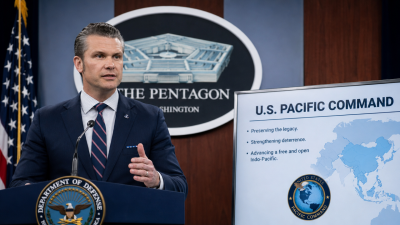
On 16 June 2026 the US Department of Defense announced reversion of USINDOPACOM to US Pacific Command (USPACOM). The move retains the command’s area of responsibility but alters nomenclature that had formally recognised the Indian Ocean and India since 2018, with consequences for strategy and diplomacy.
What changed and why it matters
Event and official rationale
- Renaming: The command name reverted to USPACOM. US officials, including Defense Secretary Pete Hegseth, cited historical continuity and esprit de corps.
- Pentagon stance: Area of responsibility and missions remain unchanged, extending from the US West Coast to India’s western border.
- Context: The announcement followed a G7 meeting between the Indian Prime Minister and the US President and coincided with a public map controversy on the command website.
Strategic interpretations
- Symbolic recalibration: Removal of “Indo” is widely read as a symbolic downshift in emphasis on the Indo‑Pacific construct.
- Quad and NDS: The 2026 US National Defence Strategy does not explicitly mention India or the Quad; the Quad’s agenda appears narrowed to maritime security, economic resilience, critical minerals and disaster response.
- China posture: The change occurs alongside a broader US recalibration toward the Pacific and China, implying altered priorities for force posture and allied burden‑sharing.
Implications for India–US relations
Diplomatic and perceptual effects
- Perception risk: Analysts warn the renaming risks signalling a reduced place for India in US strategic imagination. This can affect political trust and strategic salience.
- Map controversy: A USPACOM website map omitted India’s territorial claims in Pakistan‑occupied Kashmir and Aksai Chin as recognised by New Delhi, creating a diplomatic irritant.
- Indian response: The Government of India described the change as largely symbolic while pursuing clarifications and continuing bilateral engagement.
Operational and security implications
| Dimension | INDOPACOM (2018–2026 emphasis) | USPACOM (post‑2026 emphasis) |
|---|---|---|
| Strategic framing | Integrated Indo‑Pacific construct; explicit role for Indian Ocean and India | Pacific‑centred framing; greater focus on Pacific theatre and China |
| Allied expectations | Shared framing of regional burden across Indo‑Pacific partners | Signalled shift toward allied burden‑sharing; expectation of India assuming larger IOR role |
| Operational posture | Balanced engagement across Indian Ocean and Pacific | Resources and attention may tilt west‑to‑east; India expected to lead security in Indian Ocean Region (IOR) |
- Burden‑sharing: Interpretations of the NDS and the renaming suggest Washington expects partners, notably India, to expand security roles in the IOR.
- Practical gaps: If India is to assume primary security provider responsibilities, it requires accelerated naval logistics, domain awareness, basing/access arrangements, and multilateral cooperation.
Broader US reorientation and regional diplomacy
- West Asia shift: Concurrent US moves in West Asia, including a US–Iran Islamabad MoU entailing troop withdrawals and USD 300 billion for reconstruction, alter Gulf dynamics and US force allocation.
- South Asia engagement: Appointment of Sergio Gor as US Ambassador to India and Special Envoy for South and Central Asia signals continued US political interest in the region despite nomenclature change.
Economic and trade dimensions
- Stability through commerce: High‑level trade talks continued even after the renaming — Union Minister Piyush Goyal met US Trade Representative Jamieson Greer to advance bilateral trade and investment.
- Policy leverage: Economic links provide a stabilising pillar for the relationship and can be used to manage strategic friction while fostering supply‑chain resilience and technology cooperation.
India’s policy options and regional strategies
- Multilateral platforms: India can use IORA, BIMSTEC, SCO and potential SAARC revival to consolidate regional security and economic leadership.
- Capability building: Accelerate naval modernisation, maritime domain awareness networks, logistics agreements (access/overflight), and defence industrial collaboration.
- Diplomatic management: Seek clarifications from the US, manage public communications about sovereignty issues (map controversy), and convert burden‑sharing expectations into concrete cooperative arrangements with funding and capacity support.
Policy implications for Indian decision‑makers
- Clarify roles: Negotiate explicit understandings with the US on division of labour in the IOR to avoid strategic overreach and capability gaps.
- Resource planning: Align defence budgets, shipbuilding and logistics planning to meet expanded regional responsibilities.
- Leverage economics: Use trade and investment talks to balance strategic friction and secure technology and infrastructure cooperation.
Model Questions
1. Analyse the geopolitical ramifications of the US reversion from “USINDOPACOM” to “USPACOM” for the Indo‑Pacific construct and India–US strategic partnership. [GS‑II: International Relations]
The renaming reduces explicit US emphasis on the Indo‑Pacific framing, signalling symbolic recalibration and potential narrowing of partner focus. Consequences include a perceived lowering of India’s strategic salience in Washington, reduced Quad prominence in US strategy, and greater expectation of allied burden‑sharing. India must seek clarifications, protect strategic interests through bilateral diplomacy, and deepen multilateral ties to preserve influence in regional security architectures.
2. Examine how the 2026 US National Defence Strategy and the USPACOM renaming might redefine India’s role as a security provider in the Indian Ocean Region. [GS‑III: Internal & External Security]
The NDS’s lack of explicit India/Quad mention implies Washington expects partners to assume larger regional security roles. For India this means stepping up as primary IOR security provider: enhancing naval presence, logistics, surveillance, basing/access, and interoperability with partners. Risks include capability shortfalls and overstretch; mitigation requires increased defence investment, multilateral security frameworks, and targeted capacity‑building assistance from allies.
3. Evaluate the symbolic damage and diplomatic challenges arising from the USPACOM renaming and the associated map controversy, particularly concerning India’s territorial claims. [GS‑II: Governance]
Symbolic effects can erode trust and public perception of equal strategic partnership. The map omission raised sovereignty sensitivities and required diplomatic engagement to prevent escalation. Challenges include managing domestic political reaction, seeking US clarification and correction, and insulating operational cooperation from symbolic disputes. Timely, calibrated diplomacy and clear communication are necessary to prevent long‑term diplomatic strain.
4. Despite recent strategic recalibrations, analyse the continuing importance of economic and trade cooperation in the India–US bilateral relationship. [GS‑III: Economic Development]
Economic and trade ties remain a stabilising pillar. Ongoing high‑level talks on trade and investment provide incentives to manage strategic differences. Deepening supply‑chain integration, technology partnerships, and investment flows can sustain bilateral engagement even as defence nomenclature shifts. India should use trade negotiations to obtain technology transfers, market access, and investment commitments that support broader strategic and capacity objectives.
Last Modified: June 26, 2026