
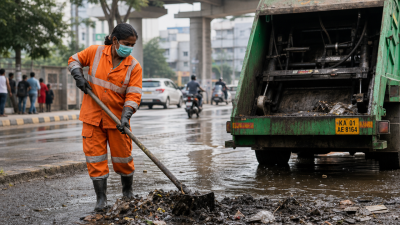
Cities face rising climate risks that disproportionately affect sanitation workers. Recent international and sector reports call for integrated action on WASH, occupational health, informal settlement infrastructure, and urban primary healthcare to protect health, livelihoods and dignity of this workforce.
What is the issue
Sanitation workers perform essential services under increasing climate stress. Heatwaves, floods and shifting disease patterns raise occupational hazards. Urban planning, public health and labour protection remain fragmented. Without targeted policy and infrastructure, climate change will worsen health inequality and service fragility.
Multi‑dimensional vulnerabilities
- Exposure to climate risks: Prolonged heat exposure, increased frequency of heatwaves, flood hazards while cleaning drains, and higher incidence of waterborne and vector‑borne diseases.
- Workplace hazards: Inadequate PPE, manual handling of sewage, contact with hazardous waste, stress during extreme weather events and limited mechanisation for confined‑space work.
- Socio‑economic vulnerability: Informal employment, irregular wages, absence of social protection, precarious housing in informal settlements and social marginalisation including persistence of manual scavenging.
- Uneven urban impacts: Risk distribution depends on housing quality, employment type, access to healthcare, and presence of social protection; marginalised groups face compounded risks.
Climate impacts on health and livelihoods
- Health outcomes: Heatstroke, dehydration, heat‑exacerbated cardiovascular and renal problems, skin and respiratory infections, gastrointestinal illnesses, vector‑borne diseases.
- Livelihood effects: Work disruption during extreme events, income loss, higher out‑of‑pocket medical expenses, and potential eviction or displacement from informal settlements.
- Dignity and safety: Stigmatisation, hazardous informal tasks, and inadequate grievance mechanisms reduce willingness to seek healthcare and social entitlements.
Gaps in urban governance and health infrastructure
- Policy and regulatory gaps: No uniform occupational health standard addressing climate exposures for sanitation workers. Weak enforcement of Prohibition of Employment as Manual Scavengers and Their Rehabilitation Act, 2013 in many localities.
- Fragmented institutional responsibilities: Municipalities, health departments and labour welfare cells work in silos. Climate action plans often omit occupational health and labour welfare modules.
- Primary healthcare access: Urban Primary Health Centres (UPHCs) are unevenly distributed and rarely designed for outreach to informal workers.
- Infrastructure deficits: Non‑resilient drainage, flood‑prone informal settlements and ageing sanitation systems increase hazard exposure.
- Data and surveillance gaps: Limited disaggregated data on occupational morbidity, climate‑linked health events and employment status of sanitation workers.
Integrated policy interventions
| Intervention | Action | Lead / Stakeholders |
|---|---|---|
| Occupational health standards | Develop climate‑specific standards (heat, flood exposure), mandatory risk assessments, periodic health checks, heat action protocols for sanitation crews. | State labour departments, municipal corporations, Ministry of Health |
| UPHC outreach | Mobile clinics, worker‑centred hours, vaccination and vector control, referral linkages to tertiary care. | Municipal health, State NHM, community organisations |
| Infrastructure resilience | Drainage upgrades, flood‑resilient toilets, decentralised treatment, safe access routes in informal settlements. | Urban local bodies, Ministry of Housing & Urban Affairs, city climate funds |
| Social protection | Health insurance portability, provident schemes, income support during extreme weather, formalisation pathways. | State welfare, labour registries, municipal payroll systems |
| Legal enforcement & dignity | Strict implementation of the Prohibition Act, mechanisation to eliminate manual scavenging, legal aid and rehabilitation. | District administrations, courts, civil society |
| Data & monitoring | Worker registries, occupational health surveillance, climate‑health indicators disaggregated by gender, caste and employment status. | Municipal data units, public health institutes, NGOs |
Role of technology, community engagement and international collaboration
- Technology: Weather‑based heat early‑warning, wearable heat‑stress sensors, climate‑resilient sanitation units, mechanised emptying equipment, context‑appropriate PPE designed for heat and exposure.
- Community engagement: Citizen science for exposure mapping, resident co‑design of drainage and sanitation upgrades, worker unions and platform organisers for voice and grievance redressal. Mukuru SPA offers a co‑design example for flood and sanitation interventions.
- International collaboration: UNICEF’s Strategic Plan 2026–2029 includes capacity‑building for sanitation workers in climate‑resilient action plans. Multilateral policy dialogue led by UNICEF with WHO, UNDP, UNEP and UN‑Habitat can inform standards, financing and technical assistance. CRS Coalition reports recommend strengthening institutional, regulatory and data systems.
Safeguarding health and dignity of sanitation workers
- Legal measures: Enforce existing prohibitions on manual scavenging, provide legal aid, ensure rehabilitation and alternative livelihoods.
- Dignified work design: Formal employment contracts, regulated working hours, minimum wages, leave during extreme weather and psychosocial support.
- Capacity building: Training in safe practices, heat‑management, use of mechanised tools and first aid. Employer responsibility for PPE and insurance.
- Awareness and advocacy: Public campaigns and media (for example, the film “Samman”) to reduce stigma and mobilise political will.
Data, research and financing priorities
- Evidence needs: Studies on heat‑related morbidity among sanitation workers, work‑hours exposure assessments, cost‑benefit of resilient sanitation investments.
- Financing: City climate funds, state urban missions, blended finance for decentralised sanitation, targeted welfare budgets for worker protections.
- Planning integration: Mainstream occupational health and labour welfare into City Climate Action Plans, municipal disaster management plans and urban development schemes.
Operational checklist for city administrations
- Immediate: Issue heat‑action guidance for sanitation crews; supply climate‑appropriate PPE; map high‑risk settlements and workers.
- Short term: Register workers, deploy UPHC outreach, initiate mechanisation pilots, establish grievance and compensation protocols.
- Medium term: Upgrade drainage and sanitation infrastructure in informal settlements; incorporate occupational health into municipal climate plans; mobilise state and central funds.
- Long term: Institutionalise cross‑departmental task forces, build worker social protection into urban payrolls, strengthen surveillance and research partnerships.
Model Questions
1. Examine the multi‑dimensional vulnerabilities faced by urban sanitation workers in India due to climate change, and suggest measures for their holistic protection. [GS-II: Social Justice]
Sanitation workers face direct climate risks (heat, floods, vector diseases), hazardous workplaces, and socio‑economic precarity from informal employment and poor housing. Protection measures: adopt occupational health standards for heat and floods; supply climate‑appropriate PPE; strengthen UPHC outreach; formalise employment with social protection; enforce the Prohibition of Employment as Manual Scavengers Act; invest in resilient sanitation infrastructure and worker registries.
2. Critically analyse gaps in urban governance and health infrastructure that amplify climate risks for sanitation workers and propose integrated policy interventions. [GS-II: Governance]
Gaps include fragmented institutional roles, absent occupational health provisions in climate plans, weak UPHC coverage, infrastructure deficits in informal settlements, and data shortfalls. Policy interventions: integrate occupational health into City Climate Action Plans; form cross‑departmental municipal task forces; finance resilience upgrades; expand UPHC outreach; create worker registries and occupational surveillance; ensure legal enforcement and coordination with state labour and health departments.
3. Discuss the role of technology, community engagement and international collaboration in building climate‑resilient, safely managed sanitation systems that protect sanitation workers. [GS-III: Science & Technology]
Technology: heat early‑warning, wearables, mechanised emptying, climate‑resilient toilets and decentralised treatment. Community engagement: citizen science for exposure mapping and resident co‑design of drainage and sanitation (Mukuru SPA example). International collaboration: UNICEF’s Strategic Plan and UN policy dialogues provide technical guidance and capacity building. Combine tech pilots, participatory planning and multilateral support for standards, finance and data systems.
4. Assess India’s progress and persistent challenges in ensuring climate‑resilient urban health and dignity for the sanitation workforce, considering legal frameworks and international initiatives. [GS-II: Governance]
Progress: legal prohibition of manual scavenging, growing advocacy and international support (UNICEF plan, UN policy dialogue). Challenges: weak implementation of laws, informal work arrangements, inadequate UPHC outreach, infrastructure deficits in informal settlements and limited disaggregated data. Response priorities: enforce the Prohibition Act, formalise worker employment, scale resilient sanitation investments, strengthen health services and use international cooperation for financing and technical assistance.
Last Modified: July 1, 2026