
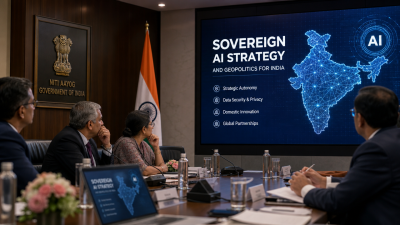
Recent policy moves — including US restrictions on access to Anthropic’s Fable 5 and Mythos 5 and a growing global shift towards state-led AI advantage — have sharpened India’s debate on building sovereign AI while ensuring access to critical systems and markets.
What is Sovereign AI for India
Sovereign AI means national control over AI development, data, compute infrastructure and model ownership to protect security, privacy and policy space. It implies ownership or assured access to foundational models, domestic compute capacity, and legal and procurement levers to use AI for governance and industry.
Why it matters for governance and security
- National security: Restricted foreign access to advanced models and US export controls create direct operational risks for defence and critical infrastructure.
- Data sovereignty: Reliance on foreign models trained on Western datasets risks cultural mismatch and possible data exposure when Indian data resides on overseas servers.
- Economic value: Overseas model and compute dependence causes capital outflow and weak domestic value capture; global players concentrate compute investment (OpenAI compute spending ~ USD 50 billion) beyond India’s current private R&D scale.
- Governance capacity: Public sector uptake remains early-stage: 46% evaluating, 46% piloting, only 4% at significant investment level.
Geopolitical drivers
- Export controls: Restrictions on semiconductors and compute access incentivise defensive hedging and domestic building.
- State-led advantage: Governments now shape AI policy for national advantage, including possible equity stakes in firms and access controls.
- Strategic autonomy: India’s leadership calls for safe, rapid and efficient AI rollout while safeguarding the global south’s interests; this requires policy alignment across diplomacy, trade and technology.
Challenges in achieving Sovereign AI
| Dimension | Challenge |
|---|---|
| R&D and finance | Low national R&D (0.6% of GDP) with private sector only one-third; domestic funds dwarf global compute investments. |
| Compute infrastructure | Insufficient high-performance domestic data centres and specialised hardware; exposure to export controls. |
| Capability & models | Gap in ownership of foundational models; dependence on foreign models lacking local context. |
| Adoption | Government organisations largely in evaluation/pilot phase; few large-scale deployments. |
| Industrial policy | Experience from pharma: PLI schemes have not eliminated 65% import dependence for key APIs, showing limits of incentives alone. |
Strategic options and trade-offs
- Defensive hedging: Build domestic stack for critical use-cases while negotiating assured foreign access for non-sensitive services.
- Selective openness: Keep international collaboration for talent and research while restricting critical layers (models, sensitive data, national infrastructure).
- Market instruments: Use public procurement, targeted incentives and state investment to seed foundational models and compute facilities.
- Diplomatic diversification: Use trade and technology diplomacy to secure alternative compute and hardware sources and to avoid single-country dependencies.
Policy measures required
- Increase R&D funding: Raise public and incentivise private R&D to close the structural gap; create long-term funding for foundational model research.
- Build compute capacity: Invest in national HPC, sovereign clouds and domestic data centres with secure supply chains for accelerators.
- Support foundational models: Fund public–private partnerships to develop Indian foundational models suited to local languages and contexts.
- Procurement policy: Use government demand to scale indigenous solutions and encourage “Buy Indian” for sensitive applications.
- Data governance: Enact clear rules on data localisation, use of citizen data, and cross-border transfer safeguards to prevent leaks and protect privacy.
- Human capital: Scale specialised AI education, industry fellowships and research chairs to retain and attract talent.
Institutional mechanisms: a whole-of-government approach
- Inter-ministerial coordination: Align External Affairs, Commerce, IT, Defence, Energy and Telecom on procurement, export controls, and supply chains.
- Central agency role: Empower a central mission (NITI Aayog or similar) to coordinate funding, standards and public procurement for sovereign AI projects.
- Defence–civil synergy: Use DRDO, ISRO and research institutions for compute and model development, with civilian safeguards for privacy and ethics.
- Regulatory interface: Create a technology regulator or clear mandates for existing regulators to certify models for safety and national-security use.
Economic and strategic implications of foreign AI reliance
- Economic: Reliance shifts value capture overseas. Domestic firms miss upstream opportunities in models and hardware. High compute investments by foreign firms (e.g., USD 50 billion) crowd out domestic scale economies.
- Strategic: Export controls and access suspensions can deny or limit use of advanced capabilities. Data on foreign servers increases leak, surveillance and privacy risks. Foreign models may produce culturally inappropriate outputs for governance and public services.
- Policy lesson: The pharma API experience shows incentives alone do not ensure self-reliance; coordinated industrial policy, supply-chain resilience and sustained funding are required.
Operational priorities for immediate action
- Risk classification: Define critical vs non-critical AI use-cases and apply different build/buy rules.
- Seed projects: Fund foundational-model pilots for Indian languages and public service tasks.
- Secure compute pools: Create government-controlled HPC and accredited private facilities with vetted supply chains.
- International engagement: Negotiate assured access arrangements, export-control workarounds and multilateral norms to reduce single-point failures.
Key metrics to monitor
- R&D intensity: Public and private AI R&D as percentage of GDP.
- Compute capacity: Domestic HPC and accelerator capacity per sector.
- Model ownership: Number and capability of domestically developed foundational models.
- Adoption depth: Share of government agencies moving from pilot to significant investment.
Model Questions
1. Analyse the concept of ‘Sovereign AI’ in the Indian context, examining its geopolitical imperatives and the inherent challenges in transitioning from a technology service provider to an owner of foundational AI models. [GS-III: Science & Technology]
India’s Sovereign AI is national control of models, data and compute to secure privacy, strategy and economic value. Geopolitical imperatives include export controls, access suspensions and state-led AI advantage. Challenges are low R&D (0.6% GDP), limited private funding, scarce domestic compute, cultural mismatch in foreign models and slow public sector adoption. Transition needs long-term funding, compute build-out and targeted foundational-model programmes.
2. Examine how evolving global AI policy, characterised by national advantage and export controls, influences India’s strategic choices in developing its Artificial Intelligence capabilities. [GS-II: International Relations]
Export controls and model access restrictions shift India toward defensive hedging and domestic capability building. States are prioritising national advantage via procurement, investment screening and equity in tech firms. India must balance access to global innovation with building sovereign layers, diversify diplomatic and trade partners for hardware/compute, and use international forums to shape norms that protect its strategic and development interests.
3. Despite significant evaluation and pilot projects, India faces a ‘structural gap’ in frontier AI systems. Discuss the policy measures and institutional mechanisms required for a “whole-of-government” approach to foster indigenous AI development and ensure secure global AI access. [GS-II: Governance]
Adopt a central mission to coordinate funding, standards and procurement. Raise public and private R&D, build national HPC and sovereign cloud capacity, fund foundational-model pilots, and use public procurement to scale domestic suppliers. Align External Affairs, Commerce, IT, Defence, Energy and Telecom on supply chains and export controls. Strengthen data governance and certify models for public deployment.
4. Drawing parallels from India’s experience with critical pharmaceutical ingredients, critically evaluate the economic and strategic implications of its reliance on foreign Artificial Intelligence models and compute infrastructure for national security and citizen privacy. [GS-III: Economic Development]
Reliance on foreign models causes capital outflow and limited domestic value creation, mirroring API import dependence despite PLI. Strategically, it creates vulnerability to access denial, export controls and data exposure. Privacy risks rise when proprietary Indian data is stored abroad. Remedy requires coordinated industrial policy, supply-chain diversification, sustained investment in domestic models and compute, and targeted procurement to grow indigenous capacity.
Last Modified: July 1, 2026