
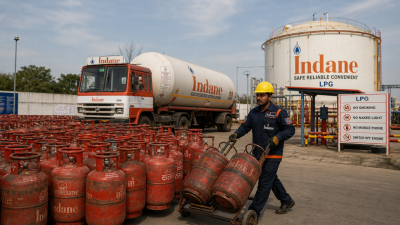
India shifted LPG sourcing rapidly after the Strait of Hormuz crisis disrupted roughly 30% of supplies and domestic imports plunged. The government diversified suppliers, increased domestic output, accelerated piped gas rollout and altered procurement to preserve household and industrial fuel availability while containing wider economic shocks.
What is the immediate issue
Scope
- Supply shock: LPG imports fell to 696,000 tonnes in April 2026 from a usual ~2 million tonnes per month.
- Daily disruption: About 30,000 tonnes of LPG supplies were affected every day, hitting SMEs and fuel-dependent processes.
- Chokepoint exposure: Around 35–50% of India’s crude flows transit the Strait of Hormuz; overall crude import dependence is ~89%.
Why this matters for governance and economy
- Household energy security: LPG is the primary cooking fuel for millions; uninterrupted supplies matter for public welfare and political stability.
- Economic activity: SMEs, food services and small industries faced operational stress from LPG shortfalls.
- Macro stability: Disrupted energy flows create price volatility and fiscal pressure through subsidies and buffer management.
- Strategic risk: Reliance on a maritime chokepoint increases geopolitical vulnerability and constrains foreign policy options.
India’s energy-security vulnerabilities revealed
- Concentration risk: Heavy reliance on West Asian suppliers for crude and LPG created single-region exposure.
- Logistics dependency: Maritime chokepoint transit increases exposure to regional conflicts and insurance/logistics cost spikes.
- Market rigidity: Limited short-term alternate supplies and domestic production capacity meant sharp import declines when routes were disrupted.
India’s LPG diversification strategy
- Rapid supplier shift: Record imports of over 1 million tonnes of LPG from the United States in June 2026 as an emergency fill-in.
- Broadened supplier base: Increased purchases from Nigeria, Australia, Kuwait and preliminary shipments from UAE, Iran, Oman, Saudi Arabia and Algeria.
- Trade-offs: US cargoes ensured supply continuity but at higher landed cost than Middle Eastern cargoes.
Broader fuel diversification — LNG and upstream moves
- LNG sourcing: Increased purchases from Oman, the US, Nigeria and Angola limited LNG import decline to 5% in April and 2% in May.
- Upstream access: Policy push to secure overseas oil and gas assets and expand upstream participation to reduce import vulnerability.
Domestic measures to reduce LPG reliance
- Maximise refinery output: Refiners were asked to ramp up domestic LPG production to substitute imports.
- Piped gas expansion: Accelerated rollout of piped natural gas connections. Early results show a 15–20% reduction in LPG consumption where piped gas is available.
- Infrastructure: Fast-tracking storage, bottling capacity and inland logistics to absorb supplier diversity and route disruptions.
Policy direction and strategy shift
- From scale to resilience: Market and policy emphasis moved from cost-efficiency and scale to resilience and supply redundancy, as noted by market analysts.
- Portfolio diversification: Strategic reserves, supplier diversification, and upstream footholds form the core of the revised approach.
- Regulatory nudges: Procurement flexibility and refinery directives to manage short-term shocks became policy instruments.
Geopolitical context and the US–Iran memorandum
- Partial reopening: A recent US–Iran memorandum led to a temporary authorisation allowing some Iranian oil exports and eased immediate maritime pressure.
- Strategic implications: Partial normalisation reduces acute pressure but leaves longer-term volatility and political conditionality that constrain reliable supply assurances.
- Diplomatic balancing: India needs to manage relations with Gulf suppliers, Iran and new partners such as the US while securing energy access.
Economic implications of the diversification
- Higher import cost: Sourcing from distant suppliers such as the US raises landed costs and can widen subsidy burdens or raise retail prices.
- Industry impact: SMEs and energy-intensive small firms face higher input costs, especially during the transition period.
- Risk reduction vs cost: Short-term fiscal and consumer costs are traded for lower probability of disruptive outages and associated economic losses.
| Dimension | Middle East suppliers | US and distant suppliers |
|---|---|---|
| Typical volume | Bulk monthly supplies (historical backbone) | Surge shipments used during crisis (record 1+ million tonnes) |
| Cost | Lower freight, lower landed cost | Higher freight and price premia |
| Reliability | Vulnerable to regional geopolitics | Less vulnerable to Gulf disruptions but exposed to longer logistics |
| Strategic value | Proximity and scale | Resilience and supplier diversity |
International cooperation and institutional responses
- Multilateral engagement: India is leveraging forums such as the BRICS Energy Ministers’ meeting to discuss collective energy security, sustainability and supply-chain cooperation.
- Market coordination: Dialogue with suppliers and buyers aims to stabilise markets and create contingency arrangements for transit disruptions.
- Domestic coordination: Ministries, state utilities and refiners are coordinating procurement, distribution and infrastructure priorities.
Policy challenges and implementation risks
- Cost burden: Sustained procurement from higher-cost suppliers can strain fiscal and subsidy frameworks.
- Infrastructure lag: Piped gas and storage expansion require capital and time; benefits are uneven across states.
- Geopolitical uncertainty: Temporary diplomatic fixes may not guarantee long-term transit security; diversification must be sustained.
Immediate policy options for India
- Diversify supply contracts: Secure medium-term contracts with multiple regions to smooth price and volume risk.
- Strengthen domestic output: Incentivise refinery LPG production and expand storage buffers.
- Accelerate fuel substitution: Speed piped gas expansion and promote alternatives where feasible.
- Expand strategic diplomacy: Bilateral and multilateral engagement for guaranteed transit and emergency corridors.
Model Questions
1. Analyse how the recent Strait of Hormuz crisis exposed vulnerabilities in India’s energy security framework. Discuss the multi-pronged strategies adopted by India to enhance resilience against such external shocks. [GS-III: Economic Development]
India’s vulnerability stemmed from heavy import dependence and transit concentration through the Strait of Hormuz, causing a 30% LPG disruption. Responses included rapid supplier diversification (US, Nigeria, Australia, Oman), higher domestic LPG output, accelerated piped-gas rollout (reducing LPG use 15–20% where available), LNG sourcing diversification, and steps to secure overseas upstream assets. The strategic pivot prioritises redundancy, storage expansion and procurement flexibility to lower outage risk.
2. Critically evaluate the efficacy of India’s LPG diversification, particularly its pivot to the United States, in ensuring energy security for households and businesses. What are the economic implications? [GS-III: Economic Development]
Pivoting to US LPG ensured supply continuity and prevented wider shortages. Efficacy lies in rapid volume replacement and market stability. The main economic trade-off is higher landed cost from distant suppliers, raising subsidy needs or retail prices and stressing cost-sensitive SMEs. Long-term efficacy depends on balancing short-term expensive fills with investments in domestic output, storage and cheaper alternative suppliers to contain fiscal impact.
3. Discuss the broader geopolitical implications of the Strait of Hormuz crisis for India’s energy diplomacy. How does the US–Iran memorandum influence India’s strategic energy choices? [GS-II: International Relations]
The crisis forced India to balance Gulf partnerships with new suppliers. The US–Iran memorandum temporarily eased transit pressure but leaves conditional and time-bound relief. India’s diplomacy must secure reliable supplies while avoiding over-dependence on any single partner. This encourages diversified bilateral ties, contingency arrangements, and engagement in multilateral energy forums to reduce leverage of regional disruptions on India’s energy imports.
4. Beyond LPG diversification, examine India’s holistic approach to bolstering energy security, covering infrastructure, domestic production and international cooperation. [GS-III: Economic Development]
India’s holistic approach combines short-term and structural measures: maximise domestic LPG output, expand storage and bottling capacity, accelerate piped natural gas rollout to cut LPG demand, diversify LNG sourcing, and secure overseas upstream stakes. Internationally, India pursues supplier diversification and multilateral dialogue (e.g., BRICS energy talks) for contingency mechanisms. Success requires coordinated investment, regulatory support and state-level implementation to close infrastructure gaps.
Last Modified: June 24, 2026