
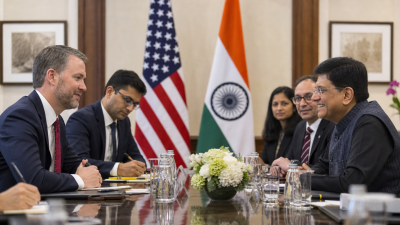
U.S. Trade Representative Jamieson Greer held high-level talks in New Delhi recently; both sides report substantial progress toward an interim and a comprehensive Bilateral Trade Agreement. A key deadline is the expiry of a temporary 10% U.S. tariff regime on 24 July 2026 and the possible introduction of a Section 301 tariff regime thereafter.
Current issue and stakes
The talks aim to finalise a first tranche of a Bilateral Trade Agreement (BTA) while the U.S. prepares a new Section 301 tariff regime. India seeks to protect domestic industry and tariff competitiveness. The U.S. seeks greater market access and rules on digital trade and supply chains.
- Diplomatic status: Substantial progress reported; Indian minister said 99% of first tranche complete; U.S. officials say negotiators are working on the last one percent.
- Timing: Temporary Section 122 tariffs expire on 24 July 2026; USTR has proposed 12.5% duties under Section 301 and set a response deadline of 7 July 2026 for India.
Economic dimensions
Trade balance and sectors
- Trade surplus: India’s goods surplus with the U.S. fell over 40% to USD 2.94 billion in May 2026 from USD 5.02 billion in May 2025.
- Sectoral shifts: Notable changes in petroleum products and electronic components. Export-sensitive sectors face tariff and market-access risk.
Mission 500
- Target: Aim to double bilateral trade to USD 500 billion by 2030. Requires trade liberalisation, investment growth, and dispute-management mechanisms.
- Implication: Achieving this requires reduction of barriers, regulatory alignment, and expanded cooperation in services, technology and manufacturing.
Legal and tariff framework
- Section 122: Temporary 10% tariff regime due to lapse on 24 July 2026.
- Section 301: USTR plans a new tariff structure under Section 301 of the Trade Act of 1974; on 2 June 2026 it proposed additional duties of 12.5% on India among 54 economies, citing failures to enforce prohibitions on goods made with forced labour.
- Response window: India to reply formally by 7 July 2026 to the proposed Section 301 duties.
- Precedent: The U.S. has used other authorities, including IEEPA and prior Section 301 actions, to impose tariffs; India remains among a small number of major economies without a formal trade pact with the U.S.
Key negotiating issues
- Market access: U.S. demand for lower tariffs and access to services and procurement; India cautious on sensitive tariffs and domestic industry protection.
- Digital trade: Rules on data flows, localisation, cross-border services and intellectual property protections under negotiation.
- Supply chain resilience: Cooperation to diversify and secure critical supply chains in semiconductors, pharmaceuticals, and defence-related sectors.
- Non-tariff barriers: Reduction of certification delays, standards divergence and regulatory opacity that hinder trade.
- Agriculture and tech products: India worried about import surges of subsidised U.S. agricultural goods and technology products that could harm local producers.
- Tariff competitiveness: India seeks a final tariff schedule that keeps manufacturing competitive relative to regional rivals in ASEAN and elsewhere.
India’s concerns and policy options
- Protective measures: Use of temporary safeguards, anti-dumping or countervailing duties where imports harm domestic industry.
- Legal and diplomatic response: Formal submission to USTR by 7 July; possible WTO challenge or negotiated mitigation if Section 301 duties are applied.
- Industrial policy responses: Support for affected exporters, supply-chain incentives, and tariff schedule calibration to maintain competitiveness.
- Enforcement and standards: Strengthen domestic enforcement against forced labour and improve traceability to counter U.S. forced‑labour claims.
- Market diversification: Accelerate access to alternate markets and trade agreements to reduce exposure to U.S. tariff actions.
Strategic and geopolitical implications
- Bilateral partnership: A BTA would deepen economic ties and complement strategic cooperation in defence, technology and the Indo-Pacific framework.
- Regional dynamics: A deal could shift investment and production location decisions in Asia, affecting competitiveness of neighbouring economies.
- Supply‑chain politics: Alignment on critical technologies can reduce dependence on single-source suppliers and bolster resilience against geopolitical shocks.
- Balance with other partners: India must balance U.S. market opening with ties to other trading partners and its own Make in India and Atmanirbhar policies.
Challenges and way forward
- Closing the last 1%: Resolve sensitive items on tariffs, procurement, agriculture and digital rules through calibrated concessions and carve‑outs.
- Section 301 timeline: Use the response window to seek exemptions, phased implementation, or reciprocal commitments that neutralise proposed duties.
- Domestic preparedness: Strengthen export competitiveness, compliance with labour and sustainability norms, and dispute-resolution capacity.
- Delivery on Mission 500: Attract investment, harmonise standards, enhance services trade, and set mechanisms for continuous review and problem-solving post-agreement.
Model Questions
1. Analyse the strategic implications of a comprehensive India–U.S. Bilateral Trade Agreement for India’s foreign policy and regional role. [GS-II: International Relations]
A comprehensive BTA would deepen strategic ties with the U.S., align economic and security objectives, and enhance India’s role in the Indo‑Pacific. It would support supply‑chain diversification, attract investment into strategic sectors, and increase diplomatic leverage. Risks include dependence on a single large market and pressure to align regulatory standards. India must balance economic gains with autonomy in foreign policy and regional partnerships.
2. Critically examine the economic impact of the proposed U.S. Section 301 duties on Indian exports and outline India’s policy responses. [GS-III: Economic Development]
Additional 12.5% duties would raise costs for affected exporters, reduce competitiveness in key sectors and could further shrink India’s U.S. surplus. Immediate responses include a formal USTR submission, pursuing exemptions, or WTO remedies. Domestic measures: targeted fiscal support, supply‑chain upgrades, diversification of export markets, and compliance improvements on labour standards to remove the stated basis for duties.
3. Discuss the main issues and challenges for India in negotiating a first‑tranche BTA with the United States, particularly on market access, digital trade, and agriculture. [GS-III: Economic Development]
Challenges include U.S. insistence on deeper market access versus India’s need to protect sensitive tariffs and farmers. Digital trade talks must reconcile data‑flow concerns and localisation policies. Agriculture is politically sensitive due to subsidised U.S. exports. Non‑tariff barriers and differing standards add complexity. Negotiations require calibrated concessions, phased liberalisation, safeguards, and regulatory cooperation to manage adjustment costs.
4. Evaluate the feasibility of achieving “Mission 500″—doubling India–U.S. trade to USD 500 billion by 2030—and the measures needed from both sides. [GS-II: International Relations]
Mission 500 is ambitious but feasible with a BTA that reduces tariffs, eases services trade, and boosts investment. India must improve market access, regulatory predictability and export competitiveness. The U.S. must address tariff threats and supply‑chain incentives. Both sides need sectoral cooperation in technology and energy, investor protection, standards alignment, and an effective dispute‑resolution framework to sustain long‑term growth in bilateral trade.
Last Modified: June 24, 2026