
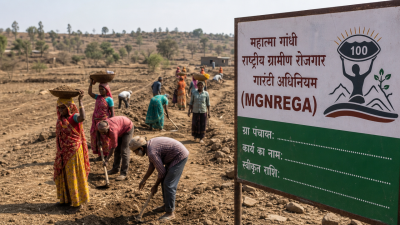
The Mahatma Gandhi National Rural Employment Guarantee Act has been replaced by the Viksit Bharat–Guarantee for Rozgar and Ajeevika Mission (Gramin) (VB-G RAM G) Act, effective 1 July 2026. Key changes: guaranteed days raised to 125, higher wages, a centrally capped formulaic allocation and a 60:40 Centre–State funding model.
What is the current issue?
- Legal change: MGNREGA replaced by VB-G RAM G Act, effective 1 July 2026.
- Entitlements: Guarantee raised from 100 to 125 days per eligible rural household; national average daily wage increased to ₹327.4; national minimum wage floor set at ₹300.
- Funding and allocation: Shift from largely central funding to 60:40 Centre–State cost sharing (90:10 for northeastern and Himalayan states). Central funds are capped and allocated by a formula (income-distance 42.5%, population 17.5%, area, GDP contribution 10%).
- Operational changes: 60-day mandatory “blackout period” during peak agricultural season; mandatory e‑KYC, renewal of job cards and phased replacement by digital Gramin Rozgar Guarantee Cards with facial recognition and biometric attendance.
- Budgetary provision: Interim central allocation ~₹95,692.31 crore for 2026–27; states required to provide matching resources and meet any excess wholly from their budgets.
Why this matters for governance, economy and society
- Fiscal stabiliser: A capped central budget and state financing obligation may weaken the programme’s ability to expand automatically during rural distress.
- Cooperative federalism: Reduced state autonomy in planning and a centralised allocation formula alter centre–state fiscal relations and implementation flexibility.
- Rural livelihoods: More days and higher wages raise potential income support; blackout period and central caps create new seasonal and fiscal vulnerabilities.
- Inclusion and governance: Digital verification could reduce leakages but risks excluding digitally disadvantaged groups unless implementation safeguards exist.
Comparative summary: MGNREGA v VB-G RAM G
| Dimension | MGNREGA | VB-G RAM G |
|---|---|---|
| Entitlement | 100 days guaranteed, demand-driven | 125 days guaranteed, entitlement retained but funding capped |
| Wage | Variable; national average ~₹298.8 | National average ₹327.4; floor ₹300 |
| Funding | Centre bore majority costs; counter‑cyclical | 60:40 Centre–State (90:10 for NE/Himalayan); central cap |
| Allocation | Released largely by demand and approvals | Formula-based (income-distance 42.5%, population 17.5%, area, GDP 10%) |
| State autonomy | High flexibility in planning and implementation | Reduced; central control over allocations and implementation norms increased |
| Technology | Biometric attendance, bank transfers in use | Mandatory e‑KYC; new Gramin Rozgar Guarantee Cards; facial recognition planned |
| Seasonal rules | No mandatory blackout | 60-day mandatory blackout during sowing/harvest |
Implications for rural employment and poverty alleviation
- Potential positive effects: Additional 25 work-days and higher wages increase guaranteed income per household. If fully funded and implemented, household consumption and local demand will rise, with multiplier effects in rural markets.
- Constraints on realisation: Central funding cap and state fiscal constraints may prevent meeting full demand. A formula-based entitlement can misalign supply with local shocks and migration-related demand patterns.
- Blackout period impact: The 60-day pause protects farm labour availability but removes a predictable income source during peak need for many households, increasing seasonal vulnerability unless alternate support is provided.
Impact on cooperative federalism and state finances
- Fiscal pressure: States face a projected 4–5 times increase in financial burden; some (Uttar Pradesh, Tamil Nadu, Bihar) could see 600–800% rise in expenditures related to the scheme.
- Allocation bias: The income-distance weight (42.5%) plus population and area components favour large, poorer states. This redistributes central funds but also imposes heavier state liabilities where administration capacity is weaker.
- Autonomy and planning: Reduced discretion for states in modulating entitlements and work priorities undermines localised responses to distress and may complicate integration with state rural development programmes.
Governance, targeting and technology
- Transparency gains: Standardised digital identity and attendance can reduce ghost beneficiaries and ensure timely payments if backend systems and bank linkages work reliably.
- Exclusion risks: Mandatory e‑KYC, facial recognition and renewal of job cards risk excluding elderly, marginalised, seasonal migrants and those without mobile or Aadhaar access.
- Administrative capacity: Panchayats and district administrations need training, IT infrastructure and contingency plans. Social audits, grievance redressal and independent monitoring must be strengthened to prevent emergent leakages.
Socio-economic effects of the blackout period and labour markets
- Labour availability: A 60-day blackout may increase agricultural labour supply and stabilise farm wages during sowing/harvest.
- Income volatility: Households dependent on scheme wages for daily consumption face an income gap; those gaps may compound in years of agrarian stress unless compensated.
- Market responses: Short-term labour scarcity outside blackout periods could raise non-farm wages; local market dynamics will vary by cropping pattern and migration cycles.
Policy options and implementation priorities
- Preserve counter-cyclical capacity: Create a central contingency fund or automatic trigger for additional central transfers during calamities to restore the fiscal stabiliser function.
- Flexible blackout design: Allow targeted exemptions or phased blackout at block level where dependence on wage work is high.
- State support mechanisms: Provide transitional financing, interest‑free loans or special grants to states facing large incremental burdens; align with Fiscal Responsibility frameworks temporarily.
- Digital inclusion: Deploy mobile enrolment camps, offline e‑KYC alternatives, and legal safeguards against wrongful exclusion from biometric/facial systems.
- Strengthen governance: Mandate social audits, real‑time public dashboards, CAG/state audit involvement, and fast grievance redress with penalties for delays in wage payment.
- Monitoring and evidence: Track indicators—demand satisfied, unpaid wages, exclusion instances, state expenditure trends—and commission periodic impact evaluations.
Model Questions
1. Critically examine the shift of MGNREGA to the VB-G RAM G Act and its change from a demand-driven guarantee to a centrally capped, formula-driven scheme. What are the implications for rural employment and poverty alleviation? [GS-II: Governance]
The shift increases guaranteed days (125) and wages (avg. ₹327.4), improving nominal household income. However, central budget caps and a formulaic allocation reduce responsiveness to local demand and shocks, weakening counter‑cyclical expansion. State fiscal constraints may limit implementation, causing unmet demand and increased seasonal vulnerability. Net effect depends on state capacity, supplementary financing during distress, and safeguards for the poorest households.
2. Analyse how the VB-G RAM G Act’s 60:40 Centre–State funding model affects cooperative federalism and state capacity to address rural distress. [GS-II: Governance]
The 60:40 cost‑sharing (90:10 for NE/Himalayan) shifts substantial fiscal burden to states, increasing their expenditure by multiple times. States with thin fiscal space may cut other development spending or under-implement the scheme. Centralised allocations and reduced planning autonomy constrain state-level policy responses, straining cooperative federalism unless transitional fiscal support and implementation flexibility are provided.
3. Evaluate the socio-economic impact of the 60-day mandatory blackout period and higher entitlements under VB-G RAM G on rural households. [GS-III: Economic Development]
Higher entitlements and wages raise potential annual household income, but the 60-day blackout removes a predictable source of non-farm wages during peak agricultural periods, creating short-term income gaps. Households dependent on scheme work may face liquidity stress. Net outcome will vary by region; mitigation requires targeted cash transfers, flexible blackout exemptions, or seasonal public works elsewhere.
4. Assess the implications of mandatory e‑KYC and digital Gramin Rozgar Guarantee Cards for transparency, inclusion and delivery of rural employment guarantees. [GS-II: Governance]
Digital verification can improve beneficiary identification, reduce fraud and speed payments. Risks include exclusion of those lacking IDs, mobiles or biometrics, and privacy concerns with facial recognition. Implementation requires offline enrolment options, data protection safeguards, capacity building at gram panchayat level, and strong grievance redress mechanisms to prevent wrongful exclusion.
Last Modified: July 8, 2026