
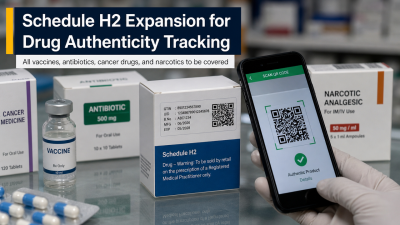
The Union Health Ministry has expanded Schedule H2 QR-code tracking to all vaccines, antibiotics, cancer drugs, and narcotic/psychotropic substances. The rule requires manufacturers to print or affix a barcode/QR on primary (or secondary) packaging and store product, manufacturer and batch data to enhance traceability, curb counterfeit drugs and enable rapid identification of defective batches.
What is the policy and why it matters
Scope and legal basis
- Scope: Mandatory QR/barcode tracking now covers all vaccines, antibiotics, anti-cancer medicines and narcotic/psychotropic substances. The prior requirement applied only to the top 300 selling brands.
- Legal basis: Expansion notified by amendment to the Drugs Rules, 1945. Implementation dates set for manufacturers: vaccines, narcotics, psychotropics and anti-cancer drugs effective from 1 July 2027; antimicrobials by 1 July 2028.
Objectives and expected public-health outcomes
- Primary objective: Verify authenticity and trace manufacturing details at pack level to reduce counterfeit and substandard drugs.
- Patient safety: Faster identification and recall of defective batches reduces adverse events and treatment failures.
- Supply-chain accountability: Unique product identifiers tie every individual pack to manufacturer, batch and licence information, improving auditability.
- AMR response: Traceability for antibiotics aids removal of poor-quality products that contribute to antimicrobial resistance.
Key provisions and data elements
- Mandate: Manufacturers must print/affix barcode or QR on primary packaging; secondary packaging allowed when space is insufficient.
- Data encoded: Unique product identification code, generic and brand names, manufacturer name/address/licence number, batch number, manufacturing and expiry dates.
- Verification points: Authentication possible at manufacturing, distribution, retail and consumer points.
Technological framework
- Code standard: QR/barcode format with encoded fields mapped to a unique product ID. Use of international standards (for example GS1 identifiers) recommended for interoperability.
- Backend systems: State-managed or interoperable central databases to record scanned events and map pack-level codes to regulatory records.
- User interfaces: Mobile apps and retail scanners for pharmacists and consumers to verify authenticity; APIs for regulators and manufacturers.
- Data governance: Secure transmission, encryption at rest and in transit, role-based access and audit logs to protect sensitive prescription data.
Role in combating counterfeit drugs and AMR
- Counterfeit removal: Pack-level authentication enables supply-chain actors to detect and quarantine fake or diverted products promptly.
- AMR mitigation: Traceability for antimicrobials helps identify low-quality or falsely labelled antibiotics, restrict their circulation and feed surveillance systems that inform stewardship policies.
- Surveillance integration: Scan-data can support pharmacovigilance, market quality surveys and targeted inspections by regulators.
Challenges in implementation
| Dimension | Issues |
|---|---|
| IT infrastructure | Need for interoperable, resilient systems across states; offline verification options for low-connectivity areas. |
| Database management | Establishing state-level registries, synchronisation with central records, and unique ID governance. |
| Compliance cost | Printing, serialization and IT integration increase costs, affecting MSMEs; need phased support and technical assistance. |
| Human factors | Pharmacist and consumer verification habits, digital literacy and incentive structures for routine scanning. |
| Data privacy and security | Prescription data protection, authorised access, and legal safeguards for sensitive health information. |
| Enforcement | Capacity of central and state drug regulators to audit, investigate and act on scan-data and market complaints. |
Regulatory and governance mechanisms
- Regulatory instruments: Amendments to the Drugs Rules, 1945 provide the statutory mandate. Regulatory oversight by CDSCO at central level and state drug authorities for on-ground enforcement.
- Compliance approach: Jan Vishwas Act 2026 classification of procedural versus substantial non-compliance channels enforcement toward substantive breaches while allowing administrative flexibility for procedural lapses.
- Operational arrangements: Clear SOPs for data sharing between manufacturers, distributors, state databases and regulators. Defined timelines and penalties for non-compliance.
- Capacity building: Training for regulators, manufacturers and pharmacists; standard operating procedures for recalls and investigations triggered by scan-data.
Stakeholder responsibilities
| Stakeholder | Key responsibilities |
|---|---|
| Union Health Ministry | Policy direction, rule amendment and national coordination. |
| CDSCO and State Regulators | Compliance monitoring, inspections and enforcement actions. |
| Manufacturers | Serialize packs, encode required data, integrate with tracking databases and report anomalies. |
| Pharmacists and distributors | Scan and verify packs at receipt and sale; report mismatches. |
| Consumers | Verify authenticity using apps; report suspected counterfeits to regulators. |
| IT providers | Develop interoperable platforms, ensure data security and maintain uptime. |
Operational risks and mitigation
- Risk — incomplete adoption: Mitigate with phased timelines, technical support and subsidies for small manufacturers.
- Risk — fragmented databases: Mitigate via national interoperability standards and APIs.
- Risk — privacy breach: Mitigate by limiting personal data in QR payloads, employing encryption and strict access controls.
- Risk — low usage by pharmacists/consumers: Mitigate through awareness campaigns, integration with procurement workflows, and regulatory checks at retail points.
Policy instruments and supporting measures
- Standards and certification: Adopt recognised serialization standards (for example GS1) and certify printing and IT vendors.
- Incentives and support: Financial or technical assistance for MSMEs to meet printing and IT costs.
- Legal safeguards: Alignment with data-protection norms and clear penalties for tampering, falsification or misuse of scan-data.
- Monitoring metrics: Indicators such as percentage of scanned packs, time-to-recall, reduction in counterfeit detections and AMR surveillance inputs.
Model Questions
1. Analyse the rationale behind expanding Schedule H2 QR-code tracking from selected brands to entire therapeutic classes and explain how this change can improve public health outcomes and supply-chain integrity. [GS-II: Governance]
India shifted from revenue-based to risk-based regulation by extending mandatory pack-level tracking to vaccines, antibiotics, anti-cancer and narcotic drugs. Pack-level unique IDs enable authentication, quicker identification and recall of defective batches, reduce circulation of counterfeit and substandard medicines, and improve accountability across manufacturers, distributors and retailers. The measure strengthens surveillance, increases patient safety, and raises confidence in drug quality while supporting targeted regulatory action and market audits.
2. Examine the technological architecture required for Schedule H2 implementation and identify the principal operational challenges that could impede nationwide rollout. [GS-III: Science & Technology]
Implementation needs QR/barcode standards, pack-level serialization, interoperable state and central databases, APIs, mobile and scanner apps, and secure data transmission. Main challenges include building resilient IT infrastructure across low-connectivity regions, synchronising state and central registries, ensuring vendor and manufacturer integration, higher costs for MSMEs, digital literacy among pharmacists, offline verification mechanisms and robust cybersecurity to protect sensitive health-related data.
3. Discuss how mandatory traceability for antimicrobials under Schedule H2 can contribute to India’s response to antimicrobial resistance (AMR). [GS-III: Environment & DM]
Traceability allows detection and removal of counterfeit or substandard antibiotics that drive inappropriate exposure and resistance. Serialized pack data feeds surveillance on product distribution and market quality. This informs targeted inspections, stewardship programmes and supply controls. Reliable data on antibiotic circulation supports rational prescribing policies, public awareness and regulatory action to preserve antibiotic efficacy, thereby contributing to national AMR containment strategies and global commitments.
4. Evaluate the regulatory and governance measures necessary to ensure effective compliance with the Schedule H2 expansion, noting the role of the Jan Vishwas Act 2026 in enforcement strategy. [GS-II: Governance]
Effective compliance requires clear rules under the Drugs Rules, 1945, active roles for CDSCO and state regulators, interoperable databases, SOPs for recalls, and capacity building for inspections. Jan Vishwas Act 2026’s distinction between procedural and substantial non-compliance should focus enforcement on material breaches while allowing corrective action for procedural lapses. Legal safeguards for data privacy, financial support for MSMEs, and transparent penalty and grievance mechanisms are also necessary.
Last Modified: June 29, 2026