
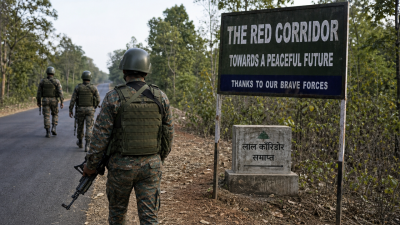
Union Home Minister Amit Shah announced recently that Naxalism has ended across India except for four districts in Chhattisgarh’s Bastar region. The government states India became effectively ‘Naxal-free’ by March 31, 2026; the Red Corridor is now limited to Bijapur (Chhattisgarh) and West Singhbhum (Jharkhand), with Kanker as a district of concern.
Current status
Operational and political authorities report a sustained decline in Maoist violence and territorial control. Intelligence-led operations, large-scale surrenders and focused rehabilitation have reduced affected districts sharply. Security agencies continue targeted action and civic outreach in remaining pockets to prevent regrouping.
Why this matters for governance and security
- Governance: Restores state presence in previously inaccessible areas and enables delivery of public services.
- Security: Lowers internal-threat burden and frees counter-insurgency resources for other priorities.
- Development: Opens scope for infrastructure, agriculture, livelihood and market access interventions.
- Rule of law: Allows prosecution of violent actors and disruption of criminal-financial networks.
Evolution and geography of the insurgency
Originated at Naxalbari (1967) and spread across tribal belts in multiple states. Factions consolidated into CPI (Maoist) in 2004. At peak, over a hundred districts were affected. Violence indicators fell from 870 incidents in 2014 to 234 in 2025; annual fatalities fell from about 310 to 100.
Multi-dimensional defeat strategy
A. Security operations and intelligence
- Forces: CRPF including CoBRA, District Reserve Guards, state police units.
- Modus operandi: Intelligence-led joint operations, improved patrol grid and area domination.
- Enablers: Modern equipment, 336 security camps and 76 helipads in core areas; rapid mobility and logistics.
- Law enforcement finance action: NIA and ED targeted funding, extortion networks and money trails.
- Outcomes (2024–Mar 2026): 706 Naxalites neutralised, 2,218 arrested, and 4,839 surrenders secured.
B. Surrender, rehabilitation and reintegration
- Approach: Incentivised surrender, guaranteed rehabilitation packages, skill training and access to social schemes.
- Scale: Reports show thousands of cadres laid down arms; 2,337 surrenders recorded in 2025 alone.
- Objective: Break cadre cohesion, cut recruitment, integrate former cadres into legal economy.
C. Infrastructure and governance push
- Service centres: 70 former CAPF camps in Bastar converted into civic service centres under Shaheed Veer Gunda Dhur Seva Dera.
- Development model: Focus on aspirational district programmes, roads, schools, health and livelihood projects to address grievances.
Achievements and measurable outcomes
| Metric | Reported change |
| Affected districts | Reduced from over 120 at peak to about eight (official CRPF figure); Red Corridor now limited to two districts by April 2026, with Kanker as concern |
| Incidents | From 870 (2014) to 234 (2025) |
| Fatalities | From ~310 (2014) to ~100 (2025) |
| Surrenders (2024–Mar 2026) | Thousands; security agencies report around 4,839 surrenders and hundreds of arrests |
Remaining challenges
- Geography: Dense forest and difficult terrain in Bastar and similar pockets facilitate hideouts.
- Local grievance drivers: Land alienation, weak service delivery, resource conflicts and employment deficits persist.
- Regrouping risk: Small armed groups may attempt fragmentation and low-intensity attacks.
- Institutional gaps: Need sustained local policing capacity, prosecution, and uniform rehabilitation implementation across states.
Way forward
| Challenge | Policy response | Lead agency / actor |
| Residual armed presence in Bastar and Bijapur | Continued intelligence-led targeted operations; surgical policing with civilian protection protocols | CRPF, state police, local DRG |
| Preventing recruitment and resurgence | Scale livelihoods, education, land-rights enforcement and youth employment schemes | State governments, district administrations, NITI Aayog programmes |
| Effective rehabilitation | Standardise rehabilitation packages; monitor placements; link to skill and credit schemes | Ministry of Home Affairs, state rehabilitation cells |
| Cutting financing and crime links | Continue ED/NIA action, strengthen anti-extortion policing and seizure regimes | NIA, ED, state economic offence units |
| Consolidating governance gains | Convert security infrastructure to service delivery hubs; institutionalise local grievance redress | District administrations, line ministries |
Model Questions
1. Critically analyse the multi-dimensional strategy that led to the near-eradication of Naxalism in India. What role did intelligence-led operations and financial targeting play? [GS-III: Internal & External Security]
Answer: The strategy combined sustained intelligence-led joint operations (CRPF, CoBRA, DRG, state police) with legal action on finances (NIA, ED). Intelligence improved target acquisition and reduced collateral harm. Financial targeting cut extortion and supply chains, weakening organisational capacity. Complementary surrenders and rehabilitation reduced manpower. Metrics—sharp fall in incidents, fatalities and affected districts—reflect the combined kinetic and non-kinetic approach.
2. Examine how socio-economic initiatives and infrastructure interventions complemented security operations in transforming former Naxal-affected regions into aspirational districts. [GS-II: Governance]
Answer: Security enabled safe access for road, health, education and market projects. Conversion of CAPF camps into civic service centres, expansion of schools, health facilities and helipads improved service delivery. Aspirational-district schemes targeted governance gaps, livelihoods and connectivity. These measures addressed root grievances, reduced local support for insurgents and facilitated return of state authority—essential for sustainable peace.
3. Despite major gains, pockets of Naxal activity persist. Analyse factors sustaining this persistence and propose immediate and medium-term measures. [GS-III: Internal & External Security]
Answer: Persistence stems from difficult terrain, local grievance and weak livelihoods. Immediate measures: sustained intelligence operations, protection of civilians, and disruption of finance. Medium-term: land-rights enforcement, scaled employment and education, standardised rehabilitation, and strengthened local policing. Inter-state coordination and continuous monitoring of indicators should prevent regrouping and consolidate gains.
4. Trace the evolution of the Naxal insurgency from origin to decline and assess implications of the Red Corridor’s near-eradication for India’s internal security and federal governance. [GS-III: Internal & External Security]
Answer: From Naxalbari (1967) the movement spread into forested tribal belts and consolidated in 2004 under CPI (Maoist). Decline followed combined pressure: security operations, financial action and development. Implications include reduced internal-threat burden, reallocation of security resources, enhanced state reach and restoration of law and governance. It also tests centre–state coordination and long-term development delivery in former conflict zones.
Last Modified: June 26, 2026