
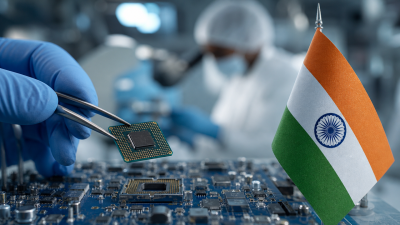
India’s semiconductor fabrication ambitions face an immediate input risk: critical minerals for fabs — notably gallium, germanium and rare earths — are largely imported, mainly from China. Recent diplomatic and domestic steps seek supply diversification, domestic processing capacity and private-sector mobilisation to translate manufacturing incentives into operational production.
What is the current issue
Scope
- Core problem: Semiconductor fabrication requires specialised critical minerals (gallium, germanium, rare earths). India lacks a secure, large-scale domestic supply and depends primarily on imports.
- Supply concentration: China is the dominant supplier for several of these minerals and related processed materials.
- Policy response: India combines manufacturing incentives under the India Semiconductor Mission (ISM) with mineral-auction and processing policies to reduce this dependence.
Why it matters for governance and security
- Industrial ambitions: ISM’s PLI and DLI schemes rely on steady mineral inputs to convert investment into functioning fabs.
- Economic competitiveness: Input shortages or export controls raise costs, delay production and weaken investor confidence.
- National security: Semiconductors underpin defence systems, AI and communications; supply fragility is a strategic vulnerability.
- Diplomacy and trade: Mineral dependence shapes India’s engagement with partners and its room for manoeuvre in supply-chain diplomacy.
Critical minerals: roles, sources and vulnerabilities
| Mineral | Use in semiconductor/tech value chain | Primary current source |
|---|---|---|
| Gallium | Compound semiconductors, optoelectronics | China (major exporter) |
| Germanium | Fiber optics, infrared optics, semiconductors | China (major exporter) |
| Rare earth elements | Magnets, polishing, catalysts | China (dominant processor and supplier) |
| Lithium, cobalt, nickel, graphite | Battery chemistries for manufacturing ecosystem | Mixed; India pursuing auctioned blocks and imports |
India Semiconductor Mission (ISM) and mineral linkage
- ISM instruments: Production-Linked Incentive (PLI) and Design-Linked Incentive (DLI) to attract capex and design activity.
- Gap: ISM focuses on fabrication, design and supply-chain services but lacks an explicit integrated mineral supply-management pillar.
- Recommendation embedded in policy debate: Integrate mineral sourcing, domestic processing and recycling provisions within ISM planning and PLI/DLI eligibility conditions.
International cooperation: Bilateral and multilateral responses
- India–US Bilateral Critical Minerals Framework: Covers lithium and rare earths across extraction, processing and recycling. Objective: reduce single-source reliance.
- Pax Silica initiative: India joined the US-led 35-nation initiative to build trusted supply chains for AI chips, semiconductors and minerals. India is seeking investments and access to a USD 250 million seed fund.
- Minerals Security Partnership (MSP): India’s membership expands options for supplier diversification, cooperative processing projects and investment co-ordination.
- Demand signalling: Indian and US officials discussed durable demand signals to de-risk private capital for processing and advanced manufacturing.
Domestic measures
- Mineral auctions: The Ministry of Mines auctioned 56 critical and strategic mineral blocks and 11 exploration licences to expand domestic resource base.
- Processing policy: The Union government will roll out a policy to develop a domestic processing value chain for battery minerals; it includes recovery of lithium, cobalt, nickel and graphite from waste.
- Private sector role: Senior officials have urged active private-sector participation to operationalise bilateral cooperation and capitalise on incentives.
Operational challenges
- Cost and scale: Establishing cost-competitive domestic processing and refining capacity requires large, patient capital and technological expertise.
- Technological gap: Advanced refining and separation processes for gallium, germanium and rare earths need specialised know‑how and environmental controls.
- Market signals: Private investors seek “durable demand signals” such as long-term procurement commitments or offtake guarantees.
- Time lag: Mines-to-fab supply chains and processing capacity take years to develop; immediate fabs still depend on imports.
Policy and strategic options: practical measures
- Integrate mineral management with ISM: Make domestic processing, recycling and secure sourcing explicit components of semiconductor incentives.
- Secure long-term contracts: Negotiate long-term supply and offtake agreements with diversified suppliers; include price‑indexation and security clauses.
- Public‑private partnerships: Use co-investment, risk-sharing and demand guarantees to attract private capital into processing facilities.
- Technology partnerships: Pursue bilateral technology transfers for refining and separation via frameworks such as the India–US bilateral pact and Pax Silica collaborations.
- Recycling and waste recovery: Scale battery-mineral recycling and urban mining to create secondary supply streams for lithium, cobalt and graphite.
- Calibrated bilateralism: Diversify supplier relationships across allied and neutral countries to reduce single‑source exposure while protecting strategic autonomy.
- Regulatory and environmental safeguards: Fast-track clearances for processing plants with strict pollution controls and compliance monitoring to build public acceptability.
- Demand aggregation: Use public procurement and sovereign-backed demand commitments to create predictable off‑take for new processing capacity.
Stakeholders and institutional mechanisms
| Stakeholder | Role |
|---|---|
| Ministry of Electronics & IT / MeitY | ISM design, semiconductor incentives, investor facilitation |
| Ministry of Mines / NITI Aayog | Mineral auctions, exploration policy, coordination for processing policy |
| Private industry | Capital expenditure, technology partnerships, operational delivery |
| International partners (US, Pax Silica members) | Technology, finance, supplier diversification, demand signalling |
| State governments | Land, clearances, single-window facilitation for plants |
Assessment
Current position
- India has combined manufacturing incentives with diplomatic initiatives and domestic mineral auctions to reduce import risk.
- Operational dependence on imported gallium, germanium and rare earths persists; recent export-control episodes exposed this vulnerability.
- Short‑term fabs will still require imported inputs; medium-term resilience depends on processing capacity, recycling and durable international partnerships.
Model Questions
1. Analyse India’s dependence on critical minerals for its semiconductor manufacturing goals and assess how the India Semiconductor Mission can address these dependencies. [GS-III: Science & Technology]
India relies on imported gallium, germanium and rare earths, concentrated in China, creating supply risk for fabs. ISM’s PLI and DLI attract fabs and design houses but must integrate mineral supply management. Measures: mandate domestic sourcing/recycling targets, support processing capacity via co-investment and demand guarantees, use long-term offtake contracts, and fast-track environmental clearances for processing plants to align supply security with manufacturing incentives.
2. Evaluate the role of recent bilateral and multilateral initiatives such as the India–US Bilateral Critical Minerals Framework and Pax Silica in strengthening India’s critical mineral supply chains. [GS-II: International Relations]
The India–US Framework covers lithium and rare earths across extraction to recycling, reducing single-source risk. Pax Silica provides multilateral finance, technology links and a USD 250 million seed fund to build trusted chains. These initiatives diversify suppliers, enable technology transfer for processing, and create coordinated demand signals that de-risk private investment, thus improving India’s negotiating position and strategic options in supply‑chain diplomacy.
3. Despite mineral block auctions and a planned processing policy, what operational challenges remain for India to achieve self‑reliance in critical minerals? Propose a comprehensive way forward. [GS-III: Economic Development]
Challenges: high capital and technical barriers for refining, time lag to operationalise mines-to-processing, need for durable demand signals, and competition from cost‑competitive foreign suppliers. Way forward: combine auctions with incentives for downstream processing, public‑private co‑investment, long‑term offtake and price clauses, technology partnerships, recycling/urban mining, environmental compliance, and use sovereign procurement to aggregate demand and attract private capital.
4. Critically examine the interplay between critical mineral security, semiconductor manufacturing and national security for India. [GS-III: Internal & External Security]
Critical minerals are foundational inputs for semiconductors that power defence, communications and AI systems. Supply concentration creates operational and strategic vulnerability; export controls or supply denial can stall defence production and civilian tech sectors. Mitigation requires diversified suppliers, domestic processing and recycling, integration of mineral policy with defence procurement, and international partnerships to secure resilient, predictable supply lines.
Last Modified: June 28, 2026