
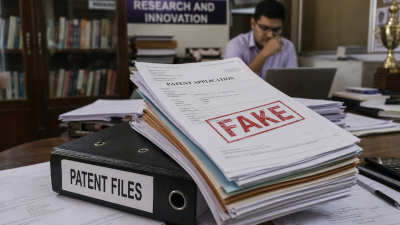
Recent reports show education firms selling thousands of UK design registrations to Indian academics. The practice lets faculty claim “international patents” for promotion and ranking points. The trend distorts metrics, corrodes research ethics and requires immediate policy and institutional corrective action.
What is the problem
Education companies have sold inventorship on UK design registrations to Indian academics for roughly £50. UK design registrations are granted quickly and without substantive novelty checks. Purchasers then claim international patenting activity on CVs and institutional reports. Eight firms are implicated. The practice is used to inflate patent counts for promotions and university rankings.
How the scheme operates
- Product: UK design registration (aesthetic/design right) sold as “patent” status.
- Process: Rapid UK registration (often ~11 days) without substantive examination.
- Transaction: Academics purchase inventorship on non‑existent designs for about £50.
- Outcome: Claimed “international patents” on CVs and institutional metric reports.
Design registrations vs utility patents
| Dimension | UK design registration | Utility patent (e.g., Indian patent) |
|---|---|---|
| Primary focus | Appearance/aesthetic | Functional invention |
| Substantive examination | No rigorous novelty/function check | Rigorous examination for novelty, inventive step, utility |
| Time to grant | Often days to weeks | Years (multiple examination stages) |
| Protection scope | Design appearance | Technical features and industrial application |
| Susceptibility to abuse | High (easy to obtain and sell) | Lower (costly and time‑consuming) |
Drivers and incentives
- Ranking metrics: Institutional ranking frameworks that count patent filings as simple quantitative indicators.
- Career incentives: Promotion rules and credit systems that reward patent numbers.
- Market supply: Commercial firms offering cheap inventorship on quick UK registrations.
- Low verification: Lack of routine checks on claims submitted for promotions and rankings.
Impact on academic integrity and the innovation ecosystem
- Research quality: Genuine research is devalued when credentials can be purchased.
- Ethical erosion: Normalises misrepresentation and short‑cuts to career advancement.
- Distorted metrics: Inflated patent counts mislead policymakers, funders and international peers.
- Resource diversion: Time and funds shift from meaningful R&D to metric manipulation.
- Reputational cost: Institutional and national credibility in science and innovation suffers.
Policy and institutional gaps
- Promotion rules: Many promotion and credit systems do not require patents to be granted, verified or of substantive technical merit.
- Ranking methodology: Reliance on raw counts rather than quality, impact or grant status.
- Verification capacity: Absence of automated cross‑checks with patent offices or international registries during evaluation.
- Enforcement: Weak mechanisms to investigate and penalise scientific misconduct tied to false inventorship claims.
Immediate and medium‑term reforms
- Revise ranking metrics: Exclude or downweight unverified patent counts; include qualitative indicators such as grant status, citations, technology transfer, and commercialisation outcomes.
- Promotion criteria reform: Require patents to be granted (not only filed or claimed) and verified against recognised patent office databases. Credit only substantive patents with examination records.
- Verification mechanisms: Build automated checks with Indian Patent Office, UK IPO, WIPO PATENTSCOPE and other databases for promotion and ranking audits.
- Regulatory action: UGC and Ministry of Education to issue rules that disallow purchased inventorships for academic credit and mandate disclosure of third‑party assistance.
- Research integrity office: Establish a national research integrity body or strengthen existing units to investigate misconduct, impose sanctions (debarment from funding, reversal of promotions, publication corrections) and maintain a public register of verified misconduct findings.
- Institutional reforms: NAAC/NIRF to adopt qualitative patent metrics; universities to strengthen internal ethics committees, conflict‑of‑interest rules and training in research ethics.
- International cooperation: Share intelligence with foreign IP offices to track firms selling inventorship and request information on suspicious registrations.
- Sanctions on intermediaries: Investigate and, where appropriate, blacklist firms offering paid inventorship and pursue legal action under relevant consumer, fraud and professional conduct laws.
- Awareness and capacity building: Train administrators, promotion committees and ranking agencies to distinguish design registrations from substantive patents.
Accountability and monitoring
- Audit trails: Require institutions to maintain verifiable documentation for each claimed patent: application number, grant document, examiner report and assignment records.
- Funding conditionality: Link public research grants and institutional funding to verified research outputs and integrity compliance.
- Periodic review: Mandate periodic external audits of institutional patent portfolios and ranking submissions.
Model Questions
1. Analyse how the prevalence of purchased UK design registrations as “fake patents” undermines academic integrity and the quality of higher education in India. Suggest institutional and policy reforms to address this challenge. [GS-II: Governance]
Recent sale of UK design registrations for inventorship corrodes merit, inflates credentials and diverts effort from genuine R&D. Reforms: revise ranking metrics to exclude unverified counts; require patents to be granted and verified for promotions; establish a national research integrity body; implement automated checks with patent databases; penalise intermediaries and institutions that facilitate misuse; strengthen internal ethics committees and training in research integrity to restore trust and quality.
2. Differentiate genuine utility patents from UK design registrations and assess the implications of misrepresenting design registrations as patents for India’s innovation ecosystem. [GS-III: Science & Technology]
Utility patents protect functional inventions after substantive novelty and inventive step examination. UK design registrations protect appearance and are granted rapidly without substantive checks. Misrepresentation inflates patent statistics, misleads policymakers and funders, redirects resources from substantive innovation, and damages international credibility. Policy response should prioritise verified, examined patents in evaluation and fund allocation to preserve genuine innovation capacity.
3. Examine the ethical dimensions of academics purchasing inventorship on non‑existent designs. What moral responsibilities do individuals and institutions have in upholding research ethics? [GS-IV: Ethics, Integrity and Aptitude]
Purchasing inventorship breaches honesty, fairness and accountability. Individuals must refrain from misrepresentation and accept professional sanctions for misconduct. Institutions must set clear standards, verify claims, enforce penalties, and create environments that reward genuine scholarship. Ethical responsibility includes transparent disclosure, refusal to condone metric manipulation, and active promotion of research integrity through training, oversight and consistent sanctions.
4. Critically evaluate how current academic ranking systems that prioritise quantitative patent data contribute to malpractices like fake patent sales. Propose changes to ranking methodologies. [GS-II: Governance]
Rankings that count raw patent numbers incentivise quantity over quality and enable abuse via cheap design registrations. Methodological changes: weight only granted and verified patents; include qualitative indicators (patent citations, commercialisation, peer review); audit submissions against patent office databases; publish methodology transparency; penalise false claims. These steps reduce perverse incentives and align rankings with authentic research outcomes.
Last Modified: June 28, 2026