
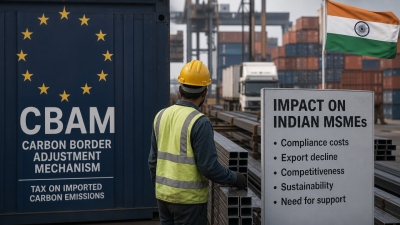
The Government of India is drafting a scheme to cover 90% of MSMEs’ compliance costs under the EU Carbon Border Adjustment Mechanism (CBAM). CBAM became operational in January 2026 and affects carbon‑intensive exports; MSMEs face compliance costs of ₹15–20 lakh per unit and reduced market access.
What is CBAM and why it matters
Mechanism and objective
CBAM places a carbon price on embedded emissions in imports to align importers with the EU Emissions Trading System. It targets carbon leakage and seeks parity between domestic and imported carbon costs.
Scope
- Goods covered: Iron and steel, aluminium, cement, fertilisers, electricity and hydrogen.
- Operational status: Financial obligations are operational from 1 January 2026.
Economic implications for Indian MSMEs
CBAM raises both one‑time and recurrent costs for MSMEs exporting to the EU. Key implications:
- Compliance cost: Estimated at ₹15–20 lakh per MSME unit for measurement, reporting and verification (MRV).
- Default‑value penalty: Where actual emissions data are absent, the EU applies default values with mark‑ups of 10% (2026), 20% (2027) and 30% (from 2028), increasing the tax burden.
- Export losses: ICRIER projects a 24% fall in India’s iron and steel exports to the EU and a 5.7% decline in global iron and steel exports for India.
- Sectoral reach: Fertilisers, aluminium and other metal products also face major exposure.
- Competitiveness: Higher compliance and carbon costs reduce price competitiveness in EU markets and compress margins for MSMEs.
Challenges faced by Indian MSMEs
- Technical capacity: Limited expertise in greenhouse gas accounting, lifecycle analysis and third‑party verification.
- Financial constraints: Upfront MRV costs (₹15–20 lakh) and investments in low‑carbon technology are beyond many units’ balance sheets.
- Data gaps: Fragmented supply chains and informal suppliers make traceable emissions data scarce.
- Awareness and compliance burden: Low awareness of CBAM rules and procedural complexity raise compliance risk.
- Risk of default values: Inability to furnish data leads to punitive default mark‑ups and loss of orders.
| Challenge | Immediate effect | Short remedy |
|---|---|---|
| Technical capacity | Incorrect MRV; failed verification | Cluster‑level MRV cells; training via BEE and MSME Ministry |
| Financial constraint | Non‑compliance; exit from EU market | Cost‑sharing scheme (90%); concessional green credit |
| Data gaps | Default values applied | Standardised templates; digital reporting platform |
India’s strategic responses and policy initiatives
- Cost‑sharing scheme: Government is drafting a programme to meet 90% of MSME compliance expenses to offset MRV costs.
- Diplomacy: Negotiations for exemptions for small industries did not secure concessions; India continues bilateral engagement with the EU and multilateral discussion at WTO forums.
- External assistance: Following an FTA signed on 27 January 2026, the EU committed €500 million over two years to support India’s emissions reduction and industrial transition.
- Institutional actors: Relevant agencies include the Ministry of Commerce & Industry, Ministry of MSME, Ministry of Environment, Forest and Climate Change, Bureau of Energy Efficiency, and Quality Council of India (for accreditation and certification).
- Domestic measures under consideration: Cluster MRV centres, centralised reporting platforms, subsidies for low‑carbon technology, and faster access to green finance.
Impact on India–EU trade dynamics
- Trade friction: CBAM introduces a pricing barrier that may strain trade ties despite the FTA framework.
- Market realignment: Exporters may diversify away from the EU or shift product mixes to lower carbon‑intensity goods.
- Cooperation track: The EU’s financial support establishes an avenue for technical cooperation and joint projects on industrial decarbonisation.
- Precedent effect: The UK plans a similar measure from 2027, signalling wider market pressures for compliance beyond the EU.
Way forward: strengthening MSME competitiveness
- Rapid rollout of the 90% cost‑sharing scheme: Clear eligibility, timely disbursal and audit safeguards to prevent delays.
- Cluster approach to MRV: Establish common MRV centres in industrial clusters to reduce per‑unit costs and standardise reporting.
- Capacity building: Short courses, certified auditors and handholding by BEE, QCI and industry associations.
- Green finance and incentives: Priority lines from public banks, interest subvention, and partial capital grants for low‑carbon equipment.
- Data infrastructure and certification: National standard for product carbon footprints, digital reporting portal, and accredited verification bodies (NABCB/QCI).
- Use of EU funds: Targeted projects for industrial energy efficiency, fuel switching (natural gas, renewables, hydrogen) and pilot MRV models.
- Export strategy: Diversify markets, upgrade product value‑addition, and pursue niche low‑carbon product segments.
- Policy symmetry: Evaluate a domestic carbon pricing or levy to internalise emissions cost and align with international standards.
| Measure | Lead agency | Immediate action |
|---|---|---|
| 90% cost subsidy | Ministry of MSME; Commerce | Finalise scheme rules; disbursal mechanism |
| Cluster MRV cells | Bureau of Energy Efficiency; State MSME directorates | Set up pilot cells in major export clusters |
| Green finance | Ministry of Finance; NABARD; Public sector banks | Introduce concessional lines and guarantees |
Model Questions
1. Examine the economic implications of the EU Carbon Border Adjustment Mechanism (CBAM) for Indian MSMEs in carbon‑intensive sectors and assess the likely effectiveness of the Government of India’s proposed cost‑sharing measure. [GS-III: Economic Development]
CBAM raises MRV and carbon costs (₹15–20 lakh/unit), risking order loss and a 24% fall in iron and steel exports to the EU (ICRIER). MSMEs face data, finance and technical gaps. The proposed 90% cost‑sharing reduces upfront barriers but will be effective only if paired with cluster MRV centres, accredited verification, fast disbursal, green finance and training to avoid default‑value penalties and restore competitiveness.
2. Critically evaluate India’s diplomatic and domestic responses to CBAM and their implications for India‑EU trade relations. [GS-II: International Relations]
Diplomatically, India sought exemptions without success; it continues bilateral and multilateral engagement. Domestically, the 90% subsidy, MRV plans and use of EU’s €500m aid after the FTA signal a combined mitigation and cooperation approach. These measures may ease trade tensions if implementation is timely, but CBAM remains a trade barrier that will push exporters to diversify markets and accelerate industrial decarbonisation.
3. Analyse the rationale behind carbon pricing instruments such as CBAM and discuss the specific challenges faced by developing economies like India in adapting to such measures. Suggest sustainable routes for industrial transition. [GS-III: Environment & DM]
CBAM aims to prevent carbon leakage and equalise carbon costs between domestic and imported goods. Challenges for developing countries include high MRV costs, limited technical capacity, informal supply chains and finance gaps. Sustainable routes are cluster MRV, subsidised green finance, domestic product carbon standards, capacity building, targeted technology grants and international cooperation using EU assistance for pilot decarbonisation projects.
4. Indian MSMEs face structural constraints despite support measures. Identify these constraints and propose a set of policy actions to improve their global competitiveness in the face of CBAM. [GS-III: Economic Development]
Constraints: limited capital, outdated technology, weak MRV capacity, data gaps and low awareness. Policy actions: implement the 90% subsidy with rapid disbursal; set up cluster MRV centres; build accredited verifier networks; provide concessional green loans and grants; deploy a national digital reporting platform; run targeted training and awareness; and use EU funds for technology pilots to lower product carbon footprints and improve market access.
Last Modified: June 28, 2026