
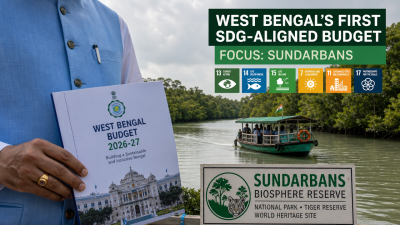
West Bengal presented a ₹4.38 lakh crore budget for 2026–27 with ₹3.01 lakh crore (69%) aligned to the UN SDGs. The budget prioritises the Sundarbans, climate finance instruments and large-scale solar projects, with stated allocations for delta projects, pontoons, solar boats, a climate fund and a floating solar-plus-BESS plant.
What is at stake
A state-level SDG-aligned budget affects governance, environmental resilience, local livelihoods and access to external finance. For a climate‑sensitive region like the Sundarbans the choices determine disaster risk, biodiversity outcomes, connectivity and energy access. International finance partners (ADB, World Bank) add conditionality and technical support needs.
Key allocations and initiatives
- Total and SDG alignment: Total budget ₹4.38 lakh crore; SDG-aligned component ₹3.01 lakh crore (69%).
- Sundarbans connectivity: ₹100 crore for pontoon-based jetties and associated infrastructure; promotion of solar-operated boats for goods and passengers.
- Delta projects: Upper Sundarbans Delta project ₹1,353 crore; Lower Sundarbans Delta project ₹4,100 crore — both with ADB and World Bank support.
- Climate finance institutions: Climate Resilient Fund and Climate Finance Facility with a combined allocation of ₹200 crore for 2026–27 to mobilise climate finance and support projects.
- Renewables: Mega Floating Solar Photovoltaic Project with Battery Energy Storage System at Bakreshwar Dam — approx. ₹2,000 crore.
- Administrative change: Proposal to carve out Sundarbans as a standalone district with an initial allocation of ₹100 crore for infrastructure and waterways.
Significance of SDG-aligned budgeting
Aligning expenditure to SDGs creates clearer links between fiscal choices and development targets. It permits outcome-oriented tracking, allows comparison with SDG India Index metrics, and aids prioritisation across social, economic and environmental objectives. For donors and multilateral lenders, SDG alignment supports project selection and performance monitoring. Risks include box‑ticking without commensurate implementation capacity.
Governance and institutional implications
Decentralisation and administration
A dedicated Sundarbans district can shorten decision chains, improve service delivery and focus resources on local vulnerabilities. It requires rapid establishment of district administration, staffed offices, and fiscal transfers to local bodies.
Coordination and capacity
SDG implementation demands inter-department coordination, defined SDG indicators at the state and district level, integrated project appraisal, and strengthened monitoring and evaluation (M&E). Partner finance will require procurement and environmental safeguard capacity.
Environmental and climate resilience dimensions
The Sundarbans is a mangrove ecosystem with protected areas and World Heritage assets. Delta projects and nature‑based interventions must address sea‑level rise, salinisation, cyclone risk, biodiversity protection and sustainable water management. Solar boats and floating solar with BESS reduce fossil fuel dependence and support decentralised energy, but require environmental impact assessment and local acceptance.
Economic and social implications
- Livelihoods: Improved waterways and low‑carbon boats can reduce transport costs for fishing, aquaculture and small trade. Delta restoration may protect agricultural land and fisheries.
- Employment: Construction and renewable projects can create short‑term and operation phase jobs; skills and local hiring clauses will determine local benefit.
- Service delivery: A new district can target health, education and disaster management more precisely.
- Fiscal effects: Large capital projects raise recurring O&M liabilities. Climate finance seed funds must be matched by sustained budgetary support or revenue streams.
Challenges and expert concerns
- Sectoral gaps: Experts note inadequate attention to waste management and air pollution. Environment department funding appears low relative to stated ambitions.
- Implementation risk: Scaling projects across islands with fragile access will test logistics, contracting and asset maintenance.
- Finance mobilisation: The ₹200 crore climate facility is a start. Mobilising concessional finance, public‑private partnerships and results‑based finance remains necessary.
- Monitoring: Absence of a clear state‑level SDG M&E framework would weaken outcome tracking and accountability.
Way forward
- Define SDG indicators: Map state and district budgets to specific SDG indicators and publish an expenditure–outcome matrix.
- Strengthen M&E: Institute independent, time‑bound monitoring with baseline surveys and third‑party verification for major projects.
- Build capacity: Train district officials, local bodies and implementing agencies on climate safeguards, procurement and O&M of renewable systems.
- Finance strategy: Use the Climate Finance Facility to blend concessional loans, grants and private capital; pursue GCF, ADB and World Bank instruments and carbon market participation where feasible.
- Community engagement: Design projects with local stakeholders, include livelihood safeguards, and ensure benefit‑sharing for resource users.
- Environmental integration: Make waste management and air quality measures part of SDG budgeting; mandate environmental impact and adaptive management plans for infrastructure.
Model Questions
1. Critically analyse the significance and likely implementation challenges of West Bengal’s first SDG‑aligned budget (2026–27). [GS-II: Governance]
The budget links fiscal choices to SDG targets, enabling outcome tracking, donor alignment and targeted resource flows. Implementation challenges include weak inter‑department coordination, limited district and local capacity, inadequate M&E systems, and fiscal sustainability of new projects. Addressing these requires indicator mapping, capacity building, transparent reporting and phased financing tied to measurable results and safeguard compliance.
2. Examine the key budgetary measures proposed for the conservation and climate resilience of the Sundarbans and assess the role of climate finance in supporting them. [GS-III: Environment & DM]
Measures include ₹100 crore for pontoons and solar boats, Upper and Lower Delta projects (₹1,353 crore and ₹4,100 crore) with ADB and World Bank support, and a ₹200 crore Climate Resilient Fund. Climate finance can provide concessional capital, technical assistance, and safeguard frameworks. Funds should be used for ecosystem restoration, resilient waterways and community adaptation, with monitoring to ensure ecological and social safeguards.
3. Discuss governance implications of carving out Sundarbans as a standalone district within the SDG‑aligned budget framework. [GS-II: Governance]
A separate district can improve targeted delivery, faster decision‑making and better alignment of projects with local needs. It raises administrative costs and requires rapid staffing, local capacity building, fiscal transfers and institutional design. Success depends on integrating district plans with state SDG indicators, strengthening panchayats, and ensuring ecology‑sensitive planning to protect mangrove and coastal livelihoods.
4. Assess the role and expected impacts of the renewable energy initiatives in West Bengal’s budget, focusing on the Mega Floating Solar project and solar‑operated boats. [GS-III: Economic Development]
Floating solar plus BESS at Bakreshwar (≈₹2,000 crore) and solar boats reduce reliance on fossil fuels, enhance energy security and add grid stability through storage. Economic impacts include capital investment, local jobs and lower fuel costs. Risks include environmental assessment needs, O&M costs, land‑use and financing challenges. Policy should ensure lifecycle planning, local skill development and integration with distribution upgrades.
Last Modified: June 25, 2026