
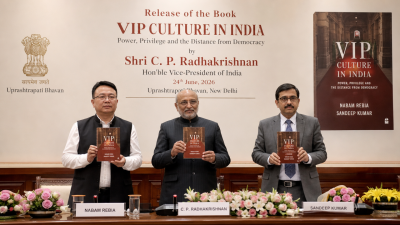
On 24 June 2026 the Vice‑President released the book “VIP Culture in India: Power, Privilege and the Distance from Democracy” by Nabam Rebia and Sandeep Kumar at the Rashtrapati Bhavan. He emphasised that public office is a responsibility and cited recent citizen‑first actions such as removal of red beacons and avoiding disruption for NEET aspirants.
What is the issue and why it matters
VIP culture denotes systemic special treatment, entitlement and preferential access for persons in power. It matters because it erodes equality before law, distorts resource allocation, reduces administrative accountability and degrades public trust—affecting governance outcomes, social cohesion and equitable service delivery.
Manifestations and ethical dimensions
- Common manifestations: reserved lanes, red beacons, large motorcades, security‑related traffic disruptions, preferential access to services and amenities.
- Ethical dimensions: entitlement over duty; violation of constitutional values of equality, fraternity and justice; accountability deficits; conflict between private privilege and public role.
Impact on democracy, public trust and governance
- Erosion of trust: visible privilege produces public cynicism and weakens legitimacy of institutions.
- Inequality: two‑tier access to services undermines rule of law.
- Resource diversion: security and logistics for VIP movement consume public resources.
- Administrative bias: decision‑making may favour influential actors over public interest.
Principles and components of citizen‑centric governance
- Core principles: accountability, transparency, responsiveness, accessibility, dignity and ease of access.
- Operational components: clear service standards, grievance redress, citizen feedback, digital access, decentralised delivery and capacity at local institutions.
Recent policy and institutional measures
- Symbolic and behavioural reforms: removal of red beacons for dignitaries; deliberate avoidance of public inconvenience in official movement.
- Leadership messaging: senior office‑holders urging service orientation—public office as responsibility.
- Panchayat focus: MoPR’s “Seva Se Samriddhi” regional workshop to strengthen Panchayat‑led service delivery.
- Regional example: Jammu and Kashmir expanded online public services from a small number to over 1,100 services, cited as a model of citizen‑centric delivery.
Role of technology and local self‑government
- SVAMITVA Scheme: drone mapping to issue property cards; about 3.18 crore property cards across 1.92 lakh villages, strengthening legal ownership, planning and local revenue.
- e‑GramSwaraj / e‑Panchayat: over 2.59 lakh Panchayats integrated; online transactions surpassing ₹3.16 lakh crore, enabling transparency, fund tracking and faster service delivery.
- Benefits: improved record‑keeping, reduced discretionary delay, empowered local planning, clearer grievance trails.
Comparison: VIP culture versus citizen‑centric governance
| Dimension | VIP culture | Citizen‑centric governance |
|---|---|---|
| Access | Preferential, exclusive | Universal, needs‑based |
| Accountability | Weak, opaque | Strong, transparent |
| Resource use | Diverted for privilege | Directed to public goods |
| Administrative culture | Entitlement, deference | Service orientation, responsiveness |
Challenges to implementation
- Bureaucratic inertia: resistance to protocol and practice change within services.
- Digital divide: uneven access limits benefits of e‑governance for marginalised groups.
- Entrenched privilege: cultural acceptance of status symbols and deference.
- Legal and procedural gaps: absence of uniform protocols on official privileges and their misuse.
- Capacity constraints: local institutions need skills, funds and data systems to deliver reliably.
Ethical foundations and measures to foster a service‑oriented ethos
- Constitutional and civilisational basis: equality, fraternity and public duty; civilisational texts and leaders’ examples that prize simplicity and duty over privilege.
- Leadership by example: senior officials should model restraint and prioritise citizen convenience.
- Codify limits: standardise and legally limit visible symbols of privilege and official protocol.
- Training and ethics: mandatory ethics modules and scenario‑based training for civil servants stressing human impact of decisions.
- Accountability systems: citizen feedback metrics, social audits, transparent grievance redress and penalties for misuse of official resources.
- Strengthen local institutions: scale e‑Panchayat tools, fund capacity building, and institutionalise Panchayat‑led service delivery.
Model Questions
1. Critically examine the concept of ‘VIP culture’ in India and its impact on democratic ethos and public trust. [GS-IV: Ethics, Integrity and Aptitude]
Public office subject to VIP culture produces entitlement, two‑tier access and accountability deficits. Effects include erosion of equality before law, resource diversion to security and logistics, administrative bias and citizen distrust. Remedy requires institutional limits on privilege, leadership by example, ethics training, transparent protocols and citizen feedback mechanisms. Constitutional values of justice, liberty and fraternity provide normative basis for reform and public service orientation.
2. What are the core principles of citizen‑centric governance and how have recent initiatives sought to implement them? Identify persistent challenges. [GS‑II: Governance]
Core principles: accountability, transparency, responsiveness, accessibility and dignity. Recent initiatives include removal of red beacons, deliberate avoidance of public inconvenience by officials, SVAMITVA property reforms, e‑GramSwaraj integration and Panchayat workshops. Challenges: bureaucratic inertia, digital divide, entrenched privilege, capacity gaps and legal lacunae. Measures needed: capacity building, service standards, grievance systems and digital inclusion.
3. Assess the role of technology and local self‑governance institutions in enhancing citizen‑centric service delivery. Illustrate with examples. [GS‑III: Science & Technology]
Technology enabled transparency and rights: SVAMITVA used drone mapping to issue ~3.18 crore property cards, strengthening land records and local revenue; e‑GramSwaraj integrated >2.59 lakh Panchayats for digital transactions and fund tracking. Local bodies act as delivery nodes when equipped with data and tools. Constraints include connectivity, digital literacy and data security. Scale requires interoperability, training, secure systems and user‑centric interfaces.
4. Discuss ethical dimensions of VIP culture and suggest measures to inculcate a service‑oriented ethos among public functionaries. [GS‑IV: Ethics, Integrity and Aptitude]
VIP culture reflects ethical failure: prioritising privilege over duty, breaching equality and weakening accountability. Remedies: visible leadership modelling restraint; codified limits on official privileges; mandatory ethics education; citizen satisfaction metrics and grievance redress; administrative incentives tied to public service outcomes; sanctions for misuse of state resources. Cultural change requires persistent top‑down and bottom‑up measures to normalise public office as responsibility.
Last Modified: June 25, 2026