
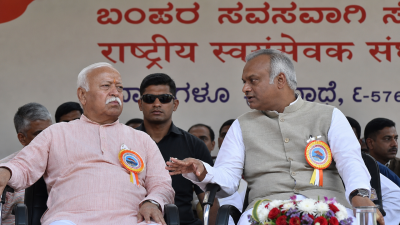
Recently, Karnataka’s Home Minister renewed a demand for the Rashtriya Swayamsevak Sangh (RSS) to disclose its legal status, finances and organisational details. The RSS rejects the demand, describes itself as a voluntary “body of individuals”, and resists formal corporate registration while Karnataka explores legal measures for transparency.
What is the issue?
The dispute concerns whether large voluntary bodies with public influence must register as legal persons and disclose finances. Karnataka’s demand seeks the RSS’s organisational records, funding and tax compliance. The RSS maintains it is a voluntary socio‑cultural body that submitted a written constitution to government decades ago and does not seek government funds; it therefore resists mandatory registration.
Legal frameworks and judicial precedents
Concept: Legal personhood permits an entity to hold rights and obligations, own property, sue and be sued. Statutory registration creates a clear legal identity.
| Route | Statute | Key features | Relevance to RSS |
|---|---|---|---|
| Society | Societies Registration Act, 1860 | Member‑based; governance by memorandum and rules; registration confers corporate status | Possible in form; RSS asserts a different organisational ethos |
| Trust | Indian Trusts Act, 1882 / State trust laws | Administered by trustees; common for charitable activities | Applicable for discrete charitable functions or assets; not for a mass voluntary body |
| Section 8 Company | Companies Act, 2013 | Non‑profit corporate entity; stricter compliance and disclosure | Legally available but entails formal corporate governance |
Judicial precedent: In Commissioner of Income Tax v Rastriya Swayamsevak Sangh (Patna High Court), donations from members characterised as “Guru Dakshina” were treated with tax considerations. Historically the RSS drafted a constitution in 1949 and amended it in 1972 to define member contributions for tax purposes.
Governance, transparency and policy trade‑offs
- Arguments for mandatory disclosure: Public accountability for organisations that exercise social and political influence; detection of unlawful funding; fiscal transparency for donations and assets.
- Arguments against compulsion: Risk of state intrusion into freedom of association; administrative burden on voluntary activity; existing compliance where organisations seek government funds.
- Practical balance: Targeted disclosure thresholds (size, public influence, receipts) reduce blanket intrusion while increasing accountability for large entities.
Institutional and federal dynamics
State initiatives to require registration raise federal questions because regulation of associations combines central law, state law and tax regimes. A state can use administrative or investigatory powers, but comprehensive reform of registration requirements would be best effected by central legislation or coordinated central‑state rules to avoid jurisdictional conflict and politicisation.
International scrutiny and implications
The US Commission on International Religious Freedom recommended targeted sanctions against the RSS in May 2026, citing links to violence against minorities. External measures or reports increase diplomatic and reputational pressure on India. Domestic regulatory actions intersect with international concerns about minority protection and religious freedom; this may shape bilateral discussions and multilateral perceptions.
Operational and regulatory challenges
- Definitional difficulty: Large, decentralised voluntary networks do not neatly fit the corporate forms envisaged by existing statutes.
- Legal gaps: Current Acts require registration for certain entities but provide limited guidance for mass voluntary federations that claim to be informal bodies of individuals.
- Enforcement limits: Compelling disclosure without specific statutory basis risks legal challenge on grounds of freedom of association.
- Existing mechanisms: Tax law, anti‑money‑laundering rules and foreign contribution regulations can address specific financial conduct without full corporate registration.
- Affiliates: Several RSS affiliates are registered under societies, labour union or student body laws, creating a mixed legal ecosystem.
Policy options and way forward
- Statutory clarity: Enact central legislation defining registration, disclosure thresholds and governance standards for large civil society entities and federated bodies.
- Threshold‑based disclosure: Require audited accounts and public registries for organisations exceeding financial or membership thresholds.
- Targeted regulatory tools: Use tax audits, FCRA and anti‑money‑laundering measures for financial irregularities without imposing blanket registration.
- Judicial adjudication: Encourage test litigation or PIL to obtain judicial interpretation of legal personhood for federated voluntary bodies.
- Safeguards: Include protections for freedom of association and proportionality tests to prevent arbitrary state interference.
Model Questions
1. Examine the legal complexities surrounding the demand for registration of large voluntary organisations such as the RSS. [GS-II: Constitution of India & Polity]
Answer: The complexity arises from the gap between statutory registration routes and federated voluntary networks. Societies, trusts and Section‑8 companies provide legal personhood but may not suit decentralised bodies. Judicial precedents and tax rulings influence practice. Mandating registration implicates freedom of association and federal competence. Resolution needs central statutory clarity, threshold‑based rules, or judicial interpretation to balance accountability with association rights.
2. Critically evaluate arguments for and against mandatory registration and disclosure norms for socio‑cultural organisations. [GS-II: Governance]
Answer: Proponents stress transparency, prevention of illicit funding, and public accountability for influential bodies. Opponents warn of state overreach, loss of voluntarism and administrative burden. A calibrated approach—mandated disclosure above defined financial or influence thresholds, independent audits, and legal safeguards for association—can reconcile accountability with organisational autonomy.
3. Analyse implications of Karnataka’s push for RSS registration and international scrutiny such as USCIRF recommendations. [GS-II: International Relations]
Answer: State demands may trigger federal friction and politicisation of civil‑society regulation. International scrutiny magnifies reputational risk and can prompt diplomatic pressure on minority protection. Domestic regulatory responses shape external perceptions; transparent, rule‑based measures reduce international criticism, while ad‑hoc actions risk escalation and affect India’s human rights narrative.
4. Trace the historical evolution of the RSS’s legal identity and its relevance to current registration demands. [GS-I: Modern Indian History]
Answer: The RSS faced a post‑1948 ban and adopted a written constitution in 1949 to resume lawful activity. A 1972 amendment defined member contributions for tax purposes. These adaptations created a hybrid legal practice without corporate registration. The history explains the organisation’s present stance and complicates demands for formal registration, as past engagement with state law emphasises compliance without adopting statutory corporate forms.
Last Modified: June 25, 2026