
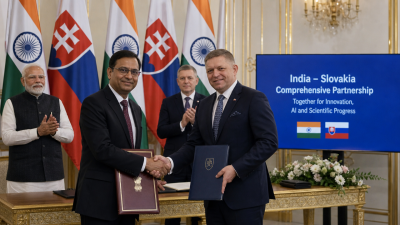
During Prime Minister Narendra Modi’s visit to Slovakia, India and Slovakia elevated bilateral ties to a Comprehensive Partnership and agreed to expand cooperation in AI, semiconductors, digital technologies, research, start-ups and academic exchanges, including an ICCR Chair in AI at the Technical University of Košice.
What is the issue
Current core elements
- Partnership status: Bilateral ties elevated to a Comprehensive Partnership with a structured agenda for science and technology cooperation.
- Key instruments: MoU on Digital Technologies; INSA–SAS scientific cooperation; ICCR Chair in AI at Technical University of Košice; IIT Delhi–Slovak Technical University student and doctoral exchange.
- Technology focus: Artificial Intelligence, semiconductors, 5G applications, 6G standardisation, IoT and M2M solutions, start-up ecosystems and research linkages.
Why it matters for governance, economy, technology and security
- Governance: Structured MoU enables policy dialogues on AI ethics, data governance and standard-setting.
- Economy: Collaboration can support semiconductor supply chains, start-up scaling, and market access for tech firms.
- Technology: Joint research and exchanges enhance capacity in emerging technologies and standards work such as 6G.
- Security: Diversified technology partners reduce strategic dependency and permit cooperative risk assessment for critical infrastructure.
Geopolitical significance and strategic autonomy
Engagement with Slovakia expands India’s presence in Central Europe. The partnership supports diversification of strategic and technological partnerships outside traditional blocs. Joint scientific and industrial ties can add supply-chain options for critical components, contributing to India’s strategic autonomy in technology and economic security.
Technological cooperation: AI, digital and semiconductors
- AI collaboration: ICCR Chair in AI and the follow-up from AI Impact Summit provide platforms for joint research, curriculum development and ethical discourse.
- Digital technologies: The MoU creates mechanisms for exchange on applied projects in 5G, IoT and M2M, and for standards discussions on emerging networks.
- Semiconductors: Cooperation can complement India’s domestic initiatives (PLI schemes, production incentives) through joint R&D, design partnerships and training.
Scientific research and academic cooperation
- Institutional links: INSA–SAS agreement institutionalises collaborative research, joint projects and scientist mobility.
- Higher education: IIT Delhi and Slovak Technical University arrangements cover reciprocal exchanges, scholarships and collaborative doctoral work to build research capacity.
- Knowledge transfer: Joint labs, co-supervised PhDs and visiting faculty promote long-term research networks and talent pipelines.
Economic and innovation ecosystem synergy
Collaboration targets start-ups, incubators and technology firms. Possible outcomes include joint ventures, cross-border investments, pilot deployments of IoT or 5G solutions, and shared access to EU and Indian markets. Skills mobility will support scale-up of innovation and competitiveness for SMEs in both countries.
India’s AI philosophy and policy framework
- Human-centric approach: India’s stated emphasis on trust, responsibility and human dignity guides bilateral work in AI ethics, safety and fairness.
- Policy instruments: MoUs and academic chairs provide fora to align research with national frameworks on data protection, AI governance and standards.
Human resource development and cultural exchange
- Student mobility: Reciprocal exchanges and scholarships will expand technical and research skills, and foster long-term professional ties.
- Cultural link: The ICCR Chair serves both academic and cultural diplomacy functions by placing Indian scholarship in a Slovak university.
Implementation mechanisms and institutional roles
- Government agencies: Ministries of External Affairs, Electronics & IT, science academies and ICCR coordinate policy, funding and exchanges.
- Academic partners: IIT Delhi, Technical University of Košice, Slovak Technical University and national academies manage research programmes and mobility.
- Industry participation: Technology firms, semiconductor design houses and start-up incubators are expected to operationalise pilots and commercial links.
Challenges and mitigation
| Challenge | Suggested measure |
|---|---|
| Data protection and cross‑border flows | Negotiate data-transfer protocols, align with national data protection laws and use model contractual clauses. |
| Intellectual property and commercialisation | Adopt clear IP rules in MoUs; establish joint technology‑transfer offices and shared licensing arrangements. |
| Financing of collaborative R&D | Create co‑funding mechanisms, tap multilateral science funds and use public‑private partnerships. |
| Scale and continuity | Set measurable milestones, multi‑year roadmaps, and institutionalise researcher mobility and student exchanges. |
Policy recommendations and operational priorities
- Joint centres: Establish India–Slovakia joint research centres for AI and semiconductor design with shared governance and alumni networks.
- Standards collaboration: Coordinate on 6G and IoT standardisation through working groups and joint submissions to international bodies.
- Industry consortia: Form bilateral consortia for pilot projects in smart manufacturing and IoT to demonstrate commercial viability.
- Capacity building: Scale scholarships, short‑term fellowships and technician training tied to industrial needs.
- Ethics and regulation: Develop joint ethical guidelines and regulatory roadmaps for safe, human‑centred AI deployment.
Model Questions
- Analyse the significance of the India–Slovakia Comprehensive Partnership for India’s strategic autonomy and technological cooperation. [GS-II: International Relations]
- Examine the initiatives India and Slovakia have agreed for cooperation in Artificial Intelligence and scientific research and assess how these align with a human‑centred AI approach. [GS-III: Science & Technology]
- Evaluate the likely economic and educational benefits of enhanced India–Slovakia cooperation in digital technologies and innovation ecosystems. [GS-III: Economic Development]
- Discuss how the Comprehensive Partnership with Slovakia fits into India’s broader foreign policy priorities and engagement with Central Europe. [GS-II: Governance]
Model answer: The Comprehensive Partnership diversifies India’s diplomatic and technology partnerships in Central Europe, reducing dependence on a few suppliers. It supports supply‑chain options in semiconductors, joint R&D in AI, and standards engagement (5G/6G). Institutional ties (INSA–SAS, IIT Delhi agreements) enable talent exchange and resilience. Strategic autonomy is strengthened through alternative markets, shared research and cooperative risk assessment for critical technologies.
Model answer: Initiatives include an ICCR Chair in AI, an MoU on Digital Technologies, INSA–SAS scientific cooperation and IIT Delhi–Slovak Technical University exchanges. These establish academic chairs, joint research, student mobility and policy dialogue. Alignment with a human‑centred approach comes from explicit emphasis on trust, responsibility and human dignity, capacity building in ethics, and frameworks for safe deployment and data governance.
Model answer: Economic benefits include joint ventures, pilot deployments in 5G/IoT, semiconductor collaboration and expanded market access for start‑ups. Educational benefits arise from reciprocal exchanges, scholarships and collaborative PhDs, building skilled talent and research capability. Combined effects improve innovation absorption, create jobs in tech sectors and support SME internationalisation through technology transfer and incubation linkages.
Model answer: The Partnership extends India’s diplomatic reach in Central Europe, diversifying partnerships and opening new economic and technological corridors. It projects India’s capabilities in digitalisation and AI, fosters multilateral cooperation on standards, and builds bilateral channels for research and industry. This complements India’s policy of varied strategic ties and strengthens cooperation on global technology governance and trade.