
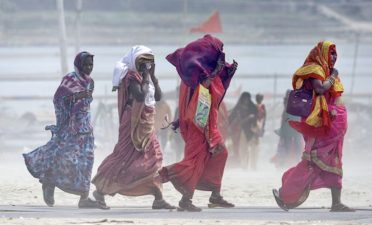
Recently, IMD reported widespread above‑normal maximum temperatures and forecast Delhi highs of 39–41°C. Northern India has experienced unusually warm nights and isolated heatwave pockets. Policy analysis points to funding and institutional gaps amid claims that the summers of 2024–26 mark a climate tipping point.
What is the current issue and why it matters
Current issue
Heat extremes have intensified across India. IMD recorded a highest maximum of 43.4°C in Banda and forecast isolated heatwave pockets in Chhattisgarh, Telangana, Vidarbha and West Uttar Pradesh. Night-time minima in parts of north‑west India have been 4–7°C above normal, reducing nocturnal relief.
Why it matters for governance and society
- Public health: rising heat increases heat‑related illness and mortality; Ministry of Health lacks a dedicated heat emergency scheme.
- Economy and labour: reduced outdoor labour productivity; agricultural stress and yield losses.
- Services and infrastructure: higher cooling demand strains power systems; water stress increases.
- Security and governance: impacts on livelihoods may raise migration, social stress and demand for disaster relief funding.
Nature and severity of recent heatwaves
Recent events include record daytime peaks and sustained warm nights. Forecasts show isolated heatwave conditions persisting in several regions. Analysts view the consecutive severe summers (2024–26) as indicating movement toward a climate tipping point—a shift to more frequent, higher‑intensity extremes with reduced recovery intervals.
Drivers of severity
- Global warming: increased baseline temperatures raise probability and intensity of extremes.
- Synoptic and local meteorology: stalled upper‑level patterns and reduced monsoon onset contribute to prolonged heat spells.
- Urban heat island (UHI): impervious surfaces, loss of vegetation and heat‑trapping urban geometry raise daytime and night‑time temperatures, especially in dense cities.
- Socio‑economic exposure: population growth in heat‑prone areas and informal outdoor work concentrate vulnerability.
Socio‑economic ramifications
- Health burden: higher incidence of heat stroke, dehydration and exacerbation of cardio‑respiratory conditions; strain on healthcare delivery.
- Agriculture and food security: crop stress during critical phenological stages; irrigation demand increases.
- Productivity losses: reduced working hours and output in construction, transport and agriculture.
- Energy and water systems: peak electricity demand for cooling; reservoir depletion and groundwater stress.
- Vulnerable populations: urban poor, elderly, outdoor workers and migrants face disproportionate risk.
Institutional and policy framework
Key actors and instruments
| Institution | Role | Current gap |
|---|---|---|
| IMD | Forecasts, heat warnings, early‑warning bulletins | Need for higher‑resolution urban heat forecasts and night‑time indices |
| NDMA | Guidelines for Heat Action Plans (HAPs) | Guidelines need stronger enforcement and funding linkage |
| State/local governments | Implement HAPs, public health response, cooling centres | Uneven coverage; over 130 districts have HAPs but many remain unprepared |
| Ministry of Health | Clinical protocols, public health interventions | No dedicated national heat emergency scheme |
| MoEFCC / Finance | Climate adaptation funding and policy | Analysis finds no dedicated funds for heat risk |
Funding gaps and legal classification
Policy analysis by CBGA and Greenpeace shows absence of dedicated MoEFCC funds and no Ministry of Health scheme for heat emergencies. Reclassifying heatwaves as a ‘national disaster’ under the Disaster Management Act (as recommended earlier by the 16th Finance Commission) would unlock central funding, enable contingency financing, mandate coordinated national response, and standardise protocols across states.
Role of Heat Action Plans (HAPs)
- Coverage: over 130 cities/districts across 23 states have HAPs; Odisha had the first in 1999.
- Components: early warning, public communication, healthcare preparedness, cooling centres, occupational guidelines.
- Limitations: variable institutional capacity, funding shortfalls, limited integration with urban planning and power/water provisioning.
Indigenous and low‑tech cooling measures
- Rajasthan: baolis (stepwells) and jaalis for evaporative cooling and passive ventilation.
- Maharashtra: matka (earthen pot) use and courtyard ventilation for night cooling.
- Karnataka: courtyard‑oriented architecture to enhance cross‑ventilation and shaded microclimates.
- Policy use: integrate vernacular techniques into building codes, retrofit programmes and urban greening strategies.
International dimension and policy tensions
At Bonn SB64 India urged focus on implementation of existing commitments and raised concerns over declining climate finance. The position reflects the need for predictable adaptation finance, technology transfer and equitable burden sharing. Domestic adaptation needs—such as heat management—depend on both domestic resource mobilisation and international financing mechanisms.
Challenges for balancing development and adaptation
- Resource constraint: limited dedicated finance for heat adaptation within central ministries.
- Policy coordination: need for inter‑ministerial alignment (Environment, Health, Urban Development, Labour, Power).
- Urban planning deficit: building codes and land use ignore heat resilience in many cities.
- Data and research gaps: need for urban heat mapping, occupational exposure studies and health surveillance.
Way forward — actionable measures
| Dimension | Action |
|---|---|
| Finance | Create dedicated heat risk funds; classify heatwaves as a national disaster to access Disaster Response Funds and contingency finance. |
| Health preparedness | Establish a national heat emergency scheme; integrate heat protocols in public health programmes and surveillance. |
| Forecasting & early warning | Invest in high‑resolution urban heat forecasts; link warnings to occupational and municipal actions. |
| Urban planning | Mandate cool roofs, urban greening, water‑sensitive design, and vernacular cooling in building codes. |
| Labour and social protection | Expand occupational heat guidelines, adjust work–rest cycles, and provide income support during extreme events. |
| Community resilience | Scale cooling centres, community water points, and public awareness campaigns targeted at vulnerable groups. |
| International engagement | Seek predictable adaptation finance, secure technology transfer and push for finance mechanisms tied to heat risks. |
Model Questions
- Analyse the factors contributing to the increased frequency and intensity of heatwaves in India and assess the implications of declaring heatwaves as a national disaster. [GS-III: Environment & DM]
- Critically examine India’s institutional preparedness for escalating heat risks and suggest measures to strengthen policy and financing. [GS-II: Governance]
- Explain the concept of a climate tipping point in the context of India’s recent summers and evaluate socio‑economic consequences and the role of indigenous cooling practices in adaptation. [GS-III: Environment & DM]
- Discuss challenges India faces in international climate negotiations when domestic climate vulnerabilities such as heatwaves are rising, citing recent positions taken by India. [GS-II: International Relations]
Model answer: Key drivers include global warming raising baseline temperatures, synoptic patterns delaying monsoon, urban heat islands and increased exposure from urbanisation and outdoor labour. Declaring heatwaves a national disaster would unlock central funds, enable coordinated response under the Disaster Management Act, standardise Heat Action Plans, and improve resource allocation for mitigation, health preparedness and infrastructure resilience. Legal classification must be paired with funding and implementation plans.
Model answer: IMD and NDMA provide forecasts and HAP guidelines, but coverage and enforcement are uneven; MoEFCC lacks dedicated heat funds and the Ministry of Health has no national heat scheme. Strengthening requires dedicated budget lines, a national heat emergency scheme, inter‑ministerial coordination, urban heat mapping, capacity building for local bodies, mandatory integration of HAPs in municipal planning, and performance‑based funding to states.
Model answer: A tipping point denotes a threshold beyond which climate systems shift to a new state; consecutive severe summers suggest movement towards persistently higher extremes. Consequences include increased health mortality, agricultural losses, reduced labour productivity, water stress and energy demand. Indigenous practices—stepwells, jaalis, matkas, courtyard design—offer low‑cost, scalable cooling solutions that should be integrated into urban design, retrofits and public housing for local adaptation.
Model answer: India prioritises implementation of existing commitments and seeks predictable finance and technology transfer. Challenges include securing adequate adaptation finance amid global declines, negotiating equitable burden‑sharing, and aligning development needs with emission reduction. Domestic vulnerabilities increase pressure for funds and technologies; India must combine domestic resource mobilisation, targeted adaptation investments and coordinated diplomacy to obtain finance and capacity support.