
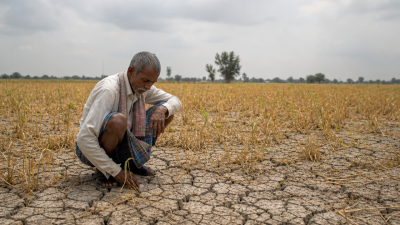
India faces a developing “super El Niño” that meteorological agencies warn will weaken the southwest monsoon. Rainfall deficits in June exceeded 40%, kharif sowing is delayed, and contingency measures have been activated for hundreds of vulnerable districts to protect crops and the farm economy.
What is the current issue
FAO and WMO advisories indicate a high probability that El Niño will persist through the monsoon season, likely at moderate-to-strong intensity. India recorded an exceptional June rainfall shortfall (cumulative deficit >43%), with sowing delays and drought risk concentrated in central India and the Deccan plateau.
Why this matters for governance, economy and society
- Food security: Rainfed kharif crops (rice, pulses, maize, oilseeds) are at risk, affecting domestic supply of staples and protein sources.
- Inflation & macro forecasts: The RBI has flagged abnormal weather as a downside risk; price spikes for cooking oil, sugar, onion and cotton will feed food and clothing inflation.
- Rural livelihoods and politics: Central India and the Deccan account for the bulk of soybean, sugarcane, cotton, pulses and peanuts; yield losses would affect farmer incomes and rural demand.
- Value-chain disruption: Localised crop failures (e.g. severe deficit in key onion districts) can trigger national price volatility and supply-chain stress.
El Niño and the Indian monsoon — mechanism and current outlook
El Niño alters Pacific sea-surface temperatures and global atmospheric circulation. The resulting change tends to suppress the Indian summer monsoon by shifting convective activity away from the Indian subcontinent and increasing subsidence. Current probabilistic forecasts show high likelihood of El Niño persistence through the monsoon window, creating conditions for below-normal rainfall and heat extremes during the season.
Geographical and crop-specific impacts
Exposure is concentrated in central India and the Deccan region (Rajasthan, Gujarat, Maharashtra, Karnataka, Uttar Pradesh, Madhya Pradesh, Chhattisgarh, Telangana). These zones supply a large share of several kharif commodities:
| Crop | Major producing region | Share (approx.) | Immediate risk |
|---|---|---|---|
| Soybean | Central India / Deccan | ~90% | Poor germination and reduced yields in rainfed areas |
| Sugarcane | Maharashtra, UP, MP | ~90% | Crop stress affects sucrose recovery and supply |
| Cotton | Central & South | ~80% | Delayed planting, pest pressure changes |
| Pulses, peanuts | Central & Deccan | ~70% | Large yield sensitivity in rainfed tracts |
| Onion (example) | Nashik and other districts | Regional hub | Severe June deficit (e.g. Nashik ~16% of normal) risks price spikes |
Economic repercussions and the farm value chain
- Aggregate farm economy: Disruption to sowing and yields threatens India’s roughly USD 300 billion farm sector through lower output and higher procurement costs.
- Inflation transmission: Reduced supply of oilseeds, sugarcane and pulses pushes food inflation; textile inflation may follow if cotton supplies tighten.
- Supply-chain and trade: Localised shortages translate into national price volatility because of thin buffers in perishable crops (vegetables, onions). Strategic grain buffers are larger after increased rice and wheat stocks post-2023 export curbs.
- Macro risk: RBI has incorporated weather-related supply shocks as an uncertainty for growth and inflation projections.
Government preparedness and institutional responses
Central and state authorities have mobilised operational measures.
- Contingency activation: Contingency plans are active for 315 vulnerable districts; 111 districts with under 25% irrigation are flagged as highly vulnerable.
- Monitoring institutions: An El Niño Monitoring Cell and a Crop Weather Watch Group have been set up under the Agriculture Ministry to track sowing, moisture, pests and market signals.
- Buffer stocks and market tools: Elevated grain stocks provide short-term resilience. Government can use procurement, buffer release, and import policy to stabilise prices if required.
- Risk transfer and farmer support: Crop insurance (PMFBY) and state relief packages remain principal instruments for compensation and cash relief in notified distress events.
- Early warnings and advisories: IMD’s advance guidance on monsoon progress and heatwave alerts informs crop calendars and labour planning at state/division level.
Operational gaps and constraints
- Irrigation deficit: Districts with <25% irrigation are exposed; lack of rapid expansion capacity limits immediate mitigation.
- Market fragmentation: Price stabilisation is hindered by storage, transport and cold-chain gaps for perishables.
- Implementation lag: Timely disbursal under insurance and relief schemes often lags crop-cycle needs.
- Data & coordination: Real-time, district-level agro-meteorological data and intra-government coordination need strengthening for rapid response.
Regional strategies and district-level actions
| Priority action | Target | Implementation note |
|---|---|---|
| Accelerated micro‑irrigation | Rainfed blocks, low-irrigation districts | Subsidy-routing to smallholders; fast-track micro-irrigation kits |
| Adjusted sowing advisories | Local extension services | IMD-Crop Watch advisories to shift crop mix and sowing window |
| Market interventions | Perishables and edible oils | Targeted buffer release, import adjustments, market intelligence |
| Short-term cash support | Affected smallholders | Use PM-KISAN, state relief, and expedited insurance payouts |
Long-term resilience and policy priorities
- Water security: Expand assured irrigation through canal modernisation, groundwater recharge, watershed treatment and on-farm water-saving technologies.
- Crop and cropping-system change: Promote drought-tolerant varieties, shorter-duration cereals and oilseeds, and crop diversification in vulnerable districts.
- Value-chain investment: Strengthen storage, cold chains, and processing capacity to reduce price volatility and post-harvest losses.
- Risk management: Improve insurance delivery (faster claims, satellite-based loss assessment) and expand contingency finance at state and centre levels.
- Climate adaptation mainstreaming: Integrate climate risk into agricultural programmes (labour, credit, input subsidies) and align ministries for long-term adaptive planning.
Model Questions
1. How does a Super El Niño influence the Indian summer monsoon and what are the geographical and crop-specific implications for India’s agriculture? [GS-III: Environment & DM]
El Niño shifts Pacific convection, weakening monsoon circulation and reducing rainfall over India. Result: below-normal monsoon, delayed kharif sowing and crop stress. Central India and the Deccan—major producers of soybean, sugarcane, cotton, pulses and peanuts—face highest exposure. Rainfed rice, maize and pulses are most vulnerable; irrigation-poor districts see greatest yield and income loss, amplifying regional food-security risks.
2. Analyse the economic repercussions of a weak monsoon amplified by El Niño on inflation and the farm value chain. What mitigation measures are in place? [GS-III: Economic Development]
Weak monsoon reduces output, raising prices for edible oils, sugar, pulses and vegetables, driving food inflation and weakening rural demand. Value-chain shocks affect processors and export prospects. Mitigation: elevated grain buffers, contingency plans across 315 districts, an El Niño Monitoring Cell, Crop Weather Watch Group, crop insurance (PMFBY) and targeted market interventions; RBI treats weather as a forecast risk.
3. Evaluate India’s preparedness and institutional response to safeguard agriculture against the developing Super El Niño. Identify regional vulnerabilities. [GS-II: Governance]
Preparedness includes contingency activation in 315 districts, monitoring cell and Crop Weather Watch Group, early IMD advisories and buffer stock policy. Gaps: districts with <25% irrigation (111 identified) remain highly vulnerable; implementation delays in insurance and relief; limited rapid expansion of irrigation and market infrastructure. Central-state coordination and district-level targeting determine response effectiveness.
4. In the context of recurring El Niño events and climate change, what paradigm shifts are required in India’s agricultural policy to enhance long-term resilience and food security? [GS-III: Environment & DM]
Shift from input-centric to climate‑resilient agriculture: invest in water-security (micro‑irrigation, recharge), drought-tolerant and short-duration varieties, cropping-system diversification, and strengthened storage/processing. Enhance early warning, real‑time data, faster insurance payouts, and value-chain investments. Policy must integrate climate risk into subsidies, credit and extension for sustained adaptation and reduced systemic vulnerability.
Last Modified: June 29, 2026