
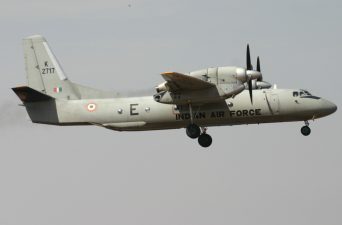
On 13 June 2026 an IAF Antonov An‑32 crashed while landing at Jorhat AFS, Assam. Five airmen died; one co‑pilot survived. The IAF has ordered a court of inquiry. The crash is the tenth AN‑32 accident since the type was inducted in 1984 and renews focus on fleet replacement and safety.
What is the issue
The AN‑32 is an ageing twin‑engine tactical transport. The recent Jorhat crash killed Squadron Leader Prashant Singh, Flight Lieutenant Shubham Kumar, Sergeant Jitendra Sharma, Agniveervayu Khemaram Kumawat and Agniveervayu Danish Alam. One co‑pilot survived and is under treatment. The IAF has opened a court of inquiry. The incident draws attention to operational risks from older platforms and the need for fleet renewal and improved maintenance systems.
Why it matters
- Security: Medium lift capability is central to troop movement, logistics, forward operating bases and rapid response in India’s border regions.
- Human resources: Recurrent accidents affect morale and reduce effective manpower at unit level.
- Governance and procurement: Delays in replacements and upgrades create capability gaps and procurement dilemmas.
- Economy and industry: The MTA offer affects defence manufacturing, jobs and supply chains under the Atmanirbhar Bharat policy.
- Operational readiness: Availability shortfalls constrain humanitarian assistance, disaster relief and special operations.
Fleet profile and safety record
- Platform: AN‑32 — Soviet‑origin twin‑engine transport. Inducted 1984 for tactical airlift.
- Safety record: The Jorhat accident is the tenth AN‑32 crash in Indian service. Previous major accidents include high‑casualty events in 2009, 2016 and 2019.
- Immediate action: Court of inquiry to determine cause, with likely operational and maintenance recommendations.
Operational and strategic implications
- Capability gap: Losses and grounded airframes reduce sortie generation and payload throughput in theatre logistics.
- Forward basing: Medium transports are required for operations from short, semi‑prepared airstrips in mountainous border sectors.
- Interoperability: Older avionics and communication equipment limit integration with modern C4ISR and joint operations.
- Risk management: Ageing platforms increase accident probability, raise lifecycle costs and heighten dependency on foreign spares.
Medium Transport Aircraft (MTA) programme — scope and intent
- Requirement: 60–80 aircraft in the 18–30 tonne payload class to replace AN‑32s and augment Il‑76 heavy lift.
- Approval: Defence Acquisition Council cleared the MTA on 26 March 2026; estimated programme value ~₹1 lakh crore.
- Procurement process: Formal RFP expected; likely contenders include Lockheed Martin C‑130J Hercules, Embraer C‑390 Millennium and Airbus A400M Atlas.
- Indigenisation: Target to produce 40–68 aircraft in India with 60% indigenous content through partnerships and offsets.
Made‑in‑India transports: C‑295 and industrial impact
- Recent milestone: The first “Made in India” Airbus C‑295 assembled by Tata Advanced Systems completed its maiden flight. The aircraft addresses 5–10 tonne roles, replacing Avro 748s and performing some AN‑32 tasks.
- Industrial gains: Local assembly and production create jobs, expand supplier base and develop aerospace subcontracting capability.
- Limits: C‑295 covers lighter roles; MTA is required for 18–30 tonne medium lift capability.
Maintenance, obsolescence and past modernisation
- Technical issues: Spare‑part scarcity, legacy avionics and non‑standard interfaces complicate maintenance on Soviet‑origin types.
- Lifecycle support: Earlier modernisation efforts for AN‑32s included airframe, engine and avionics upgrades but faced delays and supply constraints.
- Costs: Older aircraft incur higher man‑hours per flight hour and rising unscheduled maintenance.
Lessons for procurement and lifecycle management
- Specify lifecycle support: Contracts must include long‑term MRO, spares pipelines, local manufacturing and technology transfer clauses.
- Diversify suppliers: Avoid single‑source dependencies that create geopolitical risk to sustainment.
- Performance‑based logistics: Adopt outcome‑oriented support contracts tied to availability metrics.
- Fleet commonality: Seek common systems across platforms to reduce logistics complexity and training burden.
Institutional and policy reforms for air safety
- Flight safety governance: Strengthen independent safety boards, analyse human‑factor trends and publish actionable recommendations.
- Training and simulation: Expand simulator hours for transport crews and refresher training for maintenance staff.
- MRO capacity: Invest in domestic heavy MRO, non‑destructive testing and engine shops; include private sector through PPPs.
- Predictive maintenance: Pilot condition‑based monitoring and predictive analytics for older and new types.
- Procurement reforms: Fast‑track critical acquisition packages while ensuring rigorous airworthiness and lifecycle clauses.
Comparative table: likely MTA contenders
| Aircraft | Manufacturer / Origin | Rationale for candidacy |
|---|---|---|
| C‑130J Hercules | Lockheed Martin / USA | Proven tactical airlifter with short‑field performance and global logistics support network. |
| C‑390 Millennium | Embraer / Brazil | Modern turbofan transport with fast cruise and flexible payload handling; newer design with modern avionics. |
| A400M Atlas | Airbus / Europe | Larger strategic/tactical lift with long range and heavy payload; may offer expanded capability beyond 18–30 tonne class. |
Way forward: actionable priorities
- Expedite MTA procurement with clear timelines and enforceable indigenisation milestones.
- Scale up MRO and testing infrastructure with public‑private partnerships and technology transfer.
- Include condition‑based monitoring and predictive maintenance in new acquisitions and retrofit programmes.
- Ensure courts of inquiry produce public summaries of systemic causes and implement measures across the fleet.
- Balance foreign procurement with domestic assembly to secure supply chains and develop export capability.
Model Questions
- Analyze the strategic and operational implications of an ageing military transport fleet for India and suggest measures to maintain operational readiness. [GS-III: Internal & External Security]
- Assess the economic and strategic potential of indigenous manufacture under the MTA and C‑295 programmes. [GS-III: Economic Development]
- Examine recurring accidents in the AN‑32 fleet with reference to maintenance challenges for legacy platforms and lessons for future defence procurement. [GS-III: Science & Technology]
- Beyond hardware replacement, what institutional and policy reforms are required to improve air safety and operational reliability in the IAF? [GS-II: Governance]
Ageing transports reduce sortie rates, constrain logistics to forward bases and raise accident risk. Consequences include reduced rapid deployment, higher lifecycle costs and morale loss. Measures: fast‑track MTA procurement; enforce lifecycle support and spares contracts; expand domestic MRO; adopt performance‑based logistics and predictive maintenance; increase training and simulator hours; maintain a mix of tactical and strategic lift platforms for redundancy and surge capacity.
Domestic manufacture creates skilled jobs, expands supplier ecosystems and retains foreign exchange. Strategic benefits include secure supply chains and reduced dependency on single foreign suppliers. Implementation requires firm offset and technology‑transfer clauses, investment in Tier‑1 and Tier‑2 suppliers, quality control, and export promotion. Challenges include absorbing high‑end technologies and meeting production rates while ensuring cost competitiveness and airworthiness standards.
Recurring AN‑32 accidents reflect spare‑part scarcity, obsolete avionics, and extended service life beyond design intent. Past modernisation faced supply delays. Lessons: require comprehensive lifecycle and MRO commitments in contracts; mandate spare pipelines and local repair capability; diversify suppliers; include upgradability clauses; use condition‑based maintenance and real‑time monitoring; and ensure rigorous airworthiness certification and independent safety audits.
Reforms should strengthen independent safety oversight, mandate transparent inquiry follow‑up, and tie procurement to lifecycle outcomes. Expand training, simulators and technical education for ground crews. Promote private sector MRO and technology transfer. Streamline spares procurement and certification processes. Adopt data‑driven predictive maintenance and publish safety metrics to foster accountability and continuous improvement.