
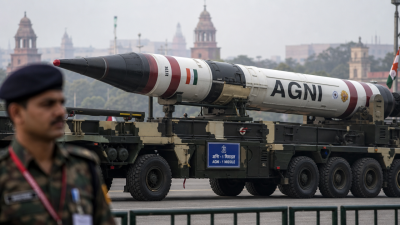
India was recently recorded by SIPRI as having 12 “operationally deployed” nuclear warheads out of an estimated 190. The classification means these warheads are mated to delivery systems and positioned with active forces, affecting deterrence posture, operational readiness and regional strategic stability.
What SIPRI reported and why it matters
- SIPRI finding: 12 warheads classified as “operationally deployed” while India’s estimated total arsenal is 190.
- Meaning: Warheads are paired with delivery systems and ready for use. This raises the force’s readiness level.
- Policy significance: Changes the signalling content of India’s deterrence without altering declared doctrine. It affects crisis calculations by neighbours and external powers.
India’s declared doctrine and strategic aim
- No First Use (NFU): India maintains a commitment not to initiate nuclear use. The commitment was publicly reaffirmed by its representative at the UN.
- Credible Minimum Deterrence (CMD): The objective is to maintain a deterrent sufficient to deny adversary objectives while avoiding large-scale accumulation.
- Second-strike emphasis: Operational readiness of some warheads and the sea-based leg aim to make retaliation survivable and thus sustain NFU credibility.
Operational readiness and delivery systems
Sea-based leg
- SSBN induction: Entry into service of an additional Arihant-class SSBN enhances survivability of Indian deterrent.
- SLBM development: Sea-launched ballistic missile programmes (K-family) support a dispersed and hidden second-strike capability.
Land-based leg
- Canisterised Agni series: Canisterisation provides mobility, longer storage life and faster launch timelines, increasing operational flexibility for land forces.
- Range focus: Development of long-range Agni variants expands targeting reach towards regional peer adversary territories.
Air leg
- Air delivery capability: Aircraft platforms and air-launched systems form the flexible leg of the triad and permit escalation management through selective employment.
| Leg | Means | Recent developments | Operational implication |
|---|---|---|---|
| Sea | SSBNs, SLBMs | Arihant-class additions; SLBM testing | Enhanced survivability and assured retaliation |
| Land | Agni ballistic missiles (canisterised) | Increased canisterisation and long-range variants | Faster deployment and wider reach |
| Air | Strategic aircraft, air-launched missiles | Force readiness and mission flexibility | Discriminatory strike options and surge capability |
Strategic rationale: China and Pakistan
- China as strategic driver: Long-range systems and sea-based survivability address the requirement to deter a larger peer with deep strike capabilities.
- Pakistan as proximate threat: Lower thresholds and short-range dynamics with Pakistan require different operational postures and crisis stability measures.
- Dual pressures: Modernisation therefore balances long-range reach and regional promptness, complicating stability management across two different threat environments.
International context and arms-control environment
- Global trend: SIPRI locates India’s developments within broader nuclear modernisation by multiple states and fraying arms-control arrangements.
- Arms-control implications: Weakening of treaties and stalled negotiations (e.g. FMCT) reduce transparency and increase incentives for capability enhancements.
- Diplomatic posture: India maintains advocacy for disarmament while pursuing security-driven modernisation. Its non-membership of the NPT permanent categories shapes negotiating space.
Implications for governance, force management and crisis stability
- Command, control and safety: Higher readiness requires robust civilian oversight, secure custody arrangements and technical safeguards to prevent accidents or unauthorised use.
- Crisis signalling: Operational deployments increase the need for calibrated strategic communication to avoid misperception by adversaries and third parties.
- Risk of arms dynamics: Enhanced readiness and long-range capabilities can produce action–reaction cycles with neighbours and spur regional procurement responses.
- Confidence-building measures: Hotlines, crisis protocols, data exchanges and restraint measures with Pakistan and China remain necessary to manage escalation.
- Policy trade-offs: Balancing NFU credibility with operational deployments demands transparency where feasible, institutional control, and sustained diplomatic engagement on arms-control forums.
Model Questions
1. Examine the strategic implications of India’s 12 “operationally deployed” nuclear warheads for its Credible Minimum Deterrence strategy and regional security. [GS-III: Internal & External Security]
Currently, operational deployment increases force readiness and the credibility of second-strike under Credible Minimum Deterrence. It strengthens deterrence vis-à-vis China and Pakistan but raises crisis misperception risks. Policy responses should include reinforced command-and-control, calibrated signalling, CBMs with neighbours, and diplomatic engagement to reduce escalation while maintaining required survivable capabilities.
2. Critically analyse India’s No First Use doctrine in the context of ongoing nuclear modernisation and shifting global arms-control regimes. [GS-II: International Relations]
NFU remains India’s stated policy and depends on a credible, survivable second-strike. Modernisation (SSBNs, canisterised missiles) supports NFU by improving retaliation assurance. Yet global erosion of arms-control norms and regional rival modernisation strain NFU’s strategic comfort. Sustaining NFU requires transparent posture signalling, secure C2, and active diplomacy to shape external perceptions and reduce incentives for pre-emption.
3. Discuss the role of India’s nuclear triad, with reference to SSBN induction and canisterised Agni missiles, in enhancing strategic autonomy and deterrent capability. [GS-III: Science & Technology]
A functioning triad disperses risk and ensures assured retaliation. SSBNs provide survivable sea-based deterrence; canisterised Agni missiles increase mobility and launch responsiveness of land forces. Together they raise deterrent survivability and operational flexibility, enabling independent decision-making under duress and reducing vulnerability to first strikes, thereby strengthening strategic autonomy.
4. Assess the significance of SIPRI’s recent classification of India’s warheads in the larger context of global nuclear trends and implications for India’s foreign policy. [GS-II: International Relations]
SIPRI’s classification signals India’s higher readiness within a global pattern of arsenal modernisation and weaker arms-control. For foreign policy, it complicates calls for disarmament but offers leverage in negotiations on strategic stability. India must combine capability development with diplomatic initiatives on risk reduction, arms-control dialogues and multilateral engagement to manage international expectations and regional stability.
Last Modified: July 1, 2026