
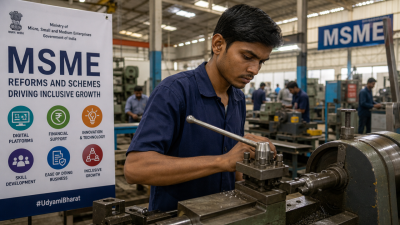
On MSME Day 2026–Udyami Bharat new digital platforms and measures were launched to deepen formalisation, credit access and grievance redressal across the country. Current data place MSMEs at the centre of jobs, manufacturing and exports, with renewed policy and technology tools to widen inclusion.
What is current and why it matters
MSMEs account for about 31.1% of GDP, 35.4% of manufacturing output and 48.58% of exports while employing over 38.9 crore persons. Recent reforms—revised definition, next‑generation digital portals, expanded credit guarantees and targeted regional initiatives—affect governance, employment, industrial competitiveness and export capacity.
Sector significance and contribution
- Macro share: Contributes 31.1% to GDP and 35.4% to manufacturing output.
- Exports: Supplies 48.58% of India’s export basket.
- Employment: Over 38.9 crore persons engaged; strong rural and informal footprint.
- Inclusive outcomes: Source of livelihoods for marginalised groups, artisans and micro‑enterprises across regions.
Policy and regulatory reforms
- Revised MSME definition: Investment plus annual turnover criteria (effective April 2025) permit scale‑up without loss of benefits.
- State action: New state measures such as the Arunachal Pradesh MSME Facilitation Ordinance introduce single‑window loan processing and simpler procedures.
- Regulatory support: Expanded guarantee cover and targetted funds align fiscal tools with revised thresholds.
Key schemes and instruments
| Scheme | Primary objective | Support provided |
|---|---|---|
| PM Vishwakarma | Artisan empowerment | Skill training, toolkits, market access |
| ASPIRE | Rural entrepreneurship | Incubation, mentoring, seed support |
| PMEGP / PMEGP 2.0 | Micro‑enterprise creation | Credit‑linked subsidy; new portal for beneficiary lifecycle |
| MSME Champions & Idea Hackathon 6.0 | Innovation and competitiveness | Financial assistance up to Rs 15 lakh per idea; mentoring |
| SRI Fund | Equity support | Growth capital for scale‑up |
| SFURTI | Traditional clusters | Cluster infrastructure; 513 artisan clusters supported |
Digitalisation, formalisation and language inclusion
- Udyam registration: Over 8.7 crore registrations signal wider formalisation and scheme access.
- Next‑gen portals: PMEGP 2.0 and SAMADHAAN 2.0 streamline beneficiary lifecycle and delayed‑payment grievances.
- Language and AI: Services in all 22 Scheduled Indian languages with AI‑enabled voice grievance redressal and document translation (BHASHINI and NIC partnership) to reduce linguistic barriers.
- Platform ecosystem: Udyam Assist, CHAMPIONS and ODR portals support discovery, competitiveness and dispute resolution.
Finance, credit and risk mitigation
- CGTMSE performance: 29.03 lakh guarantees approved (₹3.77 lakh crore approved Jan–Nov 2025); guarantee ceiling raised from ₹5 crore to ₹10 crore.
- Credit access: Enhanced guarantees and digital loan‑processing aim to reduce collateral constraints for micro and small units.
- RBI engagement: Townhalls and state‑level facilitation focus on last‑mile banking and liquidity for regional MSMEs.
Technology, skills and innovation
- Technology Centres: 18 operational with 20 more under development for skills and tech adoption at scale.
- Idea Hackathon: MSME Idea Hackathon 6.0 offers grants up to Rs 15 lakh to selected proposals to fast‑track technology adoption.
- KVIC and sustainability: New eco‑friendly product lines support value addition in village industries and green livelihoods.
Regional and social inclusion
- North East & Sikkim: Dedicated promotion for industrialisation and cluster support to reduce regional gaps.
- National SC‑ST Hub: Support framework for social inclusion; over 19,000 SC/ST entrepreneurs assisted.
- Cluster approach: SFURTI and Technology Centres target artisanal regions to raise productivity and market linkages.
Grievance redressal and dispute resolution
- MSME Samadhaan: 2,56,892 applications with claims worth ₹55,244.29 crore received; 58,148 cases disposed by June 2026.
- SAMADHAAN 2.0: New portal to speed case processing and integrate with other digital services.
- ODR and AI voice: Online Dispute Resolution and AI voice help reduce time and access barriers to justice for micro and small firms.
Constraints and implementation gaps
- Productivity deficit: Many units remain low‑productivity and technology‑light.
- Informality and scale limits: A large share of employment is informal; many micro firms face ceilings in accessing institutional finance.
- Last‑mile delivery: State capacity, bank outreach and market linkages vary across regions.
- Absorptive capacity: Smaller enterprises face difficulty meeting regulatory and environmental compliance while upgrading.
- Digital divide: Multilingual services reduce barriers, but digital literacy and connectivity gaps persist.
Policy priorities
- Deepen formalisation: Simplify registration and reporting burden while preserving incentives for small units to register.
- Expand tailored finance: Combine enhanced guarantees with venture and equity instruments (SRI Fund) and supply‑chain finance to reach medium‑sized enterprises.
- Scale technology and skill centres: Prioritise cluster‑level technology transfer, apprenticeship models and demand‑driven training.
- Strengthen market access: Public procurement reforms, e‑marketplace integration and export facilitation for MSMEs.
- Improve grievance resolution: Integrate SAMADHAAN 2.0, ODR and AI voice into a single workflow with clear timelines and accountability.
- Measure outcomes: Use dashboards and independent evaluation to track jobs, productivity and survival rates of assisted units.
Model Questions
1. Evaluate the significance of the Micro, Small and Medium Enterprises sector in driving inclusive economic growth in India. Discuss how recent policy reforms and government schemes address structural challenges to foster its expansion. [GS-III: Economic Development]
MSMEs contribute about 31.1% of GDP, 35.4% of manufacturing and 48.58% of exports while employing 38.9 crore people. Reforms—revised definition, enhanced CGTMSE cover, PMEGP 2.0, SRI Fund, MSME Champions—aim to ease access to credit, equity, markets and technology. Digitalisation and cluster‑level interventions target formalisation, productivity and regional inclusion; remaining gaps relate to productivity, last‑mile finance and regulatory compliance.
2. “Digital transformation is key to enhancing the efficiency and reach of government initiatives for the MSME sector.” Elaborate with recent digital platforms and language inclusion measures. [GS-II: Governance]
Udyam registrations exceed 8.7 crore, widening scheme access. PMEGP 2.0 and SAMADHAAN 2.0 streamline lifecycle and delayed‑payment grievances. Services now operate in all 22 Scheduled Indian languages with AI voice and document translation (BHASHINI–NIC), lowering language barriers. CHAMPIONS, Udyam Assist and ODR integrate discovery, competitiveness and dispute resolution, improving speed, transparency and reach across regions.
3. Analyse the role of specific government schemes and regional initiatives in promoting balanced and equitable growth of the MSME sector across India. [GS-II: Social Justice]
PM Vishwakarma and SFURTI support artisans and traditional clusters, KVIC product lines add value to village industries. National SC‑ST Hub backs over 19,000 entrepreneurs. North East & Sikkim programmes and state facilitation ordinances (single‑window loan processing) reduce regional disparities. Cluster‑based technology centres and market linkages help integrate marginalised producers into value chains and public procurement.
4. Assess the impact of financial and technological support mechanisms on the competitiveness and sustainability of Indian MSMEs. [GS-III: Economic Development]
Enhanced CGTMSE guarantees (29.03 lakh guarantees; cover raised to ₹10 crore) improve collateral‑constrained lending. SRI Fund provides equity for scale‑ups. Technology Centres and Idea Hackathon grants (up to Rs 15 lakh) promote adoption and innovation. Combined finance and tech support raise survival, productivity and export potential, though effectiveness depends on delivery capacity, market access and firm‑level absorptive ability.
Last Modified: June 27, 2026