
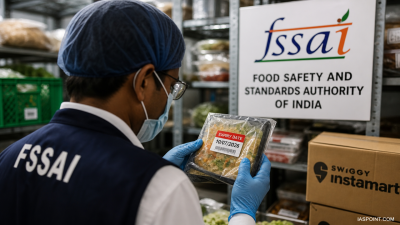
FSSAI issued nine show-cause notices to Swiggy Instamart on 11 July 2026 after consumer complaints alleging delivery of expired, spoiled or contaminated food items. The regulator has asked for a detailed compliance report covering quality assurance, inventory and storage, and warned that unsatisfactory replies may attract action under the Food Safety and Standards Act, 2006.
What is the current issue?
Multiple consumer complaints reported expired or contaminated products delivered via Swiggy Instamart, including Healthify 100% Whey Protein, Akshayakalpa Organic Eggs, Kakke da Paratha, Noice Homestyle Madras Mixture with Peanuts, and contaminated infant formula. FSSAI flagged a licensing irregularity: “NOICE” eggs were marketed under a category not covered by the platform’s existing licence and directed a halt unless covered by a modified licence. Swiggy is reviewing listings and coordinating with authorities. A separate licensing administrative matter concerning Swiggy’s Toing platform was resolved after licence updation.
Why it matters
- Public health: Contaminated or expired food poses direct health risks, especially to infants and immunocompromised consumers.
- Consumer rights and trust: Misbranding, expiry violations and licence lapses erode trust in digital food retail.
- Governance and enforcement: Rapid proliferation of dark stores challenges inspection and regulatory reach.
- Economic impact: Food safety failures can trigger recalls, litigation and reputational loss for platforms and suppliers.
Statutory and regulatory framework
- Primary law: Food Safety and Standards Act, 2006 establishes FSSAI as the statutory regulator.
- Licensing: E‑commerce food business operators require appropriate central licence/registration and must maintain supply‑chain and storage records.
- Standards and enforcement: Regulations cover adulteration, contamination, misbranding, labelling and expiry management; FSSAI issues show‑cause notices and may initiate prosecution or administrative sanctions.
Quick‑commerce model and food‑safety risks
- Dark stores: Decentralised micro‑warehouses speed delivery but increase inspection points.
- Cold‑chain gaps: Inadequate temperature control in storage or transit promotes spoilage of dairy, meat and eggs.
- High turnover & shelf‑life tracking: Rapid inventory rotation can cause expiry tracking failures.
- Packaging/transit damage: Fast last‑mile movement increases risk of physical damage and contamination.
- Traceability: Multiple intermediaries complicate batch tracking and recalls.
Compliance gaps identified in the Swiggy case
- Expired/spoiled items: Consumer receipts of expired whey protein and spoiled dairy.
- Contaminated products: Reports of contaminated infant formula and rotten eggs.
- Licensing irregularity: NOICE eggs listed under a product category not covered by the platform’s licence; regulator ordered halt.
- Record and QA shortfalls: FSSAI demanded stock, storage, hygiene and quality assurance records for verification.
Regulatory enforcement challenges
- Inspection capacity: Thousands of dark stores exceed current state and municipal inspection resources.
- Liability ambiguity: Distinguishing responsibility among manufacturer, merchant and platform is legally complex.
- Information asymmetry: Consumers cannot inspect expiry, batch or licence details before delivery without mandated disclosures.
- Jurisdictional coordination: Dark stores, delivery partners and sellers may operate across state boundaries, complicating enforcement.
Stakeholder responsibilities (comparison)
| Stakeholder | Primary responsibilities |
|---|---|
| Manufacturer | Product safety, correct labelling, batch records, recalls. |
| Merchant/seller | Maintain storage conditions, expiry checks, accurate product listing. |
| Platform (inventory‑led) | Ensure vendor onboarding, display licence/batch info, monitor dark stores, delist unsafe stock. |
| Delivery partner | Preserve transit conditions, report damaged goods, follow SOPs for perishables. |
| Regulator (FSSAI) | Licence oversight, inspections, show‑cause notices, prosecutions, standards. |
Policy and regulatory measures — practical prescriptions
- Mandatory digital disclosures: Product listing must show manufacturing date, expiry date, batch number and FSSAI licence number before purchase.
- Automated inventory controls: Enforce FIFO, auto‑block near‑expiry SKUs and require audit logs for removals.
- Licence regime for dark stores: Require registration/licence for micro‑warehouses and periodic renewal tied to audits.
- Temperature monitoring: Mandate in‑store sensors and tamper‑evident, temperature‑logged delivery bags for perishables.
- Third‑party audits: Compulsory independent food‑safety audits for platform‑operated and merchant dark stores.
- Clear liability norms: Amend regulations to define legal responsibility for aggregators, inventory‑led platforms and marketplace models.
- Traceability & data sharing: Require electronic batch tracing and API‑based data access for regulators to enable rapid recalls.
- Grievance and recall mechanism: Mandate in‑app grievance redressal with timelines and visible recall notices.
- Capacity building: Strengthen state food safety officers, create rapid response teams for digital food incidents.
Corporate governance and ethics for platforms
- Safety KPIs: Integrate product‑safety metrics into delivery targets and executive scorecards.
- Independent QA: Maintain an independent quality assurance unit and periodic external certification.
- Vendor governance: Standardise on‑boarding checks, periodic revalidation and penalty clauses for non‑compliance.
- Transparency & recall policy: Publicly accessible recall procedures and timely consumer compensation rules.
- Training and whistleblowing: Train staff and delivery partners; establish whistleblower channels for safety lapses.
Implementation checklist for regulator and platforms
- Mandate pre‑purchase digital disclosure and enforce via app store compliance audits.
- Roll out licence requirement and audit schedule for dark stores; publish registry.
- Require temperature‑logging devices and integrate telemetry data with FSSAI dashboards.
- Issue model SOPs for packaging, dispatch and last‑mile handling of perishables.
- Define statutory liability for different platform models and incorporate in regulations.
- Conduct joint state‑centre capacity building and deploy rapid response inspection teams.
Model Questions
1. Discuss the regulatory challenges faced by FSSAI in monitoring quick‑commerce platforms and suggest measures to strengthen statutory oversight. [GS-II: Governance]
FSSAI faces inspection capacity gaps, proliferation of dark stores, jurisdictional fragmentation and liability ambiguity. Strengthen oversight by mandating registration/licence for dark stores, deploying real‑time digital audits and telemetry, requiring automated FIFO inventory systems, prescribing temperature standards for transit, mandating API-based data sharing for traceability, and increasing state inspection capacity with targeted training and rapid response teams.
2. Analyse the supply‑chain vulnerabilities of the dark‑store rapid‑delivery model with respect to food safety and quality preservation. [GS-III: Economic Development]
Vulnerabilities include inadequate cold chain, poor expiry tracking, transit damage, and weak traceability. Mitigation requires temperature‑controlled storage and delivery, sensor‑based monitoring, automated inventory and expiry‑blocking, pre‑dispatch quality checks, standardised packaging and SOPs, third‑party audits of dark stores, and end‑to‑end batch tracing to enable rapid recalls and liability assignment.
3. Examine the implications of misbranding, unlicensed product sales and delivery of expired food items for consumer rights and public health. [GS-II: Governance]
Such compliance gaps risk acute and chronic health harms, especially for infants and vulnerable groups, and violate consumer rights to safe goods and accurate information. They erode trust, increase liability, and impose public health costs. Remedies include visible in‑app licence and batch details, mandatory recall procedures, stricter penalties, consumer compensation norms and strengthened grievance redressal with regulator oversight.
4. In the quick‑commerce sector, how should platforms reconcile the ethical conflict between hyper‑speed delivery and ensuring product safety? Propose a corporate responsibility framework. [GS-IV: Ethics, Integrity and Aptitude]
Platforms must balance speed with safety by embedding safety metrics into KPIs, enforcing zero‑tolerance for expired or misbranded items, conducting independent QA audits, training staff, and ensuring transparent recalls and compensation. Corporate policy should require vendor revalidation, publish safety reports, incentivise compliance via performance metrics, and maintain whistleblower channels to surface violations promptly.
Last Modified: July 13, 2026