
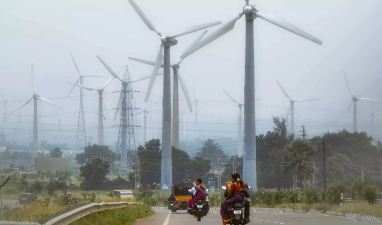
Recently, the Ministry of New and Renewable Energy hosted the Global Wind Day 2026 Conference in Goa under the theme “Wind Energy: From Ambition to Acceleration.” The event brought policymakers, manufacturers and experts together to address grid readiness, capacity expansion, supply chains, offshore development and export opportunities.
Why wind energy matters for governance and economy
Policy and targets
Wind power is integral to India’s Panchamrit pledge of 500 GW non-fossil capacity by 2030 and net‑zero by 2070. The Ministry has set medium‑term wind targets of 100 GW by 2030 and 155 GW by 2035. Central instruments include the Generation Based Incentive (GBI), a 500 MW CfD pilot and a ₹6,853 crore VGF for initial offshore capacity.
Resource potential and spatial distribution
National estimates
NIWE uses over 900 monitoring stations for resource assessment. Gross technical potential is 695.5 GW at 120 m hub height and 1,163.9 GW at 150 m hub height, indicating large underutilised onshore resources.
State concentration (150 m hub height)
| State | Estimated Wind Potential at 150m (GW) |
| Rajasthan | 284.2 |
| Gujarat | 180.8 |
| Maharashtra | 173.9 |
| Karnataka | 169.3 |
| Andhra Pradesh | 123.3 |
| Tamil Nadu | 95.1 |
| Madhya Pradesh | 55.4 |
| Telangana | 54.7 |
Capacity growth, manufacturing and exports
Installation trajectory
India is fourth worldwide in installed wind capacity. Cumulative installations reached 56.09 GW by March 2026. Another 28 GW is under implementation. Annual additions hit a record 6.05 GW in 2025–26, up from 4.15 GW the year before.
Manufacturing and indigenisation
- Domestic capacity: Manufacturing throughput is about 24 GW per year.
- Indigenisation: Major components show 70–80% domestic content for blades, towers and gearboxes.
- Export potential: Strengthened manufacturing and international supply chains aim to open export markets for turbines and components.
Grid integration and system operation
Balancing profile
Wind complements solar by supplying a larger share of energy during evening demand peaks. Nearly 45% of wind generation occurs in these higher‑demand hours, aiding system reliability.
Operational measures
- RTC bidding: New central bidding guidelines require combining wind, solar and storage to provide firm round‑the‑clock power to state utilities.
- Grid readiness: Focus areas include transmission augmentation, forecasting, flexibility services and regional scheduling to integrate higher wind shares.
Offshore wind: finance, sites and partnerships
The Union has approved ₹6,853 crore in VGF to support the first 1,000 MW of offshore wind, split between marine leasing zones off Gujarat and Tamil Nadu. Offshore deployment targets port upgrades, specialised vessels and grid interconnection investments.
International cooperation
- India–UK Offshore Wind Taskforce: Launched under Vision 2035 to collaborate on port infrastructure, blended finance and technology transfer.
- India–Belgium engagement: Renewed technical cooperation on green taxonomy and offshore research to align standards and project economics.
Policy instruments and financial mechanisms
- GBI: Central GBI supported operational projects; ₹500 crore disbursed in 2025–26 to back revenues.
- CfD pilot: A 500 MW pilot guarantees pre‑agreed prices via state balancing payments to reduce developer revenue risk.
- VGF: Capital subsidy for offshore auctions to make early projects bankable.
Challenges and policy responses
| Challenge | Policy / technical response |
| Grid constraints | Transmission expansion, improved forecasting, flexibility markets and state‑regional coordination for scheduling. |
| Financing risks | CfD pilots, VGF, blended finance from multilateral and bilateral partners, and longer‑tenor loans. |
| Supply‑chain gaps | Incentives for local manufacturing, skill development, and standards for offshore components. |
| Land & permitting | State‑centre coordination, single‑window clearances and standardised leasing frameworks. |
| Offshore capability | Port upgrades, vessel availability, environmental clearances and interstate transmission planning. |
Federal and governance implications
Spatial concentration of potential requires state‑specific land, environmental and grid planning. Central schemes (GBI, CfD, VGF) provide fiscal support; states must enable land allocation, local permits and grid evacuation. Effective federal coordination is needed for permitting harmonisation, transmission planning and revenue sharing for coastal communities.
Operational priorities for accelerating deployment
- Grid investment: Prioritise intra‑state and inter‑state transmission corridors and real‑time forecasting systems.
- Financing instruments: Scale CfD, expand VGF design for phased offshore roll‑out and mobilise blended finance.
- Manufacturing: Support component makers for higher indigenisation and export competitiveness.
- Skill and logistics: Develop port infrastructure, O&M bases and specialised maritime capacity for offshore projects.
- Regulatory certainty: Standardise auction terms, land leases and environmental criteria to reduce transaction costs.
Model Questions
- Examine the policy and institutional framework that has supported wind energy development in India and assess their effectiveness in meeting national climate and energy targets. [GS-III: Economic Development]
- Identify the main technical, financial and institutional challenges in scaling wind energy in India and suggest measures to accelerate deployment from ‘ambition to acceleration’. [GS-III: Environment & DM]
- Analyse the strategic importance of offshore wind for India and the role of international collaboration in enabling its deployment. [GS-II: International Relations]
- Assess the spatial distribution of wind resources and installed capacity in India and explain federal governance challenges for project implementation. [GS-III: Economic Development]
Discuss Panchamrit and MNRE wind targets; role of NIWE, MNRE, GBI, CfD pilot and VGF; record additions and current capacity (56.09 GW); evaluate gaps — financing, grid readiness and implementation pace; recommend strengthening CfD scale‑up, transmission investment, state facilitation and blended finance to bridge target shortfalls.
List challenges: grid constraints, forecasting, financing risk, supply‑chain gaps, land and permitting, offshore capability. Propose measures: transmission upgrades, flexibility markets, expand CfD/VGF, blended finance, local content support, single‑window clearances, port upgrades and skill development to reduce project delays and costs.
Explain offshore benefits: large near‑coast resource, higher capacity factors, proximity to demand centres. Note VGF for first 1,000 MW, targeted zones off Gujarat and Tamil Nadu. Describe India–UK Taskforce and Belgium cooperation for finance, ports and R&D. Recommend partnerships for technology transfer, standards and blended finance.
Present NIWE estimates and state concentration (Rajasthan, Gujarat, Maharashtra, Karnataka, Andhra, Tamil Nadu, MP, Telangana). Contrast with installation leadership (Gujarat, Tamil Nadu, Karnataka). Discuss federal issues: land, grid evacuation, approvals and revenue sharing; propose coordinated transmission planning, standard leases and state incentive alignment.