
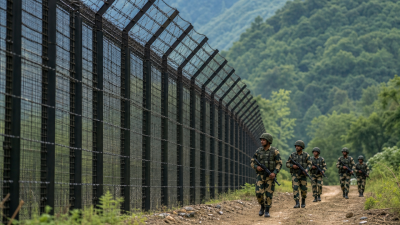
Union Home Minister Amit Shah recently set out a roadmap for a “Smart Border” framework that integrates technology, district-level governance, community engagement and central agencies. The plan includes a ₹31,000 crore programme to fence the 1,610-km India–Myanmar border, expanded border infrastructure and complementary social and demographic measures.
What is the issue and why it matters
India faces persistent threats from illegal infiltration, narcotics trafficking, proxy warfare and transnational organised crime along its land frontiers. The Smart Border initiative reconfigures border management from isolated posts to an integrated grid combining security, governance, development and technology. Implications cover internal security, local livelihoods, bilateral ties with Myanmar, environmental impact and resource allocation.
Smart Border: strategy and institutional design
- Core objective: Create an infiltration‑free India by combining hard and soft measures.
- Quadrangular security network: Border‑guarding forces, State and district administrations, Central agencies (Ministry of Home Affairs, Union Home Secretary-led coordination), and local communities.
- Operational shift: Move from isolated border outposts to an integrated, district‑level security grid with real‑time surveillance and unified response protocols.
- Governance forum: Land Border Districts’ Superintendents of Police Conference institutionalises district coordination and reporting.
- International coordination: Regular India–Myanmar border coordination meetings; Myanmar has given assurances against use of its territory for activities detrimental to India’s security.
| Stakeholder | Primary role |
|---|---|
| Border‑guarding forces (Assam Rifles, Army in sensitive sectors) | Physical security, manning fencing, patrols, rapid interdiction |
| State and district administration | Local intelligence, development delivery, law and order, coordination with communities |
| Central agencies (MHA, Home Secretary, technical agencies) | Policy, funding, technology acquisition, inter‑governmental liaison |
| Local communities | Informal surveillance, reporting, social acceptance, livelihood support |
India–Myanmar fence project: scope, rationale and status
- Scope and cost: Continuous fencing along the entire 1,610‑km India–Myanmar border; estimated cost approximately ₹31,000 crore.
- Stated objectives: Prevent illegal infiltration, counter proxy warfare, curb narcotics and smuggling, deter drone and organised crime threats, and address demographic pressures in border districts.
- Geographical focus: Sectors in Arunachal Pradesh, Nagaland, Manipur and Mizoram require different engineering and security approaches due to terrain and settlement patterns.
- Diplomatic context: The 23rd National‑Level Border Coordination Meeting reaffirmed Myanmar’s commitment not to allow its territory to be used against India’s security interests; bilateral cooperation will be needed for fencing, patrols and intelligence sharing.
Practical constraints
- Terrain and logistics: Dense forests, hills, rivers and landslide zones complicate construction, supply lines and maintenance.
- Socio‑cultural impact: Fencing may disrupt ethnic ties, customary movements and local economies. It could affect arrangements often described as Free Movement Regimes and informal cross‑border trade.
- Environmental concerns: Forest fragmentation, wildlife corridors and hydrological effects require environmental clearances and mitigation plans.
- Operational sustainability: Long‑term maintenance, repair, and funding commitments are necessary after construction completion.
Socio‑economic and demographic measures
- Vibrant Villages Programme: Prevents out‑migration by creating local employment, improving connectivity and ensuring welfare delivery in remote border settlements. Intended outcomes include stronger local state presence and improved economic resilience.
- Demography Mission: Desk and field‑level mechanism to detect abnormal demographic shifts, identify causes and recommend corrective measures. Emphasis on timely grassroots reporting and district‑level analysis.
- Security rationale: Development and demographic monitoring reduce recruitment pools for insurgents, improve human intelligence and increase local cooperation with security agencies.
Role of science and technology
- Key tools: AI‑enabled video analytics, digital monitoring networks, smart ground sensors, anti‑drone systems, satellite imagery and integrated command‑and‑control platforms.
- Operational benefits: Real‑time situational awareness, automated detection of intrusions, reduced response time and persistent monitoring of inaccessible stretches.
- Integration requirements: Interoperability standards, secure data pipelines, district‑level dashboards, training for personnel, and procedures for civilian data protection.
- Limitations: False positives, sensor maintenance in hostile climates, power and connectivity constraints, procurement timelines and lifecycle costs.
Challenges and mitigation measures
| Challenge | Mitigation |
|---|---|
| Diplomatic friction and bilateral dependence | Regular border coordination, joint patrol protocols, intelligence sharing and capacity building with Myanmar |
| Local displacement and community alienation | Community consultation, compensation, local employment under construction and maintenance contracts, extension of welfare schemes |
| Environmental damage | Strategic environmental assessments, seasonal construction windows, wildlife crossings and afforestation plans |
| Operational sustainability and costs | Dedicated maintenance budgets, technology audits, local logistics hubs and use of simpler mechanical solutions where suitable |
| Legal and human rights concerns | Clear SOPs, grievance redressal, judicial oversight where required and coordination with human rights bodies |
Policy implications for governance and security
- District empowerment: Successful implementation requires capable district administrations, properly resourced police and clear reporting lines to central agencies.
- Budgetary prioritisation: Large capital expenditure must be balanced with recurring costs for maintenance, technology upgrades and development schemes.
- Measurement and accountability: Define performance indicators — reduction in illegal entries, narcotics interceptions, local employment rates and community satisfaction indices.
- Whole‑of‑society approach: Sustained community engagement and transparent grievance mechanisms are necessary for legitimacy and long‑term stability.
Model Questions
1. Analyse the “Smart Border” initiative as a holistic approach to securing India’s land frontiers, highlighting its multi‑pronged strategy and the integration of diverse stakeholders. [GS-III: Internal & External Security]
Answer: The Smart Border combines a quadrangular grid—border forces, state/district administrations, central agencies and local communities—with technology (AI surveillance, sensors, anti‑drone systems) and development (Vibrant Villages). District‑level coordination and Demography Mission provide local intelligence. Benefits include faster detection, reduced infiltration and strengthened governance; constraints include terrain, maintenance costs, data management and need for sustained community engagement.
2. Examine the strategic imperatives behind the India–Myanmar fence project and its potential challenges for bilateral relations and local communities. [GS-II: International Relations]
Answer: Strategic imperatives are to curb illegal infiltration, proxy warfare, narcotics and smuggling and to stabilise border districts. Challenges include disruption of ethnic ties and informal cross‑border movement, environmental impact, difficult terrain and dependence on Myanmar’s cooperation. Mitigation requires joint coordination, calibrated fencing in sensitive zones, community consultations, compensation and integrated development measures to preserve bilateral trust.
3. How do socio‑economic development programmes and demographic analysis contribute to India’s “Smart Border” strategy? Discuss the objectives and expected outcomes of initiatives like the Vibrant Villages Programme and the Demography Mission. [GS-II: Governance]
Answer: Development and demographic tools address root causes of insecurity. Vibrant Villages aims to prevent out‑migration by creating local jobs, improving connectivity and ensuring welfare, thereby strengthening state presence. The Demography Mission monitors abnormal population shifts and recommends corrective action. Combined, they reduce recruitment pools for violence, improve human intelligence and foster local buy‑in; success depends on sustained funding and effective local administration.
4. Evaluate the role of scientific and technology‑driven methods in strengthening India’s border security under the “Smart Border” initiative. What are the key technological interventions and their implications? [GS-III: Science & Technology]
Answer: Key interventions include AI‑enabled video analytics, smart ground sensors, anti‑drone systems, satellite imagery and integrated digital dashboards. These provide real‑time detection, faster response and persistent monitoring of remote stretches. Implications include improved situational awareness and deterrence, but also demands for data security, interoperability, training, maintenance and measures to reduce false positives. Technology must integrate with human intelligence and district command structures.
Last Modified: July 11, 2026