
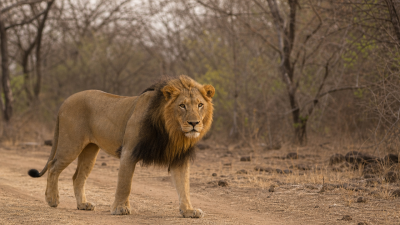
As of now the Asiatic lion census records 891 individuals, all confined to Gujarat’s Saurashtra. A decade-long impasse over the Supreme Court’s 2013 directive to translocate lions to Kuno remains unresolved, raising conservation, governance and habitat-threat concerns.
Issue in brief
The core issue is failure to establish a geographically separate second population for the Asiatic lion despite a 2013 Supreme Court judgment directing translocation to Kuno National Park. Kuno was prepared for lions but received cheetahs instead. Gujarat continues to resist sharing its lions, citing local sentiment and habitat concerns. Project Lion exists to expand habitats but has not resolved the single-site risk.
Why this matters
- Environmental risk: A single-site population is vulnerable to disease, extreme events and genetic bottlenecks.
- Governance: Non‑implementation of a Supreme Court directive exposes gaps in federal-state coordination and policy execution.
- Social and ethical: State identity claims conflict with national conservation responsibilities and species survival priorities.
- Economic and livelihood: Continued habitat threats (mining, illegal resorts) affect tourism, local livelihoods and ecosystem services.
Genesis of the impasse
The Supreme Court ordered translocation to Kuno to create a distant population. Kuno underwent village relocation and habitat restoration. No lions were moved. Gujarat resisted on grounds of local pride and habitat suitability. The Centre reportedly reconsidered its translocation strategy recently. Meanwhile cheetahs were introduced to Kuno, marking a departure from the original plan.
Ecological and scientific imperatives
- Single‑site vulnerability: Concentration of 891 lions in one region raises extinction risk from epidemics, extreme weather or a large‑scale accident.
- Disease precedent: Canine Distemper Virus outbreak in 2018 killed over 30 lions in Gir, illustrating pathogen risk.
- Genetic concerns: Long‑term genetic viability requires metapopulation structure and gene flow between separate populations.
- Site selection: Experts reject nearby alternatives such as Barda because proximity to Gir does not provide true geographic risk diversification.
Federal and governance challenges
- Judicial directive vs implementation: A Supreme Court order has not been executed over a decade, showing limits of judicial remedies without cooperative federal mechanisms.
- State autonomy: Gujarat’s refusal exposes tensions between state control of natural resources and national biodiversity obligations.
- Policy fragmentation: Centre’s altered strategy and redirection of Kuno to cheetahs indicate policy drift and weak inter‑agency coordination.
- Enforcement gaps: Lack of binding timelines, incentives or dispute‑resolution protocols for translocation stalled action.
Project Lion: scope and limits
Project Lion (approved budget ₹2,927.71 crore) aims to expand lion habitat, strengthen disease surveillance and support community measures. The scheme does not currently resolve the core need for a distant second population because state resistance and choice of local alternatives limit risk diversification. Project Lion’s success depends on integrating translocation with legal, financial and social measures to overcome political resistance.
Threats to Gir ecosystem and habitat management
- Development pressures: Proposed mining, illegal resorts and corridor disruption increase habitat fragmentation and human‑wildlife conflict.
- Forest diversion: Experts note no net addition of forest area in Gujarat for 15–20 years, and around 1,560 proposals for forest land diversion have been submitted, weakening habitat security.
- Connectivity loss: Corridor disruption undermines seasonal movement and prey dynamics, raising local stress on lion populations.
Social and ethical dimensions
- Local sentiment: Pride and identity linked to Gir shape political resistance to sharing lions.
- Ethical duty: State governments and the Centre share responsibility for species listed under the Wildlife Protection Act and national biodiversity commitments.
- Human costs: Translocation planning involves village relocation and livelihood adjustments, which require fair compensation and livelihood restoration.
Way forward — operational measures
| Challenge | Action | Rationale |
|---|---|---|
| State resistance | Structured dialogue, incentives, benefit‑sharing and legally binding timelines | Reduces political cost, builds local buy‑in |
| Judicial non‑implementation | Constitute an empowered inter‑governmental committee with clear mandate and penalties for delay | Ensures accountability and coordinated action |
| Disease and disaster risk | Establish separate metapopulation with phased translocation, strengthened disease surveillance and contingency plans | Improves species resilience |
| Habitat loss in Gir | Halt non‑essential forest diversion, restore corridors, regulate tourism and mining | Protects core habitat and reduces conflict |
| Community impact | Compensation, alternative livelihoods, participatory management and revenue sharing | Secures social legitimacy |
Institutional and legal levers
- Use existing law: Enforce provisions of the Wildlife Protection Act and the Biological Diversity Act for inter‑state action.
- National plans: Align Project Lion with the National Wildlife Action Plan and National Biodiversity targets to prioritise translocation.
- Scientific oversight: Independent expert panels to set site‑selection criteria and monitor outcomes.
- Monitoring and finance: Ring‑fenced funds, performance‑linked releases and third‑party audits for habitat and translocation work.
Model Questions
1. Analyse the governance and federal challenges that have hindered implementation of the Supreme Court’s directive to establish a second Asiatic lion population at Kuno. [GS-II: Governance]
Delayed compliance reflects tensions between state autonomy and national conservation obligations. Root causes include Gujarat’s political resistance, absence of binding enforcement mechanisms, policy shifts (Kuno repurposed), weak inter‑governmental dispute resolution and inadequate incentives. Remedies include a statutory inter‑state committee, time‑bound action plans, fiscal incentives, legal enforcement under wildlife laws, stakeholder consultations and independent scientific oversight to align political will with national biodiversity goals.
2. Examine the environmental risks of maintaining the Asiatic lion as a single‑site population and justify the scientific case for a geographically separate second population. [GS-III: Environment & DM]
Single‑site concentration raises extinction risk from epidemics, extreme events and habitat catastrophe. The 2018 CDV outbreak that killed over 30 lions demonstrates pathogen vulnerability. Genetic bottlenecks and demographic stochasticity reduce long‑term viability. A geographically separate population provides risk diversification, enables gene flow through managed translocations or metapopulation planning, and buffers the species against localised threats, thereby improving overall resilience.
3. Evaluate Project Lion’s capacity to resolve the Asiatic lion conservation impasse and suggest measures to strengthen its effectiveness. [GS-III: Environment & DM]
Project Lion allocates ₹2,927.71 crore for habitat expansion and surveillance, yet it cannot by itself overcome political resistance to distant translocation. Limitations include reliance on state cooperation and preference for nearby sites like Barda. Strengthening the project requires prioritising true geographic diversification, conditional funding linked to translocation milestones, legal safeguards against forest diversion, corridor restoration, and community compensation schemes to secure local support.
4. Discuss the ethical conflict between regional sentiment and national conservation imperatives in the Asiatic lion case and propose a balanced way forward. [GS-IV: Ethics, Integrity and Aptitude]
Ethical conflict arises when regional identity and ownership claims oppose species‑level survival needs. A balanced approach combines respect for local sentiment with duty to protect biodiversity: transparent consultations, fair compensation, benefit‑sharing from tourism revenues, phased translocation with community safeguards, independent oversight and adherence to scientific criteria. This balances moral obligations to current communities with intergenerational obligation to preserve an endangered species.
Last Modified: July 6, 2026