
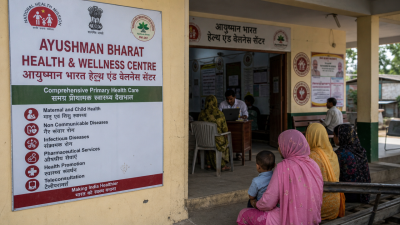
Recently, the Jammu and Kashmir hospitals association reiterated plans to de‑empanel from PM‑JAY/SEHAT from 1 July 2026. At the same time ABDHM reports over 863 million ABHA accounts and 426 million teleconsultations in 2025, while Ayushman Arogya Mandirs face role ambiguity and service gaps.
What is at issue
Ayushman Bharat combines three pillars: Ayushman Arogya Mandirs (AAMs) for primary care, PM‑JAY for secondary/tertiary hospitalisation, and ABDHM for digital health infrastructure. Recent developments expose gaps across mandate clarity, finances, service quality and the translation of digital tools into care.
Why it matters for governance and society
- Access and equity: A large ‘missing middle’ (40–50 crore people) remains uninsured and vulnerable to medical bankruptcy.
- Service delivery risk: Provider withdrawals and delayed payments threaten hospital participation and patient access.
- Policy coherence: Ambiguity in primary care roles can divert attention from population health needs such as nutrition, maternal and child health, and chronic disease control.
- Public resources: Large public expenditure on digital systems requires outcome justification beyond account counts.
Ayushman Arogya Mandirs (AAMs) — mandate and delivery
Over 1.84 lakh centres are operational. The reform converted existing SCs, PHCs and CHCs by adding a Health and Wellness Centre prefix. That conversion created uncertainty about distinct mandates for preventive, promotive and curative tasks.
Key operational weaknesses
- Mandate ambiguity: Staff and managers report unclear role definitions between routine public health work and individual wellness services.
- Shift in focus: Policy emphasis on individual well‑being risks deprioritising measurable population health programmes such as nutrition, antenatal care and chronic disease screening.
- Infrastructure gaps: Physical facilities, uninterrupted medicine supply and referral linkages remain weak in many centres.
PM‑JAY: financial and institutional pressures
PM‑JAY faces recurring implementation stresses that affect sustainability and trust.
Recent and structural problems
- Provider finance: Delayed claim settlements and inadequate package rates have led to provider protests and planned de‑empanelment (e.g., JKPHDA action from 1 July 2026).
- Fraud and quality: The scheme has faced fraud, poor clinical quality and delayed payments, imposing costs on patients and hospitals.
- Coverage gap: The ‘missing middle’ remains outside PM‑JAY due to income criteria and cannot afford private insurance.
- Federal roll‑out: West Bengal recently joined PM‑JAY as the 36th State/UT, extending potential benefits to about 1.43 crore families.
ABDHM: digital reach versus health outcomes
ABDHM has created over 863 million digital health accounts (ABHA) and supported over 426 million teleconsultations in 2025. These are large adoption figures but they are process metrics, not outcome measures.
Principal challenges
- Access gap: Unequal internet and smartphone access constrains rural uptake.
- Infrastructure: Poor connectivity and limited local digital capacity reduce the usefulness of telemedicine and registries.
- Data privacy: Privacy and governance of health data remain concerns requiring legal and technical safeguards.
- Outcome evidence: Large public spending on ABDHM lacks clear evidence that digital databases alone improve hospital, doctor or medicine availability.
Policy and public‑health implications
- Population versus individual metrics: Moving evaluation from population health outcomes to individual wellness can obscure structural determinants such as nutrition, sanitation and social determinants.
- Supply‑side weakness: Strengthening public sector provision is required; digital tools cannot substitute for scarce beds, trained clinicians or medicines.
- Financial sustainability: Timely payments and realistic tariffs are necessary to keep private providers engaged while public capacity expands.
Way forward — targeted measures
| Challenge | Action | Responsible agent |
|---|---|---|
| Mandate ambiguity at AAMs | Define a concise service package with role profiles, staffing norms and performance indicators for population health tasks. | MoHFW; State health departments; district health offices |
| Primary care inputs | Capital and recurrent funding for facility upgrades, medicine procurement, diagnostics and referral transport. | Union and State budgets; NHM funds |
| PM‑JAY financial stress | Timely claim settlement mechanism, actuarial review of package rates, escrow or working‑capital support for hospitals. | National Health Authority; State implementing agencies |
| Fraud and quality | Strengthen audit, e‑claims analytics, standard treatment guidelines and clinical audits. | NHM, NHA, State quality cells |
| Missing middle | Design subsidised contributory schemes, micro‑insurance or targeted vouchers for informal workers. | Ministry of Labour, NHA, State governments |
| ABDHM outcome gap | Mandate outcome indicators, integrate digital IDs with supply chains, invest in rural connectivity and digital literacy, and enact strong data‑protection rules. | MeitY, MoHFW, TRAI, State IT cells |
Model Questions
1. Critically examine the challenges in achieving Universal Health Coverage in India through the Ayushman Bharat initiatives, focusing on structural and implementation gaps in Ayushman Arogya Mandirs and PM‑JAY. [GS-II: Governance]
UHC via Ayushman Bharat faces mandate ambiguity at AAMs, a policy tilt from population health to individual well‑being, weak facility infrastructure, irregular medicine supplies and poor referral systems. PM‑JAY suffers delayed claim settlements, inadequate package rates, fraud and provider exits (e.g., JKPHDA). Addressing these requires clarified primary care roles, assured public financing, timely reimbursements, fraud controls and schemes for the ‘missing middle’.
2. Analyse the effectiveness of the Ayushman Bharat Digital Health Mission in improving actual healthcare access and outcomes, and suggest measures to bridge the gap between digital adoption and service delivery. [GS-III: Science & Technology]
ABDHM shows large uptake (863 million ABHA IDs; 426 million teleconsultations in 2025) but digital reach alone does not secure beds, clinicians or medicines. Key constraints are the digital divide, weak rural connectivity and data privacy risks. Measures include rural broadband and device access, digital literacy, interoperable standards, legal privacy safeguards, integration with primary‑care supply chains and outcome metrics linking digital use to health improvements.
3. Discuss the implications of converting existing sub‑centres, PHCs and CHCs into Ayushman Arogya Mandirs for public health policy and grassroots service delivery. [GS-II: Governance]
The conversion created role confusion by adding a wellness prefix to existing centres. This risks diverting effort from preventive and population health programmes (nutrition, maternal and child health, chronic disease control). Grassroots problems include weak infrastructure, irregular medicines and poor referral linkages. Policy must define service packages, staffing norms, supply chains, referral protocols and community health indicators to preserve population health duties.
4. Assess the economic and institutional factors that threaten the sustainability of PM‑JAY, with reference to recent developments and provider behaviour. [GS-III: Economic Development]
PM‑JAY sustainability is threatened by delayed payments, low package rates and fraud. Provider responses include de‑empanelment threats (e.g., JKPHDA) that reduce access. Economic fixes include timely claim settlement, actuarial revision of tariffs and working‑capital support. Institutional reforms require stronger fraud detection, transparent audits, grievance mechanisms and simultaneous investments to expand public sector capacity and cover the ‘missing middle’.
Last Modified: June 25, 2026