
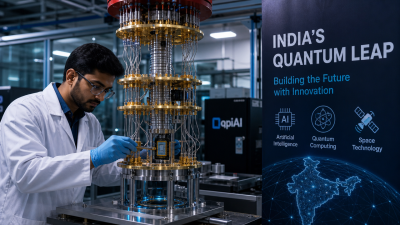
India is shifting focus from invention to scaling in AI, quantum and space. Recent commitments — a ₹6,003 crore National Quantum Mission, IndiaAI infrastructure, state Centres of Excellence and demonstrator milestones such as a 64‑qubit processor and a 1,000 km quantum link — frame the challenge: build globally competitive enterprises from domestic innovation.
What is the issue
Core problem
- Gap: India can invent but struggles to convert prototypes into exportable, high‑value firms at global scale.
- Policy response: Large mission outlays (National Quantum Mission, IndiaAI), state CoEs and private‑academic hubs aim to close the gap.
Why it matters
- Governance: Secure quantum links and AI platforms affect national security, critical infrastructure and public services.
- Economy: Scaling deep tech can create high‑value employment and export earnings.
- International relations: Leadership in quantum and space strengthens strategic partnerships and tech diplomacy.
- Society: Affordable, scalable solutions expand access to services and lower costs.
Historical context and lessons learned
- SCL (1970s): Early semiconductor effort failed to achieve global competitiveness due to limited capital, scale and policy support.
- ECIL (1967): Delivered strategic electronics and indigenous computers but prioritised strategic needs over commercial market scale.
- Positive models: Pharmaceutical exports, PARAM supercomputing and digital public goods (Aadhaar, UPI) show India can scale cost‑effective solutions to global impact.
- Lesson: Systemic support for scale, market development and capital is as important as research and invention.
Policy framework and institutional mechanisms
- National Quantum Mission (NQM): Committed ₹6,003 crore to develop up to 1,000‑qubit machines and a 2,000 km quantum communication network; four thematic hubs involve 43 organisations and 17 startups.
- IndiaAI Mission: Outlay over ₹10,300 crore to build indigenous AI computing infrastructure, including a common facility with >38,000 GPUs.
- State initiatives: Kerala launched AI Centres of Excellence; Andhra Pradesh created an AI & Quantum Centre in Amaravati Quantum Valley; Karnataka opened a state Centre for Space Technology.
- Private‑academia hubs: Startups and universities are forming training and commercialisation hubs (example: Chinar Quantum AI with Christ University).
Key achievements
- Quantum: QpiAI’s 64‑qubit superconducting processor “Kaveri” and an early demonstration of a 1,000 km secure quantum communication link.
- AI: IndiaAI common computing facility plans and state CoEs to broaden access to compute and datasets.
- Space: Chandrayaan and Mangalyaan show frugal mission design; states and Centre promote orbital computing, space AI and space‑based communications.
- Systems success: PARAM, Aadhaar and UPI show how public procurement, standards and wide adoption can create global platforms.
Challenges in scaling and commercialisation
- Capital and continuity: Deep tech requires sustained, patient capital beyond initial grants. Scale investments must match global competitors.
- Market creation: Limited domestic demand for high‑end quantum and space services slows revenue pathways for startups.
- Talent shortage: Shortage of specialised engineers and researchers in quantum hardware, cryogenics, superconducting qubits and space‑orbital computing.
- Manufacturing ecosystem: Semiconductor and precision hardware supply chains remain weak for quantum and satellite components.
- Commercialisation gap: Weak industry‑academia handoffs, low venture capital for deep tech and immature IP commercialisation routes.
- Standards and regulation: Need for technical standards, export controls, data and cryptography rules that balance security and cooperation.
Frugal innovation and strategic value
- Principle: Deliver advanced capability at lower cost through design trade‑offs, modular systems and mission engineering.
- Examples: Mangalyaan and Chandrayaan delivered mission objectives at a fraction of typical costs; Aadhaar and UPI scaled public services affordably.
- Strategic alignment: Frugal, exportable solutions enhance India’s soft power and offer alternatives to high‑cost Western models for developing countries.
International cooperation and strategic positioning
- Diplomacy and partnerships: Engagements at events such as VivaTech aim to secure joint research, talent exchange and market access, notably with European partners.
- Security balance: Collaborations must manage dual‑use risks. Quantum cryptography and space systems require secure frameworks and vetting.
- Trade and standards: Participation in global standard‑setting bodies and export control dialogues will shape market access and technology transfer.
Way forward — policy prescriptions
- Sustain funding: Convert mission outlays into multi‑year funding streams with clear milestones and commercialisation targets.
- Scale centres: Establish national testbeds and fabrication‑linked incubators for quantum hardware, AI accelerators and space components.
- Market pull: Use mission procurement and public sector demand to create early adopters and anchor customers.
- Finance instruments: Create deep‑tech venture funds, revenue‑linked financing and tax incentives for capital‑intensive startups.
- Skills and talent: Fund specialised courses, fellowships and industry apprenticeships. Promote return incentives for diaspora experts.
- Industry‑academia linkage: Mandate translational labs, IP management offices and industry sabbaticals to speed commercialisation.
- Supply chain policy: Support local manufacturing clusters, strategic imports and tie‑ups with global suppliers to secure critical inputs.
- Regulation and standards: Issue clear rules for data, cryptography and space operations; develop national standards and ethical frameworks for AI and quantum.
- International strategy: Combine selective technology partnerships with export promotion of affordable solutions to Global South markets.
Model Questions
1. Assess how India’s past technology initiatives such as SCL and ECIL inform current strategies to scale AI, quantum and space technologies into globally competitive enterprises. [GS-III: Science & Technology]
India’s SCL and ECIL show failures of scale, capital and market orientation. Current strategies respond with large mission funding (NQM, IndiaAI), state CoEs, startup support and public procurement to create markets. Policy shifts include building compute infrastructure, promoting industry‑academia links, and attracting private capital. Success requires sustained funding, export promotion, IP monetisation and supply‑chain development to convert innovation into global firms.
2. Examine the multi‑stakeholder approach in India’s quantum push and identify main obstacles to building a globally competitive quantum ecosystem. [GS-III: Science & Technology]
The multi‑stakeholder model combines central missions (NQM), state CoEs, thematic hubs, startups, and university partnerships (e.g., Quantum Hubs). Achievements include a 64‑qubit processor and a 1,000 km quantum link. Obstacles include talent shortages, cryogenic and fabrication infrastructure, limited venture capital for deep tech, weak commercial pathways and standards. Remedies: focused testbeds, industry consortia, dedicated finance vehicles and targeted skilling.
3. Discuss how frugal innovation supports India’s strategic aims in AI and space and its implications for international relations. [GS-II: International Relations]
Frugal innovation delivers functional, low‑cost advanced systems. In space and AI it lowers entry barriers, widens adoption and creates exportable models (Mangalyaan, Chandrayaan, Aadhaar, UPI). Internationally, affordable Indian solutions strengthen soft power, deepen South‑South cooperation and expand market share. Diplomacy should combine technology partnerships, standards dialogue and capacity‑building offers to create long‑term strategic ties and market access.
4. Identify the principal hurdles that prevent India from converting inventions in AI, quantum and space into competitive enterprises and propose a comprehensive policy response. [GS-III: Economic Development]
Hurdles: insufficient patient capital, weak manufacturing and supply chains, talent gaps, limited market pull and poor IP commercialisation. Policy response: ensure multi‑year mission funding, create deep‑tech funds, use public procurement as market‑pull, set up fabrication/test clusters, scale specialised skilling, streamline IP transfer, and negotiate cooperative international supply arrangements to de‑risk scaling and support exports.
Last Modified: June 25, 2026