
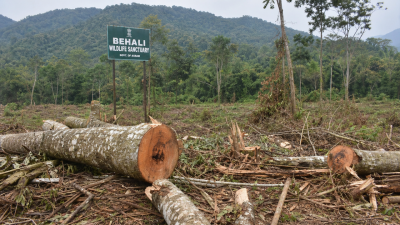
Armed miscreants fired about 16 rounds at forest personnel trying to stop illegal tree felling inside Behali Wildlife Sanctuary, Sonitpur. Officials, including the MP, Deputy Commissioner and SSP, visited the site to assess ongoing large‑scale encroachment, land conversion and security lapses along the Assam–Arunachal border.
Issue at a glance
What is happening
- Violent obstruction: Armed assailants fired on forest staff while they attempted to stop illegal logging inside the Behali Reserve Forest.
- Land conversion: Large tracts, notably Naharjan and Chauldhowa, are reported occupied and converted to agriculture (colocasia, oil palm).
- Administrative action: District-level officials and senior police and forest officers visited the area and forwarded incident reports to the state government.
- Inter‑state dimension: The crisis is entangled with unresolved Assam–Arunachal boundary issues, complicating enforcement.
Why it matters
- Environment: Deforestation and land conversion degrade habitat, reduce biodiversity and fragment corridors for wildlife.
- Law and order: Armed attacks on forest personnel indicate erosion of state authority in a protected area.
- Governance and federalism: Persistent encroachment exposes gaps in inter‑state coordination and local administration.
- Livelihoods and economy: Conversion to cash crops changes land use, affecting forest ecosystem services and downstream communities.
Dimensions and causes
Environmental and operational scale
The Behali Reserve Forest, preliminarily notified as a wildlife sanctuary in 2022, faces sustained tree felling and illicit land occupation. Conversion to perennial cash crops signals long‑term, capitalised encroachment rather than transient extraction.
Drivers
- Boundary dispute: Unresolved Assam–Arunachal limits create jurisdictional uncertainty and enforcement gaps.
- Security vacuum: Reduction in visible enforcement presence after political transition has been alleged locally, enabling intensified illegal activity.
- Economic incentives: Cash crops on cleared land provide higher short‑term returns to encroachers than subsistence farming.
- Administrative inertia: Prior inter‑state meetings produced commitments, but implementation and follow‑through appear inconsistent.
Administrative and institutional response
- Field visits and reporting: Senior officials including the MP, DC and SSP inspected the site; SSP and DFO reports were sent to the state government.
- Inter‑state meetings: A joint field inspection in May produced decisions for strict action, but recurrence indicates enforcement shortfalls.
- Law enforcement: Forest staff are frontline actors but lack protection against armed resistance; policing responses have been mobilised at district level.
Implications
- Biodiversity loss: Habitat destruction reduces species resilience and ecosystem services such as water regulation and carbon storage.
- Personnel safety: Armed confrontations increase casualties risk and deter routine patrolling and enforcement.
- Inter‑state relations: Continued tensions over border control may escalate unless mechanisms for joint action and dispute resolution are sustained.
- Rule of law: Persistent encroachment erodes public faith in legal protection of protected areas.
Legal and institutional instruments
- Protected area notification: Wildlife (Protection) Act procedures govern sanctuary status and enforcement powers.
- Forest Conservation Act: Regulates diversion of forest land for non‑forest use; requires clearances and compensatory measures.
- Forest Rights Act: Claims under FRA require scrutiny to separate legitimate rights from illegal occupation.
- Police and criminal law: Armed attacks invoke penal statutes; prosecution requires coordinated investigation and custody of offenders.
Practical measures: immediate to medium term
| Challenge | Policy / Operational response |
|---|---|
| Immediate threat to personnel | Provide armed escorts from police, rapid response teams, medical evacuation plans and statutory empowerment for forest staff during joint operations. |
| Ongoing tree felling and land conversion | Deploy joint patrols, use temporary sealing of cleared plots, and initiate swift legal action including seizure of equipment and prosecution under Forest/Criminal laws. |
| Jurisdictional uncertainty | Operationalise a permanent inter‑state coordination committee with district representation, agreed protocols for joint patrolling and shared intelligence. |
| Detection and monitoring gaps | Expand satellite and drone surveillance, geotagging of critical zones, and community reporting apps linked to district control rooms. |
| Socio‑economic drivers of encroachment | Verify FRA claims, design targeted livelihood alternatives (agroforestry, institutional markets for non‑timber products), and link welfare schemes to compliance. |
Operational design considerations
- Rules of engagement: Clear SOPs for joint forest‑police teams are required. Use of force must be lawful and proportionate.
- Accountability: Timebound action plans, public disclosure of steps taken, and independent review of enforcement lapses will improve credibility.
- Community role: Local villagers and village defence committees can be partners for monitoring if provided legal safeguards and economic incentives.
- Legal fast‑tracking: Special courts or priority filing for forest offences in high‑risk zones to deter recidivism.
Indicators of successful intervention
- Reduction in illegal felling: Measurable fall in active cutting sites recorded by remote sensing.
- Restoration of cleared land: Reforestation or natural regeneration on de‑occupied plots.
- Improved security: Fewer violent incidents against staff and regularised joint patrol presence.
- Inter‑state cooperation: Operational protocols enacted and functioning joint committees at district and state levels.
Risks and trade‑offs
- Force vs legitimacy: Heavy security action without rehabilitation risks alienating local communities and creating new conflicts.
- Resource allocation: Sustained enforcement requires funds for personnel, technology and legal processes.
- Political economy: Strong vested interests may resist eviction and prosecution; political will is necessary for sustained action.
Priority actions for policymakers
- Immediate: Secure forest teams, launch joint operations against active felling, and freeze further land conversion pending investigation.
- Short to medium term: Institutionalise inter‑state operational protocols, scale surveillance, and fast‑track prosecutions.
- Medium term: Resolve boundary differences through technical mapping and political negotiation; implement participatory restoration and livelihood programmes.
Model Questions
1. Examine the multi‑faceted challenges posed by illegal encroachment and armed resistance to forest personnel in Behali Wildlife Sanctuary, and assess their implications for wildlife conservation and border security. [GS-III: Internal & External Security]
The crisis combines environmental degradation, violence against state agents and jurisdictional ambiguity at a state border. Implications include habitat loss, weakened law enforcement, and potential escalation across the Assam–Arunachal boundary. Response requires secured forest operations, joint police‑forest action, technical mapping to settle boundary lines, intelligence sharing, and legal action to deter armed encroachment while protecting frontline staff and wildlife corridors.
2. Analyse governance failures that have allowed persistent illegal encroachment in Behali Reserve Forest and suggest institutional mechanisms to strengthen inter‑state coordination. [GS-II: Governance]
Failures include weak enforcement follow‑through after inter‑state meetings, unclear jurisdictional control, and lack of coordinated rapid response. Institutional remedies: a permanent inter‑state coordination committee with operational protocols, shared intelligence platforms, joint patrolling SOPs, time‑bound action plans, district‑level task forces, and legal fast‑track for forest offences. Transparency and public reporting will create accountability for implementation.
3. To what extent do socio‑economic factors and land‑use incentives contribute to encroachment in protected areas like Behali, and how can policy balance conservation with local livelihoods? [GS-I: Indian Society]
Encroachment is driven by higher returns from cash crops, land scarcity and limited livelihood options. Policy must distinguish illegitimate occupation from bona fide rights claims under FRA, provide alternative incomes (agroforestry, NTFP markets, wage work), link benefits to conservation compliance, and invest in community forest management. Combining enforcement with livelihood packages reduces incentives for illegal conversion while protecting social justice.
4. Discuss implications of the armed attack on forest personnel in Behali for India’s wildlife protection framework and recommend measures to strengthen enforcement in sensitive border protected areas. [GS-III: Environment & DM]
Armed attacks expose gaps in protection, deter patrolling and undermine sanctuary management. Strengthening enforcement requires police backing for forest operations, dedicated rapid response units, legal clarity on jurisdiction, use of surveillance (satellite, drones), training and equipment for forest staff, community intelligence networks, and coordinated prosecution. Policy must combine security measures with dispute resolution and ecological restoration to restore rule of law and habitat integrity.
Last Modified: July 10, 2026