
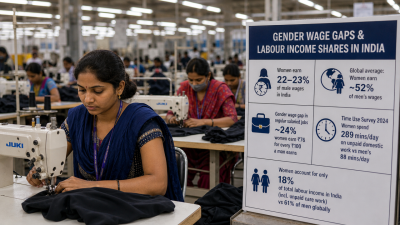
India records a labour income share above 57%, yet women earn only 22–23% of male wages. Recent judicial recognition of unpaid domestic care and new data on participation, unpaid time use and sectoral gaps make gender wage equity a central governance and fiscal challenge.
Current status
- Aggregate share: Labour income share in national income exceeds 57%.
- Gender gap (aggregate): Women earn about 22–23 paise for every rupee earned by men nationally.
- Sectoral gaps: Regular salaried: women ≈76% of men’s wages; casual labour: ≈69%; self-employment: ≈36%.
- Labour contribution: Including unpaid care, women account for only about 18% of total labour income.
- LFPR: Female labour force participation rose from 23.3% (2017–18) to 40% (2025), driven by rural women.
- Informality and protection: About 90% of employment is informal; only 26% of women have any social protection cover.
- Time use: Women spend on average 289 minutes per day on unpaid domestic services; men spend 88 minutes.
- Gig economy signal: Women freelancers charge on average 19% less than men for comparable work.
Why this matters for governance and economy
Persistently low female labour income reduces household welfare, aggregate demand and inclusive growth. High unpaid care burdens and informality constrain productive employment and fiscal planning for social protection. Gendered wage gaps raise inequality and weaken human capital returns from public investment in education and health.
Causes
Occupational segregation
- Job concentration: Women are overrepresented in elementary occupations, care work and low-paid services.
- Glass ceilings: Under-representation in managerial, technical and formal skilled roles limits wage mobility.
Informalisation
- Contract insecurity: Large informal employment means weak wage contracts and no statutory benefits.
- Self-employment penalty: Women in self-employment earn a fraction of male counterparts (≈36%).
Unpaid care burden
- Time constraints: Daily unpaid care (289 minutes) restricts hours available for paid work or skill acquisition.
- Economic invisibility: Unpaid care is not captured in wages or national accounts; exclusion lowers measured female labour income to 18% when included.
Discrimination and market bias
- Wage setting: Persistent pay differences across identical roles indicate discrimination.
- Gig platform bias: Lower pricing by women freelancers points to demand-side and reputation effects, or constrained pricing power.
Supply-side constraints
- Skills and mobility: Limited access to targeted vocational training and constrained mobility reduce entry into higher‑paid sectors.
- Social norms: Norms about gender roles channel women into part‑time and domestic-facing work.
Impact
- Household poverty: Lower female earnings raise vulnerability and reduce household resilience to shocks.
- Aggregate growth: Underpaid female labour lowers aggregate productivity and consumption potential.
- Inequality: Large gender gaps contribute to broader income inequality and uneven human capital returns.
- Fiscal policy: Low social protection coverage for women increases demand for targeted transfers and care infrastructure spending.
Legal and governance framework
- Statutory law: Equal Remuneration Act, 1976 prohibits gender discrimination in wages but enforcement is weak.
- Judicial intervention: Recent Supreme Court judgment recognised “loss of unpaid domestic care” as a distinct compensation head and suggested a notional income of INR 30,000 per month for homemakers, creating legal precedent for valuing unpaid care.
- International standards: ILO conventions and time‑use measurement guidance support policy design for care and social protection.
Challenges to policy implementation
- Data gaps: Need for frequent time‑use and disaggregated wage data by sector, caste, region and urban/rural status.
- Fiscal constraints: Scaling care infrastructure and social protection requires sustained financing.
- Enforcement: Weak labour inspection and informal sector reach impede equal pay enforcement.
- Behavioural inertia: Household norms slow redistribution of unpaid care responsibilities.
Policy measures and institutional options
- Value unpaid care: Integrate time‑use valuation into national accounts and set guidelines for compensation in social transfers and legal awards, building on the judicial notional income.
- Formalise female work: Incentivise formalisation for enterprises employing women; simplify registration and provide tax/credit benefits conditional on social protection coverage.
- Expand social protection: Extend maternity, health and pension cover to informal women via modular portable benefits and contributory‑plus‑subsidy models.
- Care infrastructure: Scale public childcare, community care centres and eldercare services with public financing and PPP options.
- Skill and employment policies: Targeted vocational programmes, placement support, and apprenticeships for women in high‑paying trades and tech roles.
- Regulatory action: Strengthen inspection, penalise discriminatory pay practices, and require gender pay reporting for large firms and platforms.
- Behavioural interventions: Public campaigns and school curricula to redistribute domestic responsibilities; incentives for paternity leave uptake.
- Data and monitoring: Regular national time‑use surveys, gender‑disaggregated wage statistics and outcome targets for ministries.
| Intervention | Responsible agencies | Expected outcome |
|---|---|---|
| Time‑use valuation & compensation guidelines | Ministry of Finance, MoSPI, Judiciary inputs | Recognition of unpaid care; basis for transfers and awards |
| Care infrastructure expansion | Ministry of Women & Child Dev., State governments, ULBs | Reduced unpaid care burden; higher labour supply |
| Formalisation incentives | Labour Ministry, MSME Ministry, Tax Authority | Increased social protection coverage; higher wages |
| Gender pay reporting & inspection | Labour Ministry, Equal Employment authorities | Transparency; reduced discrimination |
Operational priorities for the short and medium term
- Short term: Introduce portable social protection pilots for informal women; mandate gender pay audits for large employers; publish time‑use data updates.
- Medium term: Build nationwide affordable childcare network; reform apprenticeship and skill schemes for female uptake; integrate unpaid care valuation into budgetary planning.
Model Questions
1. Analyse the persistence of gender wage gaps in India despite rising female labour force participation. Discuss socio-economic factors and policy measures to achieve equitable labour income shares. [GS-III: Economic Development]
Rising LFPR (23.3%→40%) has not closed wage gaps due to occupational segregation, informality (90% jobs), unpaid care (289 min/day), low social protection (26% coverage) and discrimination. Policy mix: formalise female employment, expand social protection, scale public childcare, enforce equal pay and mandate gender pay reporting, and target skills/apprenticeships for women to shift into higher‑paid sectors and reduce wage differentials.
2. Examine implications of unpaid domestic care on women’s economic contribution and labour income share. How does recent judicial recognition affect policy choices? [GS-II: Social Justice]
High unpaid care limits women’s paid work, reducing measured labour income to ~18% when valued. Judicial recognition of “loss of unpaid domestic care” and a notional INR 30,000 monthly value creates legal precedent for compensatory transfers and strengthens the case for integrating care valuation into social policy. Policy responses: care infrastructure, time‑use monetisation in budgets, and portable benefits for homemakers and informal workers.
3. India shows a higher labour income share but a wider gender wage gap than peers. Critically evaluate causes and propose a multi‑pronged strategy to bridge this paradox. [GS-III: Economic Development]
Higher aggregate labour share (>57%) coexists with extreme gender disparity (women 22–23% of male wages) due to sectoral concentration, informality, and undervaluation of care. Strategy: formalisation incentives, gender‑targeted skills, enforceable equal pay rules, public care services, expand social protection to informal women, gender‑disaggregated data and fiscal support for women‑owned enterprises to improve earnings and reduce inequality.
4. Discuss the role of occupational segregation and the informal sector in perpetuating gender wage disparities in India. What steps should government and civil society take to formalise women’s work and improve wages and protection? [GS-I: Indian Society]
Occupational segregation confines women to low‑paid, informal roles, reducing earnings and social security. Government should simplify enterprise registration, provide formalisation incentives, extend portable social protection and invest in childcare. Civil society can run skilling, market linkage and awareness programmes, support cooperatives and advocate for gender pay transparency. Joint action will increase wages, security and social inclusion for women workers.
Last Modified: June 24, 2026