
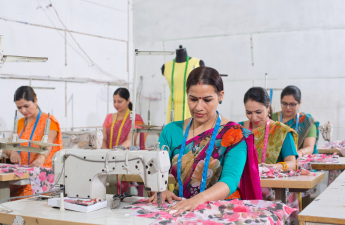
The Centre has reoriented policy from welfare transfers to a women-led development model. Fiscal support rose to 9.3% of the Union Budget and Female Labour Force Participation reached 41.7%. Policy now uses lifecycle interventions in nutrition, health, education and economic sovereignty to raise capabilities and participation by 2047.
What is the current issue
Policy has moved from beneficiary-focused schemes to positioning women as active drivers of growth and leadership. The shift is operationalised through lifecycle interventions, a higher gender budget allocation and specialised institutional architecture that integrates safety, health, education and market access.
Why this matters
- Governance: Institutional redesign (Mission Shakti) consolidates schemes and standardises service delivery and emergency response.
- Economy: Rising FLFPR and market linkages aim to expand productive capacity and household incomes.
- Society: Changes in asset ownership, education and health reshape social norms and intergenerational outcomes.
- Security: Integrated crisis response and legal forums improve gender justice and public safety.
Mission Shakti: Institutional framework
Sambal vertical (Safety and security)
- One Stop Centres: Integrated legal, medical and psycho-social services; over 730 centres operational with plans for ~300 additional units in large districts.
- Women Helpline: 24-hour emergency response integrated with 112 for immediate rescue and referral.
- Beti Bachao Beti Padhao: Multi-ministerial campaign expanded to include skill education, sports and technical training for the girl child.
- Nari Adalats: Grassroots alternative dispute resolution forums functioning as women’s collectives to facilitate timely gender justice.
Samarthya vertical (Empowerment)
- Shakti Sadans: Consolidation of Swadhar Greh and Ujjawala into a network for relief, rehabilitation and repatriation of vulnerable women.
- Sakhi Niwas: Working women hostels providing safe rental accommodation to bypass long construction timelines.
- National Creche Scheme: Day-care facilities to reduce the domestic care burden on working mothers.
- Pradhan Mantri Matru Vandana Yojana (PMMVY): Conditional cash transfer providing maternity benefits directly to pregnant and lactating mothers; 4.92 crore beneficiaries and over ₹20,150 crore disbursed via DBT by mid-2026.
Health and nutrition interventions
- Pradhan Mantri Surakshit Matritva Abhiyan: Assured antenatal care on the 9th of each month; over 7.4 crore pregnant women checked; MMR reduced to 88 per lakh live births.
- Janani Shishu Suraksha Karyakram (JSSK): Eliminates out-of-pocket costs for pregnant women and sick infants; served 1.99 crore women in 2024-25.
- Ayushman Bharat (AB-PMJAY): ₹5 lakh per family cashless coverage; women hold nearly 49% (21 crore) of 43.52 crore cards issued.
Educational reforms and skill acquisition
| Scheme / Parameter | Operational mechanism | Quantitative milestone |
| School infrastructure | Functional girls’ toilets and drinking water in schools. | 97.3% schools have functional girls’ toilets; female enrolment 48%. |
| Kasturba Gandhi Balika Vidyalayas | Residential schooling for marginalised girls. | 5,316 functional units; 7.58 lakh girls enrolled. |
| Gender Inclusion Fund (NEP) | Targeted finance for flexible learning and retention. | Deployed to reduce dropouts among disadvantaged girls. |
| PM Kaushal Vikas Yojana | Industry-aligned vocational training. | Over 1.37 crore youth trained across three phases. |
Financial inclusion and economic sovereignty
Rural livelihoods and entrepreneurship
- DAY-NRLM: 10.05 crore rural women mobilised into 90.90 lakh Self-Help Groups; core infrastructure for the Lakhpati Didi initiative.
- Lakhpati Didi: Target to raise 6 crore SHG households to ₹1 lakh plus annual income; supported by a National Campaign training 50 lakh members through 50,000 Community Resource Persons.
- Digital monitoring: LokOS application and Digital Aajeevika Register used for progress tracking.
Institutional credit and savings
- Pradhan Mantri Mudra Yojana: Collateral-free loans up to ₹10 lakh; women claim ~70% of sanctioned loans.
- Stand-Up India: Each bank branch mandated to lend ₹10 lakh–₹1 crore to at least one woman borrower for greenfield enterprises.
- Sukanya Samriddhi Yojana: Savings scheme for girl child at 8.2% annual interest; cumulative deposits crossed ₹3.33 lakh crore.
Market integration and public procurement
- SHE-Mart: Community-owned retail outlets across districts to link rural women producers to consumers.
- Womaniya on GeM: Over 2 lakh women-led units registered; procurement orders exceeding ₹80,000 crore.
Legal, political and demographic dimensions
- Demography: NFHS-5 sex ratio 1,020 women per 1,000 men, an improvement from 2011.
- Asset ownership: PMAY requires houses to be registered solely or jointly in the woman’s name, shifting ownership patterns.
- Political representation: Nari Shakti Vandan Adhiniyam (Constitution 106th Amendment Act) reserves one-third seats in Lok Sabha and State Assemblies for women.
Agricultural inclusion and care economy
- Agriculture: Women form 80% of the agricultural workforce but own only 13.9% of land. Mahila Kisan Sashaktikaran Pariyojana extends training and inputs to farm women under DAY-NRLM.
- Care economy: Budgetary plan to train 1.5 lakh caregivers in geriatric, child and allied care to reduce unpaid care burdens on women.
Implementation, monitoring and gaps
- Delivery mechanisms: Direct Benefit Transfer used for PMMVY; digital registries used under NRLM for tracking.
- Capacity and coverage gaps: Geographic unevenness in service quality; informal sector barriers persist; female asset ownership remains low.
- Fiscal sustainability and outcomes: Higher gender budget allocates resources but outcome measurement must link spend to labour market gains and reduced unpaid care time.
Model Questions
- Analyse the paradigm shift from welfare-centric to women-led development in India. Discuss how recent policy initiatives and budgetary allocations reflect this transition towards achieving a fully developed nation by 2047. [GS-II: Governance]
- Examine the multi-dimensional approach of Mission Shakti in enhancing women’s safety, security and socio-economic empowerment. Evaluate its effectiveness and limitations. [GS-II: Social Justice]
- “Economic sovereignty is pivotal for true women’s empowerment.” Analyse India’s measures for financial inclusion and market integration for women and their likely impact. [GS-III: Economic Development]
- Discuss the role of health, education and legal reforms in strengthening women’s capabilities and participation in India’s development trajectory. Provide illustrative schemes and institutional measures. [GS-II: Governance]
Answer should define the policy shift and its objective. Use FLFPR 41.7% and the 2026-27 gender budget at 9.3% as indicators. Explain lifecycle interventions (nutrition, health, education, economic sovereignty). Give examples: Mission Shakti, Lakhpati Didi, PMMY, SHE‑Mart, Womaniya on GeM. Assess implications for governance, fiscal priorities and institutional delivery for 2047 goals.
Answer should outline Sambal and Samarthya verticals and key components: One Stop Centres (>730), Women Helpline integrated with 112, Nari Adalats, Shakti Sadans, Sakhi Niwas, National Creche, PMMVY. Assess reach (PMMVY enrolment, DBT), integration benefits, and gaps such as service quality, scale-up needs and regional disparities. Recommend stronger monitoring and convergence with state systems.
Answer should explain economic sovereignty and list measures: DAY‑NRLM (10.05 crore women, 90.90 lakh SHGs), Lakhpati Didi target, PMMY (women ~70%), Stand‑Up India, Sukanya Samriddhi, SHE‑Mart, Womaniya on GeM (2 lakh units, ₹80,000 crore orders). Evaluate impact on incomes, entrepreneurship, procurement access and persistent constraints in scale, credit terms and market competitiveness.
Answer should link capability formation to participation. Cite health schemes: PMSMA (7.4 crore antenatal check-ups), JSSK (1.99 crore served), AB‑PMJAY (women 49% of cards). Education reforms: girls’ toilets (97.3% schools), KGBVs (5,316 units), Gender Inclusion Fund, PMKVY (1.37 crore trained). Legal measures: PMAY asset registration in women’s name, Nari Shakti Vandan Adhiniyam for one‑third seats. Assess combined effect on agency and labour participation.