
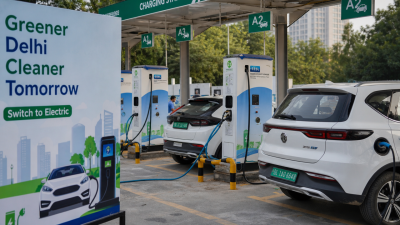
India’s EV transition has recent operational and policy moves: Ola Cell’s BIS certification for an indigenously developed LFP 46100 cell, Delhi’s plans for integrated charging and swapping hubs, and a new Delhi EV Policy draft proposing phased bans on petrol two‑wheelers and CNG three‑wheelers. National policy is shifting from subsidies to regulation while investment and localisation gaps remain large.
What is the issue
India attracted ₹2.23 lakh crore into the EV ecosystem between 2020–25, yet electricity made up only 1% of road transport energy in 2025–26. BEV share in new vehicle sales is 6.8% overall, with large variation by segment: three‑wheelers and buses show high penetration; two‑wheelers and passenger cars lag. Investment shortfalls and supply‑chain dependencies constrain scale‑up.
Why it matters for governance and economy
Transport electrification affects urban air quality, oil import dependence, industrial policy, and strategic supply‑chains for batteries and semiconductors. Policy choices determine whether public funds catalyse a durable domestic manufacturing base or only temporary demand. State actions and central regulation will shape investment flows, jobs, fiscal outcomes (subsidies and tax concessions) and India’s climate commitments.
Current status and segmented penetration
| Indicator | Value / Note |
|---|---|
| Investment (2020–25) | ₹2.23 lakh crore |
| Road transport energy from electricity | 1% (2025–26) |
| BEV share — new vehicle sales | 6.8% (national) |
| Three‑wheelers (passenger) | 35% BEV penetration |
| Buses — Delhi | 79% electric (procurement mandates) |
| Two‑wheelers | 6.3% BEV penetration |
| Cabs / passenger cars | 1.6% BEV penetration (cabs); passenger car adoption limited |
Key challenges to faster adoption
- Market concentration by segment — High BEV uptake is limited to fleets and three‑wheelers; private two‑wheelers and cars remain price‑sensitive.
- Supply‑chain dependence — India aims for 90–100% localisation in several components by 2030 but depends on imported semiconductors and rare‑earth magnets.
- Battery investment gap — Battery demand projected from 17.7 GWh (2025) to 256.3 GWh (2032); meeting 2030 targets needs ~₹12.5 lakh crore, current investments cover ~18%.
- Policy implementation and funds — Less than 10% of the ₹25,938 crore PLI allocation for automobile components has been disbursed; subsidy schemes are time‑bound (PM‑E‑DRIVE two‑wheeler subsidies expire 31 July 2026).
- Charging network and operations — Infrastructure rollout uneven; need for interoperable charging and battery‑swap models in dense urban centres and highways.
Policy framework: shift from subsidies to regulation
Early policy used demand subsidies and purchase incentives to kick‑start uptake. Current strategy is moving towards regulation, localisation targets and supply‑side measures. Policy instruments now under consideration include binding ZEV sales mandates, public procurement, state‑level registration bans, tax concessions tied to localisation, and accelerated disbursement under PLI and related schemes.
Zero Emission Vehicle (ZEV) sales mandate — rationale, legal basis and likely effects
Rationale
Direct subsidies have limited reach in segments where OEM incentives and consumer preferences favour ICE or hybrid products. A binding sales mandate shifts compliance obligation to manufacturers, creating a predictable demand signal for batteries and local manufacturing capacity.
Legal basis
Regulatory authority derives from pollution control statutes, including Section 31A of the Air (Prevention and Control of Pollution) Act, 1981, which permits setting technical standards and performance requirements to control vehicular emissions.
Likely effects
- Market transformation — Manufacturers will need product portfolios aligned to BEV targets.
- Investment pull — Predictable minimum sales improve viability of battery plants and cell manufacturing.
- Compliance costs — May raise OEM costs short‑term and require transition mechanisms (credit trading, phase‑in periods).
Indigenous technology and manufacturing
Domestic capabilities are growing: Ola Cell Technologies received BIS certification for an LFP 46100 cylindrical cell, the first Indian firm to certify that format. Achieving 90–100% localisation by 2030 across many components requires scaling cell manufacturing, materials processing (cathode/anode), recycling, and semiconductor supply. Policy must support anchor investments, R&D, and global partnerships for critical inputs.
EV battery supply chain and financing gaps
Projected battery demand requires large capex and working capital. Shortfalls arise from slow PLI disbursement and investor caution amid uncertain demand signals. Policy levers include faster PLI release, interest subvention, sovereign guarantees for strategic capacity, long‑term offtake commitments (public fleet procurement), and export promotion for surplus capacity.
Charging infrastructure and operational models
- Public charging hubs — Municipal plans (Delhi MCD) for integrated hubs with multi‑point chargers and battery‑swap facilities near markets and metro stations improve accessibility.
- Public sector role — IOC, BPCL, HPCL, NTPC, Power Grid, and EESL are active in deployment, providing network scale and land access.
- Business models — Need mix of fast DC chargers on highways, depot charging for buses and taxis, and battery‑swap for high‑utilisation two‑wheelers and three‑wheelers.
State policies and federal dynamics
States act as policy laboratories. Delhi’s EV Policy 2026–30 proposes banning new petrol two‑wheeler registrations from April 2028 and new CNG three‑wheeler registrations from January 2027, and includes contested incentives such as a 50% road tax waiver for strong hybrids priced up to ₹30 lakh. State procurement (electric buses) and registration rules can accelerate demand but require coordination with national targets to manage fuel security, grid impact and localisation incentives.
Policy options and trade‑offs
| Challenge | Policy response |
|---|---|
| Low EV uptake in cars and two‑wheelers | ZEV mandate for OEMs; targeted purchase incentives during phase‑in; preferential public procurement |
| Battery manufacturing finance gap | Faster PLI disbursement; interest subsidies; sovereign guarantees; binding demand signals |
| Critical imports (semiconductors, magnets) | Trade diversification; strategic partnerships; R&D and small‑scale manufacturing support; stock policy for strategic inputs |
| Charging network scale | Land allocation for hubs; role for PSUs; standardisation and interoperability; private investment incentives |
Immediate priorities for policy makers
- Operationalise credible demand signals — finalise ZEV mandate design with realistic phase‑in, compliance mechanisms and credit trading.
- Accelerate PLI implementation — clear timelines, faster disbursements, simpler procedures.
- Targeted public procurement — scale bus, fleet and shared mobility electrification to anchor domestic demand.
- Charging and grid planning — integrate charging infrastructure build‑out with distribution planning and renewable expansion.
- Supply‑chain resilience — incentivise cell chemistry diversity (LFP, NMC), recycling, and semiconductor partnerships.
Model Questions
1. Despite substantial investments, India’s EV transition shows uneven adoption across segments. Analyse the main factors impeding adoption and evaluate the shift from a subsidy‑led approach to a regulation‑driven framework. [GS-III: Economic Development]
Answer: Low BEV penetration in two‑wheelers and passenger cars reflects price sensitivity, limited model availability, and inadequate charging networks. Supply‑chain dependence on imported semiconductors and magnets raises costs. Subsidies accelerated early adoption but are fiscally limited and short‑term. A regulation‑driven approach — notably ZEV mandates, procurement commitments and localisation targets — can create predictable demand, attract long‑term investment and force OEM product realignment while requiring transition support for consumers and industry.
2. Examine the case for a Zero Emission Vehicle (ZEV) sales mandate in India. Discuss its legal basis and likely economic and environmental impacts. [GS-II: Governance]
Answer: A ZEV sales mandate compels manufacturers to meet minimum BEV sales, providing a stable market signal needed for battery and cell investments. Legal authority exists under pollution control statutes such as Section 31A of the Air (Prevention and Control of Pollution) Act, 1981. Economically it shifts compliance costs onto OEMs and mobilises localisation investment; environmentally it reduces tailpipe emissions where deployment replaces ICE vehicles. Careful phase‑in, credit mechanisms and support for charging infrastructure are necessary.
3. Assess the role of indigenous technology development and charging infrastructure in meeting India’s EV targets. What are the primary challenges in achieving supply‑chain self‑reliance? [GS-III: Science & Technology]
Answer: Indigenous cell certification (e.g. Ola Cell’s BIS‑certified LFP 46100) and public charging hubs are critical for reducing import dependence and improving usability. Main challenges: securing upstream materials, semiconductor dependence, large capex for gigafactories, slow PLI disbursement, and establishing recycling. Policy responses include faster financial incentives, R&D support, international partnerships for critical inputs, public procurement to anchor demand, and standards for interoperable charging.
4. State policies can accelerate or complicate national EV goals. Critically discuss using Delhi’s draft EV Policy 2026–30 as an example. [GS-II: Governance]
Answer: Delhi’s draft proposes banning new petrol two‑wheelers and CNG three‑wheelers and includes incentives such as road tax waivers for strong hybrids. State measures can accelerate local uptake and demonstrate operational models (e.g. electric buses). However, incentives for hybrids may dilute zero‑emission aims and divergent state rules complicate industry planning. Coordination with national mandates, grid readiness and localisation policies is essential to align state actions with long‑term clean mobility objectives.
Last Modified: June 25, 2026