
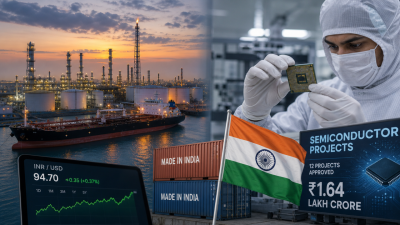
India faces rising vulnerabilities as energy and technology import dependence collides with external shocks. Crude oil reliance above 90%, limited strategic reserves and concentrated tech supply chains are straining the rupee, fiscal buffers, rural employment and external financing channels.
What is the current issue?
Core facts
- Crude oil dependence: Import dependence exceeded 90% in FY26; strategic reserves about 21 million barrels (roughly five days of consumption).
- Energy inputs: Natural gas imports ≈50%; fertilizer production depends on imported LNG and potash.
- Renewable manufacturing: Solar module upstream inputs are imported—98% of wafers and 100% of polysilicon primarily from China.
- Technology push: Government approved 12 semiconductor projects worth ≈₹1.64 lakh crore to build local capacity.
- External receipts: Remittances reached USD 135 billion (FY2024-25); services exports sustain current account but face political and technological threats.
- Macro response: RBI and state-run banks intervened; rupee stabilised near 94.70 per USD after interventions. RBI sold over USD 53 billion in FY2025‑26 to support the currency.
- Social protection: MGNREGA transitions to VB‑G RAM G from 1 July 2026 with 125 guaranteed days and 60:40 Centre‑State wage cost sharing for general states.
Why it matters for governance and the economy
- Price and inflation transmission: Oil and gas price shocks feed consumer inflation and fiscal subsidies.
- Fiscal risk: Public sector oil marketing companies absorbed an estimated burden of ₹1 lakh crore–₹1.2 lakh crore to shield consumers.
- External vulnerability: Heavy reliance on services and remittances makes the current account sensitive to immigration policy shifts and AI-driven service disruption.
- Rural resilience: Employment guarantee redesign and fertilizer price volatility affect farm incomes and rural demand.
- Strategic security: Concentrated supply routes and inputs (e.g., Strait of Hormuz closure impact) create geopolitical exposure.
Energy dependence: anatomy and implications
Crude oil
- Scale: Over 90% import dependence increases exposure to international price and supply shocks.
- Strategic buffers: Reserves at ~21 million barrels cover about five days; current policy recommendation is substantial expansion of strategic petroleum reserves (SPR).
- Supply-route risk: Disruptions on key routes cause immediate price spikes and balance‑of‑payments strain.
Natural gas and fertilizers
- Gas imports: Around half of gas needs are imported. LNG price swings affect fertiliser feedstock costs.
- Fertiliser security: Dependence on imported LNG and potash raises farm input price volatility and food security risks.
Renewable manufacturing
- Value‑chain gap: Solar module manufacturing depends on imported wafers and polysilicon; domestic upstream capacity is minimal.
- Implication: Renewable deployment and green manufacturing targets remain exposed to external supplier decisions and pricing.
Technological dependence and the path to self‑reliance
- Semiconductors: Recent approval of 12 projects (≈₹1.64 lakh crore) aims to build fabrication, packaging and testing capacity. Projects are capital and time intensive and need ecosystem inputs (materials, IP, skilled labour).
- Solar upstream inputs: Near-total import reliance for wafers and polysilicon signals need for upstream investments and linkages.
- Services sector risk: IT/BPO exports face structural risk from AI and stricter immigration regimes in destination markets; this undermines a major foreign exchange source.
- Policy gaps: R&D investment, IP incentives, specialised skilling and supply‑chain clustering require acceleration to shorten gestation periods for tech projects.
External sector and macro stability
- Current account financing: Services exports and remittances together finance deficits; this concentration creates structural fragility.
- Exchange rate management: RBI sold over USD 53 billion in FY2025‑26; state‑bank intervention and central bank communication helped stabilise the rupee.
- Growth outlook: Rating agencies revised FY27 growth forecasts downward to 6.6% citing rising oil prices and weak monsoon; RBI’s projection remains slightly higher.
- Inflation risk: Energy price pass‑through raises inflationary pressure, complicating monetary policy choices between growth and price stability.
Social protection and employment guarantees
- VB‑G RAM G design: The new scheme guarantees 125 days of employment and shifts to a 60:40 Centre‑State wage cost sharing for general states. This alters fiscal incidence between centre and states.
- Implementation risk: States with constrained finances may face funding shortfalls. Effective targeting, timely payments and dovetailing with livelihood programmes are necessary.
- Rural buffer: Enhanced guaranteed days can stabilise rural incomes during agricultural stress and energy‑price induced inflation.
Policy responses: assessment and priority measures
- Immediate measures: Expand SPR capacity; deploy targeted subsidy mechanisms rather than blanket fiscal absorption; improve price transparency for fuels.
- Medium term: Diversify energy imports and suppliers; scale domestic gas production and storage; build fertiliser feedstock linkages and buffer stocks; develop domestic polysilicon and wafer manufacturing.
- Technology and industry: Implement end‑to‑end semiconductor ecosystem policies, combine capital incentives with R&D grants, and invest in specialised workforce training.
- External resilience: Diversify export markets; promote non‑IT tradable services; create remittance‑friendly channels and engage diaspora for investment flows.
- Macro management: Maintain adequate foreign exchange buffers; use FX intervention judiciously; preserve monetary policy credibility to anchor inflation expectations.
| Challenge | Policy option |
|---|---|
| Over 90% crude import dependence and limited SPR | Scale SPR, diversify suppliers, boost domestic oil/gas exploration, promote biofuels and demand management |
| Fertiliser input imports | Develop domestic ammonia/urea feedstock facilities, strategic potash procurement and buffer stocks |
| Solar upstream reliance on China | Incentivise polysilicon and wafer capacity, promote clustering and import‑substitution with quality standards |
| Semiconductor ecosystem gaps | Long‑term capital, IP policy, industry‑academia linkages and export promotion for local fabs |
| Services/remittance concentration | Market diversification, upskilling for AI‑resilient services, partnerships for overseas placements |
Implementation challenges and governance priorities
- Financing: Large capital requirements for SPR, semiconductor fabs and upstream solar manufacturing demand blended finance, sovereign support and private investment.
- Coordination: Central‑state cost sharing under VB‑G RAM G requires fiscal transfers and administrative synchronization.
- Time horizons: Industrial projects have long gestation; interim measures (strategic procurement, buffer stocks, targeted subsidies) are needed to manage near‑term shocks.
- Trade-offs: Protecting consumers may raise fiscal costs; removing subsidies quickly can stoke inflation and political resistance. Phased, transparent adjustments minimise disruption.
Model Questions
1. Analyse the multi‑faceted nature of India’s energy dependence, especially in crude oil and critical industrial inputs. Discuss economic implications and evaluate current strategies to enhance energy security. [GS-III: Economic Development]
India’s oil import dependence (>90%) and SPR of ~21 million barrels (≈five days) raise price and supply risks. Fertiliser production relies on imported LNG and potash, and solar upstream inputs are imported. Economic implications: inflationary pressures, fiscal subsidies (OMCs absorbed ₹1–1.2 lakh crore), current account vulnerability. Strategies: expand SPR, diversify suppliers, scale domestic gas and biofuels, invest in upstream renewable manufacturing and targeted subsidy reform; assess financing and timelines.
2. Examine challenges to India’s technological self‑reliance, focusing on semiconductors and solar upstream components, and suggest policy measures to build a resilient tech ecosystem and diversify external revenues. [GS-III: Science & Technology]
Challenges: semiconductor fabs require large capital, skilled labour and supply chains; solar wafers and polysilicon largely imported from China; IT/BPO exports face AI disruption and immigration headwinds. Measures: end‑to‑end semiconductor ecosystem support, R&D and IP incentives, skilling, PLI for upstream solar, supplier diversification, export market diversification, promote high‑value services resilient to automation and bilateral agreements for labour mobility.
3. Critically evaluate the government’s and RBI’s interventions amid recent exchange rate pressures and growth revisions, and assess the implications of replacing MGNREGA with VB‑G RAM G. [GS-II: Governance]
RBI sold over USD 53 billion to stabilise the rupee; state‑bank interventions and central bank communication aided recovery to ≈94.70 per USD. Growth forecasts diverged (S&P 6.6% vs RBI 6.9%), reflecting oil price and monsoon risks. VB‑G RAM G increases guaranteed days to 125 and shifts to 60:40 Centre‑State wage sharing, improving rural cover but raising fiscal and implementation risks for states; requires clear transfers, monitoring and integration with livelihood schemes.
4. To what extent can India mitigate economic vulnerabilities from energy and tech dependence while navigating geopolitical shifts? Propose a comprehensive strategy covering capacity building, trade diversification and domestic reforms. [GS-III: Economic Development]
Mitigation requires a mix of near‑term buffers and long‑term structural change: expand SPR and strategic buffer stocks; diversify energy suppliers and accelerate domestic renewables and biofuel production; build upstream solar and semiconductor capacity via financing, R&D and skilling; diversify export markets and service offerings; strengthen FX reserves and prudent fiscal policy; enhance social safety nets and state capacity for implementation.
Last Modified: June 28, 2026