
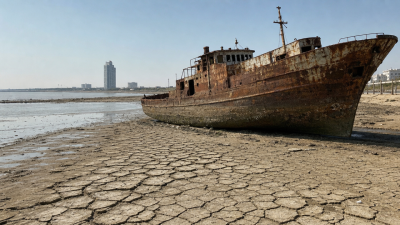
The Caspian Sea has lost about 24,000 km² and fallen nearly two metres since the mid‑1990s. Recent research attributes roughly 60% of the decline to human river engineering and diversions, with the remainder due to increased evaporation, creating ecological, economic and geopolitical stress for the five littoral states.
Current issue and significance
The sea’s decline is large-scale and ongoing. The Volga River supplies roughly 80% of inflow; reduced Volga discharge from dams, reservoirs and diversions is the main driver. Loss of area and depth is transforming the northern Caspian — a shallow, productive zone — with consequences for fisheries, wetlands, ports and offshore energy facilities across Iran, Russia, Turkmenistan, Azerbaijan and Kazakhstan.
Magnitude and principal causes
- Scale: ~24,000 km² surface loss since mid‑1990s; water level down ≈2 metres.
- Attribution: Recent study: ~60% due to human activity (dams, diversions); ~40% due to increased evaporation from regional warming.
- Volga’s role: Supplies ≈80% of inflow; inflow sharply reduced by river engineering despite slight increase in basin rainfall.
- Other diversions: Volga–Don canal and irrigation/industrial withdrawals further reduce inflow.
Environmental and ecological consequences
- Northern Caspian drying: Loss of shallow habitats, increased salinity gradients and shoreline reconfiguration.
- Biodiversity impacts: Stress on sturgeon spawning grounds, decline in fisheries, threat to Caspian seal and migratory bird habitats.
- Water quality: Rising chlorophyll concentrations and deteriorating quality; higher frequency of harmful algal blooms.
- Long-term risk: UN experts warn of continued decline over coming decades with persistent ecological degradation.
Economic impacts
- Ports & navigation: Reduced drafts, stranded berths, rerouting and higher dredging costs.
- Energy infrastructure: Offshore oil and gas platforms, pipelines and supply chains face operational and fiscal risks.
- Fisheries: Shrinking spawning areas and stock declines hit coastal livelihoods and export earnings.
- Coastal economies: Tourism, wetlands-based services and fisheries-dependent communities are vulnerable.
Human activities and riverine engineering
- Dams and reservoirs: Alter timing and volume of Volga discharge; increase retention upstream.
- Agricultural and industrial withdrawals: Large-scale irrigation and water-intensive industry reduce basin runoff reaching the sea.
- Canal transfers: Volga–Don and other diversions redirect water for navigation and irrigation away from the Caspian basin.
- Operational practices: Reservoir management often prioritises national irrigation/energy needs over downstream environmental flows.
Governance, geopolitical risks and institutional context
- Littoral states: Iran, Russia, Turkmenistan, Azerbaijan, Kazakhstan — competing national priorities shape responses.
- Legal framework: 2018 Aktau Convention sets certain rules for the Caspian’s legal status but lacks mechanisms for basin‑wide water allocation and enforceable ecological protection.
- Fragmented governance: No comprehensive, binding regime for shared water management, data sharing or joint environmental assessment.
- Risks: Resource competition, unilateral engineering measures, and infrastructure disputes can produce diplomatic friction and localised conflict potential.
Current mitigation and cooperation measures
- State actions: Kazakhstan diverted water into the Caspian (6.16 billion m³ in early 2026; >35 billion m³ over ~2.5 years) to partly restore levels.
- Scientific monitoring: Novaya Delta 2026 expedition documented shoreline change and island growth in the northern Caspian.
- International aid: Japan and UNDP launched a USD 3 million project with Kazakhstan for environmental sustainability and water management.
- UN assessments: Expert warnings on ecological and economic consequences and calls for coordinated action.
Governance gaps and practical challenges
| Governance gap | Practical implication |
|---|---|
| Absence of binding water allocation rules | States prioritise national withdrawals; no equitable sharing mechanism. |
| Poor data sharing | Inconsistent monitoring hinders joint management and impact assessment. |
| Weak enforcement | Existing agreements lack penalties or dispute‑settlement mechanisms. |
| Funding and capacity shortfalls | Limited resources for restoration, monitoring and adaptation projects. |
| Divergent priorities | Economic development goals versus ecological protection create policy deadlock. |
Way forward: policy and technical options
- Integrated basin management: Establish basin‑scale plans covering the Volga and other inflows with agreed environmental flow standards.
- Optimise reservoir operations: Recalibrate dam releases to support seasonal flows for the Caspian’s ecology.
- Water‑use efficiency: Promote efficient irrigation (drip, scheduling), industrial recycling and wastewater treatment in upstream basins.
- Legal and institutional measures: Negotiate a binding protocol under the Aktau framework for water allocation, monitoring and environmental impact assessment with enforcement clauses.
- Data and scientific cooperation: Create a shared monitoring platform, joint expeditions and open data commitments among littoral states.
- Habitat restoration: Protect and restore wetlands and spawning grounds; employ nature‑based solutions to retain and filter runoff.
- International finance and technical support: Mobilise multilateral finance and technical assistance for adaptation and infrastructure realignment.
- Disaster risk measures: Adjust port logistics, dredging plans and energy asset management to reduce economic losses.
Model Questions
1. Analyse the primary drivers behind the rapid shrinkage of the Caspian Sea and critically evaluate its environmental and economic consequences for the littoral states. [GS-III: Environment & DM]
The main driver is human river engineering and diversions (≈60%), chiefly on the Volga which supplies ~80% of inflow; evaporation due to warming explains ≈40%. Environmental effects include drying of the northern Caspian, loss of sturgeon spawning grounds, rising algal blooms and seal stress. Economic consequences affect ports, shipping, offshore energy, fisheries and coastal livelihoods, raising adaptation costs and regional socio‑economic vulnerability.
2. “The geopolitical stability of the Caspian region is increasingly threatened by the environmental crisis of its shrinking sea.” Discuss. [GS-II: International Relations]
Shrinkage creates shared resource scarcity across Iran, Russia, Turkmenistan, Azerbaijan and Kazakhstan. Fragmented governance and absence of binding allocation foster unilateral measures and distrust. Competing economic priorities (energy, irrigation, navigation) increase diplomatic friction. Effective regional cooperation, legally binding agreements, shared monitoring and dispute‑settlement mechanisms are necessary to reduce tensions and preserve regional stability.
3. Examine riverine engineering contributions to the Caspian’s decline and recommend sustainable water management measures riparian states should adopt. [GS-III: Environment & DM]
Dams, reservoirs and diversions on the Volga and other tributaries have reduced downstream discharge. Sustainable measures include optimised reservoir operations for environmental flows, improved irrigation efficiency, industrial water recycling, wastewater treatment, basin‑wide planning, joint monitoring and incentives for water‑saving technologies. International funding and technology transfer can support these reforms and restore inflow where feasible.
4. What are the key challenges in establishing a comprehensive, enforceable system for water allocation and ecological protection of the Caspian Sea? [GS-II: Governance]
Challenges include sovereign interests of five littoral states, differing development priorities, lack of a binding legal regime for water allocation, weak enforcement and dispute resolution, inadequate data sharing and limited financing. Overcoming these requires negotiated binding protocols, institutional mechanisms for monitoring and enforcement, joint scientific platforms and multilateral financing for implementation and capacity building.
Last Modified: June 27, 2026