
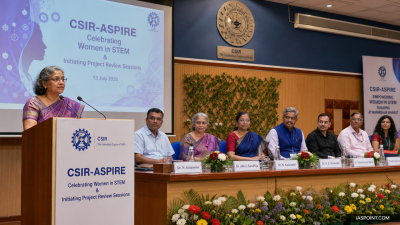
On 13 July 2026 CSIR organised “ASPIRE-SHAKTI: Celebrating Women in STEM & Initiating Project Review Sessions” at Anusandhan Bhawan, New Delhi. Dr N. Kalaiselvi presided and released the ASPIRE-SHAKTI Compendium documenting outcomes of the CSIR-ASPIRE Research Scheme for women scientists.
What is the current issue
CSIR-ASPIRE is a targeted funding scheme for women researchers managed by CSIR-HRDG. Launched on International Women’s Day 2023 and envisioned by the Union Minister for Science & Technology, the scheme funds women as independent Principal Investigators to strengthen their research leadership and career continuity.
Why this matters for governance, economy and science
- Governance: Public R&D must ensure equitable access to state funds and representation in decision-making roles.
- Economy: Commercialising high-quality academic research expands innovation-led growth and job creation.
- Science & Technology: Gender-diverse teams broaden research questions and reduce bias in outcomes.
Scheme design and performance
Administration: The scheme is operated by CSIR Human Resource Development Group (CSIR-HRDG). Leadership: Dr N. Kalaiselvi (Director General, CSIR; Secretary, DSIR) presided over the recent event and launched the Compendium. Origin: Envisaged by the Union Minister of State (Independent Charge) for Science & Technology and launched on International Women’s Day 2023.
Selection, disciplinary spread and outputs
Scale and selection: 2,878 proposals were received from 969 institutions; 301 women researchers were funded as independent Principal Investigators (≈10% selection ratio).
| Dimension | Figures |
|---|---|
| Life Sciences | 152 projects |
| Engineering Sciences | 54 projects |
| Inter/Transdisciplinary Sciences | 37 projects |
| Chemical Sciences | 34 projects |
| Physical Sciences | 25 projects |
| Publications (SCI-indexed) | >253 |
| Patent applications | >15 |
| International presentations | >20 |
| Research personnel trained | >300 (JRF/SRF/RAs) |
Next phase: translation and commercialisation
CSIR will identify 20–30 outstanding ASPIRE projects for additional support, commercialisation and linkage with startups and innovation partners. The aim is to move select projects from publication to patenting and market deployment through industry partnerships and incubation support.
Socio-cultural barriers and scheme responses
- Leaky pipeline: Women drop out at successive career stages due to family responsibilities and social expectations. CSIR-ASPIRE counters this by funding women as independent PIs, improving career continuity.
- Limited leadership roles: Institutional norms restrict women from heading projects. Direct PI funding assigns leadership, CV credit and visibility.
- Networking and mentoring gaps: Targeted review sessions, Compendium publication and conference support increase professional networks and global exposure.
- Resource constraints: Competitive, earmarked funding gives financial autonomy and helps balance domestic and professional duties.
Regional imbalances and policy governance
CSIR data show comparatively low participation from the North-East and Ladakh and concentration in urban, Tier‑1 institutions. Governance measures must correct geographic inequity in R&D access.
- Targeted outreach: Awareness drives and workshops for universities and colleges in Tier‑2/3 and underrepresented regions.
- Capacity building: Proposal-writing support, regional mentorship networks and virtual review panels to lower entry barriers.
- Incentive design: Special funding windows or relaxed criteria for applicants from underserved regions and institutions.
R&D translation, intellectual property and startup linkages
Current outputs include >15 patent applications and plans to commercialise select projects. Conversion requires institutional mechanisms and funding instruments.
- Institutional mechanisms: Strengthen Technology Transfer Offices (TTOs), incubation centres and IP support within host institutions.
- Funding instruments: Seed grants, proof-of-concept funds and equity-free incubator support to bridge lab-to-market gap.
- Industry engagement: Formal partnerships with industry, startups and CSR-funded innovation programmes for pilot deployment.
- Procurement linkages: Use of public procurement and test‑bed facilities to validate and scale technologies.
Ethical and normative dimensions
- Equality and justice: State-funded schemes should reflect equal opportunity in research leadership to meet constitutional equality norms.
- Epistemic fairness: Women-led projects diversify research agendas and reduce gender bias in study design and outcomes.
- Democratic science: Inclusive participation improves public trust in scientific priorities and resource allocation.
- Role modelling: Trained researchers and visible PIs create future leaders and mentors for women in STEM.
Challenges and policy options
| Challenge | Policy response |
|---|---|
| Low regional participation | Targeted outreach, regional proposal clinics, special fellowship windows for North‑East and Ladakh |
| Weak translation pipeline | Scale TTOs, proof‑of‑concept funds, linkages with incubators and industry partners |
| Career discontinuity | Flexible timelines, childcare support at institutions, re‑entry fellowships for career breaks |
| Limited IP capacity | IP training, subsidised patent filing and legal support for early-stage inventors |
Model Questions
1. Examine the socio-cultural barriers that restrict women’s participation in STEM in India. How does a scheme that funds women as independent Principal Investigators address these barriers? [GS-I: Indian Society]
Answer: Social barriers include the leaky pipeline caused by domestic responsibilities, marriage pressures and workplace bias. Funding women as independent PIs provides leadership roles, financial autonomy and visibility. It reduces reliance on male supervisors, strengthens CVs for promotions, expands networks through conferences and review sessions, and supports retention via project continuity and mentoring opportunities, thereby improving career survival and upward mobility in STEM.
2. The CSIR-ASPIRE scheme shows regional disparities in participation. Analyse policy measures that can improve geographic inclusivity of research funding. [GS-II: Governance]
Answer: Remedies include targeted outreach to underrepresented regions, regional proposal-writing clinics, and virtual review panels to lower access barriers. Create special funding windows or relaxed eligibility for applicants from North‑East and Ladakh. Strengthen local infrastructure via collaborative grants, establish regional mentorship networks and monitor participation metrics. Use public institutions and state science councils to coordinate capacity building and awareness campaigns.
3. Evaluate how selecting outstanding academic projects for commercial support can impact economic development and technological readiness. Suggest mechanisms for effective translation. [GS-III: Economic Development]
Answer: Supporting select projects for commercialisation accelerates technology transfer, creates startups, and generates skilled jobs. Economic benefits include higher innovation output, improved competitiveness and marketable IP. Mechanisms needed are proof‑of‑concept funds, strengthened Technology Transfer Offices, incubators, industry partnerships, seed funding and use of public procurement for pilot deployment. Patent support and mentoring for entrepreneurialisation are essential for market readiness.
4. Discuss the ethical implications of gender imbalance in scientific research and how empowering women as independent PIs contributes to ethical research practice. [GS-IV: Ethics, Integrity and Aptitude]
Answer: Gender imbalance causes epistemic injustice and biased research priorities. Empowering women as independent PIs promotes fairness in access to public resources and diversifies perspectives in study design. This improves validity and societal relevance of research, aligns institutional practice with equality norms, and enhances accountability. Female leadership also fosters inclusive mentorship, increasing ethical standards in recruitment and research conduct.
Last Modified: July 14, 2026