
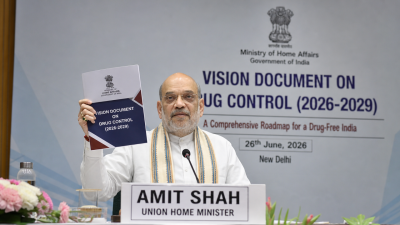
Recently Union Home Minister Amit Shah unveiled the Vision Document on Drug Control (2026–2029) at the 10th Apex-Level NCORD meeting and launched the Online Drugs Disposal Fortnight Campaign to destroy over 2.09 lakh kg of seized narcotics worth more than ₹6,000 crore. The document sets a national roadmap for the next three years.
What the Vision Document is and why it matters
The Document is a time-bound national roadmap for 2026–2029 that aims to shift India from reactive seizures to integrated prevention, prosecution and rehabilitation. It addresses internal security, public health, international obligations, and criminal justice capacity. Implementation will affect policing priorities, judicial processes, rehabilitation budgets and international cooperation on precursors and trafficking.
Four key pillars
| Pillar | Primary measures |
|---|---|
| Enforcement, Intelligence & Operations | Intelligence-led operations; NCORD coordination; expand NCB zonal reach; convert ANTFs to full-time units; community policing; use of technological intelligence and data analytics. |
| Precursor & Synthetic Drug Control | Regulate precursor chemicals; monitor legal chemical supply chains; forensic capacity for novel psychoactive substances; international cooperation with UNODC/INCB. |
| Demand Reduction & Rehabilitation | Prevention campaigns; treatment and reintegration services; move toward reformative provisions in NDPS Act for addicts; reduce stigma and strengthen public-health response. |
| Capacity Building & Coordination | Specialised training, forensic labs, exclusive NDPS courts, improved inter-agency protocols, state-centre coordination and enhanced prosecution arrangements including extradition support. |
Strategic approach: “Detect, Disrupt and Destroy”
Detect: Human intelligence, technology (forensics, data analytics, dark‑web monitoring), and community policing to map networks and routes. Disrupt: Target financial flows, logistics and precursor supply chains; coordinated multi‑agency operations; ANTFs as dedicated units. Destroy: Physical dismantling of labs, safe disposal of seized consignments (Online Drugs Disposal Fortnight Campaign), and legal closure through prosecution.
Institutional and operational reforms
- NCORD: Apex coordination platform for national strategy and state‑centre intelligence sharing.
- NCB expansion: New zonal offices in Jammu and Guwahati to address regional trafficking corridors.
- ANTFs: Conversion to full‑time units for sustained investigations and continuity.
- Exclusive NDPS courts: Proposed to expedite trials and reduce backlog.
- Inter‑agency links: Enhanced collaboration with CBI, customs, immigration and international partners for extradition and cross‑border prosecution.
Legal and legislative measures
The Department of Revenue proposes amendments to the NDPS Act to close legal gaps and introduce a more reformative approach for persons with addiction while retaining strict penalties for traffickers. Amendments aim to clarify scheduling of new psychoactive substances, strengthen precursor controls, streamline asset seizure and enable faster mutual legal assistance.
Demand reduction and rehabilitation (social justice dimension)
- Public health framing: Treat addiction primarily as a health and social problem requiring treatment, not only punishment.
- Rehabilitation network: Expand de‑addiction centres, community support, skill development and measures for social reintegration.
- Legal relief: Reformative provisions in NDPS Act to allow diversion to treatment for addicts and reduce incarceration for minor users.
Key achievements informing the Vision
- Seizures: Between 2014 and 2026 authorities seized 1.18 crore kg of drugs valued at ₹1.84 lakh crore.
- Disposal drive: Online disposal campaign targets over 2.09 lakh kg of seized substances worth more than ₹6,000 crore.
Operational and policy challenges
- Synthetic drugs: Rapid emergence of new psychoactive substances and ease of small‑scale synthesis complicate detection and evidence gathering.
- Precursors: Diversion from legitimate chemical trade requires tighter regulation and industry cooperation without hampering commerce.
- Inter‑jurisdictional coordination: Varied capacity across states; need for secure, real‑time intelligence sharing and standard operating procedures.
- Judicial delays: Backlog in courts reduces deterrence; specialised NDPS courts are proposed but need infrastructure and judges with expertise.
- Rehabilitation gaps: Limited treatment capacity, regional disparities and social stigma impede demand‑reduction goals.
- Border and cyber threats: Porous borders, maritime routes, dark‑web marketplaces and use of crypto pose enforcement complexities.
- Environmental and safety aspects: Safe destruction and environmental compliance for large disposals require technical protocols.
Implementation priorities and indicators
- Short term: Operationalise ANTF full‑time units, open NDPS courts pilot, expand NCB zonal footprint, complete safe disposal drives.
- Medium term: Amend NDPS Act, scale forensic capacity, national precursor monitoring regime, strengthen rehabilitation network with clear referral pathways.
- Metrics: Reduction in availability indicators, prosecution conviction rates, treatment completions, number of destroyed consignments, time-to-trial in NDPS courts.
Model Questions
1. Analyse the key features and strategic pillars of the ‘Vision Document on Drug Control (2026–2029)’. How does it aim to strengthen India’s fight against narcotics? [GS-II: Governance]
The Vision Document rests on four pillars: Enforcement, Precursor & Synthetic Control, Demand Reduction & Rehabilitation, and Capacity Building & Coordination. It operationalises a “Detect, Disrupt and Destroy” strategy using human and technological intelligence, expands NCB zonal reach, proposes exclusive NDPS courts, converts ANTFs to full‑time units and seeks NDPS Act amendments to balance punitive measures with reformative treatment for addicts.
2. Examine the multi‑pronged strategy in the Vision Document to counter drug trafficking and abuse, and identify principal implementation challenges. [GS-III: Internal & External Security]
Strategy combines intelligence‑led enforcement, precursor regulation, public‑health oriented rehabilitation and inter‑agency coordination via NCORD. Key measures: NCB zonal offices, ANTFs, disposal campaigns. Challenges include synthetic drug proliferation, precursor diversion, cross‑border trafficking, cyber/dark‑web threats, uneven state capacity, judicial delays and limited rehabilitation infrastructure; these require legal, technical and institutional capacity upgrades.
3. Assess the importance of pairing demand reduction with a reformative legal approach in addressing socio‑economic dimensions of drug abuse. [GS-II: Social Justice]
Demand reduction and reformative law reduce social exclusion and lower long‑term costs. Treatment, education and reintegration address root causes such as unemployment and social marginalisation. Reformative NDPS provisions allow diversion to treatment, reduce incarceration for dependent users, improve recovery outcomes and ease burden on courts and prisons, but need adequate treatment capacity and anti‑stigma measures.
4. Evaluate the institutional and legislative measures proposed in the Vision Document to enhance inter‑agency coordination and operational effectiveness against drug trafficking. [GS-III: Internal & External Security]
Measures include NCORD apex coordination, NCB zonal expansion, converting ANTFs to full‑time units, exclusive NDPS courts and NDPS Act amendments. These strengthen prosecution, expedite trials, standardise procedures and enable mutual legal assistance. Effectiveness depends on data systems, trained personnel, forensic capacity, state cooperation and clear protocols for extradition and evidence sharing with agencies like CBI and customs.
Last Modified: June 27, 2026