
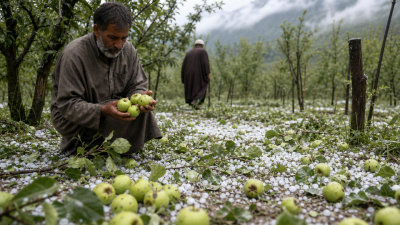
Recently, fresh hailstorms and heavy rainfall struck south Kashmir, damaging apple orchards, vegetable crops and farmlands in Anantnag, Tral (Aripal belt) and Kulgam. Orchardists report substantial fruit and foliage loss; growers demand insurance, compensation, KCC relief and restoration of the Market Intervention Scheme.
What is the current issue
Scope
Hailstorms and heavy rain have become more frequent and intense in Kashmir, hitting during fruit‑setting stages. Recent incidents affected Shangus, Sheikhgund, Wangam, Krad (Anantnag), Tral’s Aripal belt (Satora), Buchroo (Kulgam) and multiple Kulgam villages. Horticulture losses are locally assessed at 40–70%.
Why it matters for governance and economy
- Rural livelihoods: The apple industry supports over 3.5 million people in Jammu & Kashmir.
- Local economy: Horticulture is a major contributor to the Union Territory’s GDP and rural employment.
- Fiscal exposure: Repeated disasters raise demands for compensation, loan waivers and market support, creating fiscal and administrative pressure.
- Food and market stability: High yield losses risk distress sales, price volatility and downstream processing shortages.
Specific impacts observed
- Crop and quality loss: Hailstones damaged developing fruit and foliage, reducing yield and grade. District assessments estimate 40–60% loss; growers report 50–70% in several orchards.
- Seasonal timing effect: Damage occurred during fruit‑setting, impairing fruit development and next season’s returns.
- Socioeconomic effect: Immediate income loss, increased likelihood of indebtedness, and calls for KCC loan waivers and relief packages.
Existing policy instruments and institutional roles
- Crop insurance: National schemes (eg. PMFBY and state implementations) provide yield/area‑based coverage but show limits for horticulture specifics.
- Disaster funds: SDRF and NDRF fund major relief; district administration and horticulture departments assess losses and release assistance.
- Market intervention: MIS has been used earlier to support prices for perishable produce; growers demand its restoration for apples.
- Research & advisories: IMD provides weather warnings; ICAR and SKUAST‑K undertake region‑specific research on varieties and practices.
Key shortcomings in current frameworks
- Inadequate insurance design: Area‑based schemes often fail to capture orchard‑level hail damage and quality loss; premiums and sum‑insured levels may not match orchard economics.
- Delayed settlement: Slow damage assessment and claim processing aggravate farmer liquidity stress.
- Insufficient preventive support: Little public investment in protective infrastructure such as anti‑hail nets or subsidised protective technologies.
- Market support gaps: MIS is not consistently available; lack of processing and storage adds vulnerability.
Technical and agronomic adaptation options
- Protective infrastructure: Anti‑hail nets, windbreaks and shade nets to reduce direct impact; evaluate cost‑benefit and targeted subsidies for high‑value orchards.
- Varietal adaptation: Promote and fast‑track adoption of cultivars with faster maturation or greater resilience; support SKUAST‑K/ICAR trials and seedling supplies.
- Water and canopy management: Improved irrigation scheduling, pruning and canopy training to reduce vulnerability at fruit‑set stage.
- Early warning and last‑mile communication: Strengthen IMD‑agromet advisory dissemination using SMS, apps and extension networks for timely orchard protection actions.
- Value‑chain adjustment: Expand cold storage, processing (juice/dry fruit lines) and contract aggregation to reduce distress sales after loss events.
Financial, insurance and market measures
| Mechanism | Shortcoming | Recommended reform |
|---|---|---|
| Crop insurance | Area‑based design, slow claims | Introduce orchard‑level/parametric (hail/precipitation) products, fast settlement via remote sensing and predefined triggers |
| Credit (KCC) | Repayment stress after repeated losses | Temporary moratoriums, targeted restructuring, and conditional waivers where losses exceed thresholds |
| Market Intervention Scheme | Intermittent activation | Define objective activation triggers and procurement logistics for perishables; link to processing incentives |
Operational and governance reforms
- Rapid damage assessment: Standardise district assessment protocols; use satellite imagery, UAVs and field committees to speed claims and relief.
- Tailored policy for horticulture: State and UT departments should co‑design horticulture insurance products and a protective infrastructure subsidy policy.
- Targeted fiscal support: Time‑bound relief packages, emergency working capital, and performance‑linked support for community cold‑storage and processing units.
- Capacity building: Strengthen extension services, farmer producer organisations (FPOs) and cooperatives for collective risk management and bargaining power.
- Research and environment linkage: Invest in local climate impact studies, integrate results into varietal and land‑use recommendations, and include orchard micro‑climate mapping.
Priority implementation checklist for administration
- Immediate: Rapid damage enumeration, emergency cash relief, KCC moratorium announcements where warranted, MIS activation criteria review.
- Short term: Fast‑track parametric insurance pilots, subsidise anti‑hail nets for most affected belts, deploy agromet advisories and mobile alerts.
- Medium term: Expand cold chain and processing, institutionalise orchard‑level insurance, integrate remote sensing for settlement.
- Long term: Reconfigure orchard planning to climatic trends, promote diversification and strengthen research on resilient cultivars.
Model Questions
1. Analyse the multifaceted economic and social repercussions of escalating hailstorm risk on Kashmir’s horticulture. Suggest policy interventions to enhance farmer resilience. [GS-III: Economic Development]
Escalating hailstorms reduce apple yields and quality (40–70% reported), undermining incomes for over 3.5 million dependent people, raising indebtedness and destabilising rural markets. Policy responses: tailor horticulture insurance (orchard‑level/parametric), rapid claim settlement, emergency cash relief, KCC moratoria or restructuring, MIS restoration, subsidised protective infrastructure, expansion of cold chains and processing, and strengthening FPOs for collective risk management.
2. Examine the shortcomings in existing governmental mechanisms for climate‑induced agricultural distress in Kashmir and propose administrative reforms for better disaster response. [GS-II: Governance]
Shortcomings: area‑based insurance mismatch, slow damage assessment/claim settlement, intermittent MIS activation, limited preventive support and weak last‑mile advisories. Reforms: standardise rapid assessment protocols using remote sensing, pilot parametric products, set objective MIS triggers, provide targeted subsidies for protective infrastructure, strengthen extension and agromet dissemination, and create a disaster contingency window for KCC relief and emergency working capital.
3. Discuss how increasing extreme weather events affect apple fruit‑setting and yield in Kashmir. Propose long‑term agronomic and technological adaptation strategies. [GS-III: Environment & DM]
Hailstorms during fruit‑setting bruise young fruit and foliage, reducing set and marketable grade; repeated damage lowers orchard productivity. Adaptation: deploy anti‑hail nets and windbreaks, adopt resilient/early‑maturing cultivars, improve canopy and irrigation management, expand agro‑met early warnings, invest in varietal research via ICAR/SKUAST‑K, diversify cropping and develop processing to absorb shocks and protect farmer incomes.
4. Evaluate the role of comprehensive crop insurance and the Market Intervention Scheme (MIS) in protecting Kashmir’s apple growers. What design changes are needed? [GS-II: Governance]
Comprehensive insurance and MIS can stabilise income and market prices. Current gaps: area‑basis fails to capture orchard‑level/quality loss; MIS activation is ad hoc. Design changes: introduce orchard‑level or parametric hail products with rapid settlement, subsidise premiums for small growers, define MIS activation triggers, build procurement and processing linkages, and integrate insurance payouts with credit relief to prevent debt distress.
Last Modified: June 22, 2026