
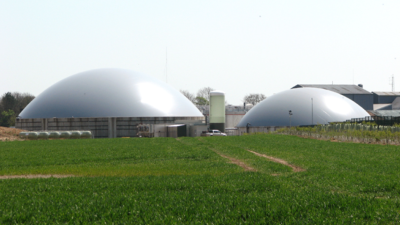
India is scaling biogas from household digesters to industrial Compressed Bio-Gas (CBG) plants. Policy measures, targeted grants and mandated blending targets aim to convert agricultural and municipal organic waste into fuel, fertiliser and livelihoods while reducing gas imports and methane emissions.
What is the issue
Current focus
India is shifting policy emphasis from decentralised domestic biogas to industrial CBG. Organic waste is now treated as a strategic feedstock for energy, fertiliser and waste management. Achieving scale requires market rules, supply-chain solutions and aligned inter-ministerial action.
Why it matters
- Energy security: India imports about 50% of domestic natural gas; CBG potential is estimated at 90 bcm/year.
- Environment: Anaerobic digestion reduces methane emissions and can lower stubble burning in key states.
- Rural economy: Value from feedstock collection, plant operation and bio-slurry marketing supports livelihoods.
- Waste management: Converts cattle dung, paddy straw and municipal organic waste into commercial products.
Strategic architecture of CBG
Industrial CBG plants purify biogas to pipeline-quality CBG for direct injection into City Gas Distribution networks. The model treats multiple outputs—CBG, bio-slurry (FOM/LFOM) and other downstream products—as joint revenue streams under a circular-economy approach.
Institutional framework and inter-ministerial governance
- MoPNG: Energy policy, commercial off-take, SATAT oversight and CBG market formation.
- MNRE: Technical standards and capital grants under the National Bioenergy Programme and CFA scheme.
- Ministry of Jal Shakti: GOBARdhan implementation for community and rural installations under SBM-G Phase II.
- Ministry of Chemicals & Fertilisers: Integration of bio-slurry into formal fertiliser markets and FCO classifications.
Policy action follows a Whole-of-Government model to reduce regulatory friction across the value chain.
Quality and technical standardisation
Processed CBG must meet BIS IS 16087. Minimum methane concentration: 90% by volume. CO2, H2S and moisture removal are mandatory for compatibility with commercial natural gas systems and direct CGD injection.
Circular economy and multi-product value streams
Economic viability depends on combined revenue from CBG and bio-slurry products. Typical flow: raw feedstock (paddy straw / dung / MSW) → anaerobic digester → CBG (≥90% CH4) + bio-slurry → transport/industrial fuel and FOM/LFOM organic fertilisers. Market development for bio-slurry is essential to project returns.
Energy security and import substitution
- Import offset: 90 bcm/year sustainable CBG potential could substitute a large share of natural gas imports.
- Price insulation: Domestic CBG supply reduces exposure to global gas price volatility.
Agrarian nutrient recovery streams
Bio-slurry is nutrient-dense. The Ministry of Agriculture and Farmers Welfare included two FCO classifications: Fermented Organic Manure (FOM) and Liquid Fermented Organic Manure (LFOM). The central government provides Market Development Assistance of ₹1,500 per metric ton to promote commercial blending and distribution with chemical fertilisers.
Core policy initiatives and mandates
- Compressed Bio-Gas Blending Obligation (CBO): Phased legally binding blending targets for CGD entities to create guaranteed demand.
| Financial Year | Mandatory Minimum CBG Blending Target |
| 2025–26 | 1.0% of total CNG / PNG consumption |
| 2026–27 | 3.0% of total CNG / PNG consumption |
| 2027–28 | 4.0% of total CNG / PNG consumption |
| 2028–29 onwards | 5.0% of total CNG / PNG consumption |
- BAM Scheme: MoPNG outlay ₹564.75 crore to subsidise machinery (balers, tractors) for agricultural residue collection.
- DPI Scheme: ₹994.5 crore to finance pipeline links between rural CBG plants and regional gas networks through 2028–29.
- MNRE CFA: Capital grants up to ₹4 crore per 4,800 kg/day CBG capacity; project cap ₹10 crore.
Operational bottlenecks and structural deficiencies
Feedstock aggregation risks
Residues are seasonal with 15–20 day collection windows after harvest. Rural storage is limited. Supply shortages and price volatility occur. These factors disrupt steady industrial-scale operation.
Low plant capacity utilisation
IEA reports average utilisation around 35%. Causes: inconsistent feedstock quality, poor process control (digestor temperature), and delayed pipeline hookups.
Financial and capital constraints
Commercial banks view CBG projects as high-risk. This limits access to low-cost debt despite RBI classifying CBG infrastructure under Priority Sector Lending. Perceived revenue uncertainty and operational risks raise financing costs.
Key initiatives and international context
- Global Biofuels Alliance (GBA): Launched under India’s G20 presidency to align standards and accelerate biofuel adoption globally.
- SBM-G Phase II district grants: Up to ₹50 lakh per district for community GOBARdhan units.
- Carbon credits: MEFCC has approved commercial CBG plants as eligible under Article 6.2 for carbon credit generation.
Way forward: policy and operational recommendations
- Feedstock security: Create rural storage hubs, seasonal aggregation centres and long-term collection contracts with farmers and cooperatives. Use BAM funds to deploy collection equipment where needed.
- Demand assurance: Enforce CBO targets and standardise off-take contracts with CGD companies to stabilise revenue streams.
- Financial de‑risking: Offer blended finance (grant + concessional loan), credit guarantees, green bonds and lower interest windows under PSL status to reduce bank exposure.
- Operational standardisation: Strengthen MNRE technical standards, training for plant operators, and quality-linked incentives to raise capacity utilisation above current levels.
- Fertiliser market integration: Expand MDA-backed blending programmes and retail channels for FOM/LFOM; link bio-slurry quality certification to FCO rules.
- Infrastructure rollout: Prioritise DPI pipeline connections and modular mobile upgrading units to bridge early-stage plants to CGD networks.
- R&D and technology adoption: Fund digestion technologies that handle mixed feedstocks, improve gas yield and reduce downtime.
- Regulatory coherence: Maintain inter-ministerial coordination, with clear roles and a single-window on approvals for project developers.
Model Questions
- Examine India’s policy framework for scaling Compressed Bio-Gas (CBG). Analyse its potential contribution to energy security and environmental objectives, and identify the main implementation challenges. [GS-III: Economic Development]
- Assess the Whole-of-Government approach in India’s bioenergy sector. How does inter-ministerial coordination affect integration of biogas production with waste management and agriculture? [GS-II: Governance]
- In the context of a circular economy, evaluate how multi-product value chains from CBG plants support agrarian nutrient recovery and project viability. What incentives encourage integration of bio-slurry into the fertiliser market? [GS-III: Environment & DM]
- Commercial CBG projects face operational and financial bottlenecks despite policy support. Critically analyse these constraints and propose measures to raise capacity utilisation and bankability. [GS-III: Economic Development]
The answer must describe SATAT, National Bioenergy Programme, CBO and financial supports (CFA, MDA, BAM, DPI). Analyse benefits: import substitution (90 bcm potential), methane and pollution reduction, rural livelihoods. Identify challenges: feedstock seasonality, 35% capacity utilisation, financing constraints, pipeline link delays. Suggest policy measures: demand assurance, storage hubs, blended finance and standardisation to improve viability.
Cover roles of MoPNG, MNRE, Ministry of Jal Shakti and Ministry of Chemicals & Fertilisers. Explain coordination benefits: reduced regulatory friction, unified incentives, GOBARdhan and SBM-G grants for community projects. Discuss gaps: synchronising approvals, data sharing, and execution at state/district level. Recommend single-window clearances, joint monitoring and linked funding to ensure policy alignment across waste, energy and agriculture sectors.
Explain outputs: CBG and bio-slurry (FOM/LFOM). Note FCO classifications and MDA of ₹1,500/MT for commercial blending. Discuss soil health benefits, reduced chemical fertiliser use, and additional revenue stream improving project IRR. Address market needs: quality certification, retail channels, blending rules. Recommend incentives: extension services, buyer guarantees, and scale-up grants to develop demand for bio-organic fertilisers.
List constraints: seasonal feedstock aggregation, low utilisation (35%), quality variability, delayed pipeline hookups, bank risk aversion. Propose measures: storage and aggregation centres, standard operating procedures, operator training, enforceable off-take agreements, credit guarantees, blended finance instruments, PSL-based interest subventions and performance-linked grants to attract long-term debt and improve utilisation.