
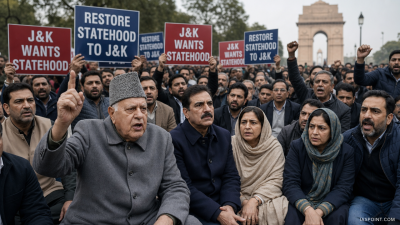
On 20 July 2026 the Jammu and Kashmir National Conference organised protests in New Delhi and at district headquarters across Jammu and Kashmir, led by Farooq Abdullah and Omar Abdullah, demanding restoration of statehood. The Delhi march began from Prithviraj Road after permission to gather at Jantar Mantar was denied and coincided with the opening of the Monsoon Session of Parliament.
What is the current issue
The demand is for restoration of full statehood to Jammu and Kashmir, which was reorganised into two Union Territories under the Jammu and Kashmir Reorganisation Act, 2019 after the abrogation of Article 370. The Supreme Court upheld the abrogation but directed that statehood be restored at the earliest. Political mobilisation by regional parties seeks legislative, executive and fiscal powers currently constrained under the Union Territory framework.
Why it matters
- Governance: Statehood changes the distribution of executive authority and legislative competence, affecting service delivery and accountability.
- Security: Control of police and public order will shift, with implications for counter‑terrorism, intelligence sharing and border management.
- Democracy: Restoration addresses the democratic deficit created by prolonged centralised administration.
- Centre–state relations: It will recalibrate federal balance and parliamentary oversight.
Constitutional and federal dimensions
Legal basis: Article 370 was abrogated and the Reorganisation Act, 2019 created two Union Territories. The Supreme Court Constitution Bench in December 2023 upheld the Central action but directed restoration of statehood and assembly elections. Federal implications: Restoring statehood reassigns subjects from Parliament to the state assembly where they fall in the State List. The change reverses an exceptional use of Union powers and restores Jammu and Kashmir as a constituent unit with autonomy over state subjects while preserving national security prerogatives of the Centre.
Governance and administrative friction
Divided executive: As a Union Territory, the Lieutenant Governor retains powers over police, public order and services, producing frequent friction with the elected government. Fiscal and bureaucratic control: Major budgetary approvals require LG/Union oversight. Senior officers remain accountable largely to the Union. Statehood would increase fiscal autonomy, strengthen legislative oversight and align senior bureaucracy with the elected executive.
| Dimension | Union Territory (current) | State (post‑restoration) |
|---|---|---|
| Legislative competence | Parliament can legislate broadly | Assembly has exclusive State List powers |
| Police & public order | Under LG/Centre | Under elected state government |
| Budgetary control | LG/Union oversight | Greater fiscal autonomy; state budgeting |
| Bureaucratic accountability | To Centre through LG | To state executive and legislature |
Internal security and operational readiness
Current posture: Centralised control aids unified counter‑terror operations and coordination with paramilitary forces along the Line of Control. Transition challenges: Transfer of police and public order requires phased arrangements for intelligence sharing, joint operational protocols, command continuity, and legal clarity on jurisdiction. There must be safeguards to prevent security gaps during personnel and function transfers. Mitigation measures: Detailed transfer protocol, joint command centres, formalised intelligence‑sharing agreements, continued central support for border defence, and capacity building of local police forces.
Ethical and democratic dimensions
Democratic deficit: Extended central administration with constrained local authority diminishes representative governance and public trust. Moral obligation: The Supreme Court direction and political assurances create a duty to restore electoral and administrative rights. Restoration should balance rights restoration with objective security safeguards and transitional oversight to maintain order while empowering elected institutions.
Implementation steps and institutional roles
- Legal process: Parliament must repeal or amend provisions of the Reorganisation Act to restore statehood and define transitional arrangements.
- Electoral process: The Election Commission must prepare for free and fair assembly elections once legal status is changed.
- Security transition: Home Ministry, state police leadership and central security agencies should sign time‑bound protocols for transfer of police and public order with operational continuity clauses.
- Fiscal transition: Finance Ministry and Finance Commission recommendations should guide fiscal devolution, grants and debt allocation to ensure uninterrupted public services.
- Capacity building: Programme for strengthening local police, judiciary, civil services and public institutions to assume expanded responsibilities.
Policy risks and safeguards
- Risk: Hasty transfer could create security vacuums. Safeguard: Phased handover and retained central rapid‑response elements.
- Risk: Bureaucratic resistance. Safeguard: Clear accountability mechanisms and administrative training.
- Risk: Political polarisation. Safeguard: Inclusive dialogue with regional parties, civil society and affected communities.
Relevance for UPSC Mains
The issue links constitutional law, federal polity, internal security management, administrative reforms and public ethics. Questions may test ability to analyse legal doctrine, practical transition planning and normative obligations of democratic governance.
Model Questions
1. Analyse the constitutional and federal implications of restoring statehood to Jammu and Kashmir in the light of the Supreme Court’s direction. [GS-II: Constitution of India & Polity]
Restoration reassigns State List competence to the assembly, reversing exceptional parliamentary dominance created by the Reorganisation Act. It restores executive authority to the elected government, strengthens federal balance and legislative federalism, and aligns administrative accountability with popular mandate. Parliament must legislate the legal reversal while preserving national security prerogatives. The process must respect the Supreme Court directive and ensure clear inter‑governmental safeguards.
2. What security and administrative challenges will arise during the transition from Union Territory with a legislature to full statehood, and how should they be managed? [GS-III: Internal & External Security]
Challenges include transfer of police/public order, continuity of intelligence, coordination with central paramilitary forces, and border security management. Manage through phased transfer protocols, joint command centres, formal intelligence‑sharing agreements, capacity building of local police, retention of central quick‑response assets during transition, and legal clarity on jurisdiction to avoid operational gaps and maintain counter‑infiltration readiness.
3. Examine the governance friction inherent in the current Union Territory model for Jammu and Kashmir and explain how statehood would address these frictions. [GS-II: Governance]
The UT model centralises control in the Lieutenant Governor over police, public order and services, producing delays and bureaucratic duality with an elected cabinet. Statehood returns executive powers to the elected government, enhances fiscal autonomy, improves bureaucratic accountability to the legislature, and streamlines policy implementation, reducing administrative conflict and strengthening democratic responsiveness.
4. Discuss the ethical dilemma between security‑driven central control and the moral duty to restore democratic representation in regions such as Jammu and Kashmir. [GS-IV: Ethics, Integrity and Aptitude]
The dilemma pits utilitarian security concerns against deontological obligations to democratic rights. Ethically, prolonged central control risks eroding civic dignity and trust. The moral duty is to restore representation while designing transitional safeguards that protect security. A rights‑respecting, phased restoration with accountability, transparency and institutional checks reconciles security needs with democratic legitimacy.
Last Modified: July 20, 2026