
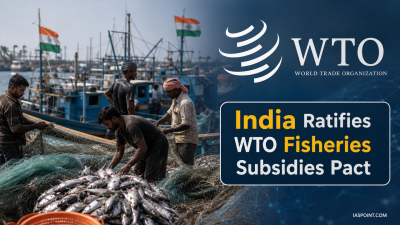
On 20 July 2026 India deposited its Instrument of Acceptance for the WTO Agreement on Fisheries Subsidies, becoming the 123rd party. The instrument was presented by Commerce Secretary Rajesh Agrawal to WTO Director‑General Ngozi Okonjo‑Iweala. The move follows the treaty’s entry into force and ongoing Phase II negotiations.
What is the current issue
The WTO Agreement on Fisheries Subsidies regulates subsidies linked to marine wild capture fishing. Phase I rules, already in force, ban subsidies for illegal, unreported and unregulated (IUU) fishing, subsidies that support fishing on overfished stocks unless for rebuilding, and subsidies for unregulated high‑seas fishing. India’s accession applies these Phase I commitments while Phase II disciplines remain under negotiation.
Why this matters
- Governance: Ratification imposes notification and transparency obligations on India and requires engagement in multilateral fisheries governance.
- Economy & livelihoods: India’s fisheries sector supports over 9 million fisher families; policy changes affect subsidies, market access and export credibility.
- Environment & food security: The pact targets unsustainable incentives that deplete marine stocks while excluding aquaculture and inland fisheries to protect domestic food needs.
- International relations: India’s stance in Phase II affects negotiations on Special and Differential Treatment (S&DT) for developing countries and rules for distant‑water fleets.
Background and chronology
- Adoption: Agreement adopted at the WTO 12th Ministerial Conference in Geneva.
- Entry into force: The treaty entered into force after the required acceptances were deposited.
- India’s action: India deposited its acceptance instrument on 20 July 2026 and is the 123rd ratifying member.
Scope and key provisions (Phase I)
- Covered activities: Marine wild capture fishing and related activities at sea.
- Exclusions: Aquaculture and inland fisheries are excluded from the treaty’s scope.
- Prohibitions: Subsidies for IUU fishing; subsidies that contribute to fishing of overfished stocks (except for stock rebuilding); subsidies for unregulated high‑seas fishing.
- Transparency: Members must notify fisheries subsidies and relevant management measures to the WTO.
India’s domestic fisheries context
- Subsidy intensity: India’s fisheries subsidies average about USD 15 per fisher family annually—among the lowest globally.
- Structure of sector: Predominantly small‑scale, artisanal and near‑shore fishers; India does not operate large distant‑water industrial fleets.
- Livelihoods and schemes: The sector supports more than 9 million fisher families; schemes such as the Pradhan Mantri Matsya Sampada Yojana (PMMSY) provide investment in infrastructure, value‑chain and livelihoods.
Implications for the domestic marine sector
- Immediate compliance: India must ensure national subsidies comply with Phase I prohibitions and meet notification obligations.
- Livelihood protection: Small‑scale fishers operate largely within EEZs; India seeks permanent carve‑outs to protect artisanal fisheries from restrictive disciplines.
- Ecosystem management: Reduced incentives for IUU and overfishing can support stock recovery, aiding long‑term catch stability and food security.
- Trade and market access: Accession improves India’s export credibility in markets with sustainability standards and may reduce non‑tariff barriers for seafood exports.
India’s negotiating strategy in Phase II
- Leverage and timing: India withheld earlier ratification rounds to preserve leverage while Phase II rules were negotiated; accession now focuses leverage on Phase II outcomes.
- Key demands: A 25‑year transition period for developing countries; a permanent carve‑out for traditional and small‑scale fishers within EEZs; stronger disciplines on distant‑water industrial fleets operated by advanced economies.
- Equity concern: India frames demands as Special and Differential Treatment (S&DT) to protect developmental policy space and livelihoods.
- Global context: Top subsidisers (China, EU, US, South Korea, Japan) account for a large share of global subsidies; India seeks rules that target such large‑scale subsidisation rather than small domestic support.
Environmental, food security and SDG considerations
- Marine conservation: Banning subsidies for IUU and overfished stocks supports SDG 14.6 and global stock recovery efforts.
- Food security: Excluding aquaculture and inland fisheries protects domestic protein supplies and smallholder food systems.
- Balanced outcomes: Policy must balance stock rebuilding with continued livelihoods and local food needs; targeted management measures and scientific rebuilding plans are essential.
Institutional and regulatory challenges
- Notification and transparency: Members must provide regular, detailed notifications on subsidies and stock status—this requires institutional capacity and data systems.
- Monitoring and enforcement: India’s dispersed artisanal fleet complicates vessel tracking, IUU detection and enforcement in coastal waters.
- Scientific and technical constraints: Stock assessments, biomass surveys and fisheries management plans need sustained scientific infrastructure and funding.
- Capacity building: India can draw on WTO technical assistance, the WTO Fish Fund, regional fisheries management organisations (RFMOs) and domestic schemes like PMMSY to build systems for compliance.
Policy options and administrative measures
- Targeted subsidy reform: Reorient subsidies from capacity‑enhancing inputs to livelihood support, safety, gear replacement and stock‑restoration programs.
- Artisanal protection: Legislate a clear definition and carve‑out for small‑scale fishers operating within the EEZ to safeguard livelihoods.
- Strengthen monitoring: Scale up vessel monitoring systems, community reporting and coastal surveillance for IUU control.
- Scientific investments: Increase funding for stock assessments, fisheries management plans and data systems to meet notification requirements.
- Diplomacy: Use Phase II negotiations to secure S&DT, long transition periods and strict limits on distant‑water industrial subsidies by major subsidisers.
Model Questions
1. Evaluate the implications of India’s ratification of the WTO Agreement on Fisheries Subsidies for its domestic marine sector and fisher households. [GS-III: Economic Development]
India’s accession requires compliance with Phase I prohibitions on IUU and overfished stocks and increases transparency obligations. Benefits include improved stock recovery and export credibility. Risks arise from notification burdens and potential constraints on subsidies. Protecting livelihoods requires targeted subsidy reform, statutory carve‑outs for artisanal fishers within EEZs, investment in PMMSY‑type measures and scientific management plans to rebuild stocks while sustaining incomes.
2. Analyse how India’s demands in Phase II reflect Special and Differential Treatment principles and the policy space needed for developing countries. [GS-II: Governance]
India seeks a 25‑year transition, permanent artisanal carve‑outs and strict rules for distant‑water fleets. These demands mirror S&DT by allowing extended implementation timelines and exemptions for small‑scale fishers, preserving developmental policy space. Such measures permit phased reforms, capacity building and infrastructure investment without immediate constraints on livelihood support, while focusing disciplines on major subsidising industrial fleets.
3. Examine the role of the WTO fisheries subsidies agreement in reconciling global marine conservation objectives with food security needs in developing countries. [GS-III: Environment & DM]
The agreement curbs incentives for IUU and fishing of overfished stocks, aiding stock recovery and SDG 14.6. By excluding aquaculture and inland fisheries, it preserves domestic protein sources. Reconciliation requires targeted measures: allow rebuilding subsidies, protect subsistence and artisanal fishing, fund scientific management, and ensure capacity building so conservation measures do not undermine short‑term food security.
4. Identify institutional and regulatory challenges India faces in meeting WTO notification and compliance requirements and suggest administrative responses. [GS-II: Governance]
Challenges include limited data on stocks, dispersed artisanal fleets, weak vessel monitoring and fiscal constraints for scientific assessments. Administrative responses: strengthen fisheries data systems, expand vessel monitoring and community surveillance, use WTO technical assistance and the Fish Fund, integrate PMMSY investments with compliance needs, and set up inter‑ministerial mechanisms for regular notifications and policy coordination.
Last Modified: July 20, 2026