
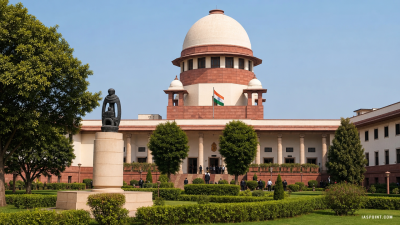
The Supreme Court directed the Union Government to set up a committee within two weeks to frame uniform post‑retirement guidelines for former High Court Chief Justices and judges. The committee must submit recommendations within three months; the Centre has no objection. The matter stems from a writ petition and a contempt petition by Justice V.S. Dave.
What is the issue?
Core problem
Retired High Court judges receive widely differing post‑retirement facilities across states. Services include domestic help, drivers, telephone reimbursement, medical reimbursement, security arrangements and government accommodation during travel. The Supreme Court has asked the Union to constitute a committee to prepare uniform guidelines and to report within three months.
Bench and representation
The bench was headed by Chief Justice Surya Kant, with Justices Joymalya Bagchi and V. Mohana. Solicitor General Tushar Mehta stated the Union has no objection to the committee. The petitions include a writ on security and facilities and a contempt petition filed by Justice V.S. Dave.
Why it matters for governance and judicial independence
- Judicial independence: Predictable post‑retirement amenities reduce pressure on serving judges to seek executive favour for future postings, protecting impartial adjudication.
- Rule of law and dignity: Adequate security and medical cover preserve personal safety and dignity of retired judges who decide sensitive matters.
- Cooperative federalism: State variation in benefits creates an uneven national standard for constitutional functionaries; central coordination affects intergovernmental relations.
- Administrative efficiency: Lack of uniformity increases litigation, administrative delays and grievance redress costs.
Constitutional and statutory framework
- High Courts: Operate under Articles 214–231 as state constitutional courts.
- Fiscal division: Salaries and administrative expenses of High Court judges are chargeable to the Consolidated Fund of the State (Article 202). Pensions are charged to the Consolidated Fund of India (Article 112(3)(d)(iii)). This split complicates state‑level provision of post‑retirement facilities.
- Governing statute: The High Court Judges (Salaries and Conditions of Service) Act, 1954 sets service conditions but does not prescribe a uniform schedule for post‑retirement logistical support.
- Judicial precedents: The Court has previously suggested the Andhra Pradesh model as a yardstick (P. Ramakrishnan Raju v Union of India, 2014) and held that states must meet minimum standards (State of Uttar Pradesh v Association of Retired SC & HC Judges, 2024).
Federal and governance challenges
- State revenue disparities: Wealthier states can allocate better facilities; fiscally constrained states struggle to provide drivers, security officers or medical reimbursements.
- Administrative responsibility: Facilities often require recurring budgetary allocation and staff; states control these items but national uniformity requires central coordination or fiscal support.
- Accountability gaps: No uniform monitoring mechanism exists to ensure minimum standards across jurisdictions.
Institutional security and welfare dimensions
- Security needs: Retired judges who heard organised‑crime, terrorism or high‑value commercial disputes may require protection across state borders.
- Logistics and dignity: Transport, medical reimbursement, telephone facilities and accommodation affect mobility and access to health care and official duties (for example, committee appearances).
- Redress mechanisms: Delays in reimbursement and ad hoc executive orders undermine timeliness and dignity.
Separation of powers and the Court’s role
- Judicial directive: The Court has directed the Union to form a committee rather than prescribing rules itself. This uses judicial supervisory power to remedy systemic administrative gaps without drafting detailed policy.
- Article 142 context: The Court can issue directions that are necessary for doing complete justice where systemic failures persist. Directing formation of a consultative committee leaves policy formulation to the executive while ensuring judicial concern is addressed.
- Executive cooperation: Centre’s assent to committee formation preserves institutional boundary and enables inter‑governmental consultation.
Ethical dimensions and integrity
- Conflict of interest risk: Uncertain post‑retirement prospects may create temptation for judges to seek remunerative executive posts, affecting perceived impartiality.
- Dignified retirement: Uniform benefits reduce ethical vulnerabilities by securing basic needs and removing dependence on discretionary executive largesse.
Way forward: practical options for uniformity
| Dimension | Options |
|---|---|
| Policy basis | Amend the High Court Judges (Salaries and Conditions of Service) Act, 1954 to include a schedule of post‑retirement facilities. |
| Fiscal mechanism | Central matching grants or a dedicated central fund to reimburse poorer states for meeting minimum standards. |
| Operational design | Model rules framed by the committee with minimum entitlements (security, medical, transport, accommodation, telephone, domestic help) and state‑level implementation plans. |
| Implementation tools | Automated reimbursement via direct benefit transfer, centralized grievance portal, and periodic audits by an independent body. |
| Safeguards | Clear eligibility rules, tenure‑limited security protocols, and guidelines on post‑retirement appointments to avoid conflict of interest. |
Stakeholders and roles
- Union Government: Constitute committee, provide fiscal support, amend statute where required.
- State Governments: Implement agreed minimum standards, budget for recurring costs, coordinate local security arrangements.
- Judiciary (retired and serving): Provide inputs on needs and ethical safeguards.
- Independent auditors/oversight body: Monitor compliance and fund utilisation.
Model Questions
1. The disparity in post‑retirement facilities for retired High Court judges presents challenges to uniform judicial administration and cooperative federalism in India. Discuss. [GS-II: Governance]
A good answer should explain fiscal causes—state variation in revenue and Article 202/112 split—show how uneven facilities affect national standards for constitutional functionaries, and analyse institutional responses: central policy coordination, matching grants, statutory amendment to the 1954 Act, and monitoring mechanisms. Conclude with trade‑offs between state autonomy and the need for uniform minimum entitlements.
2. Analyse how securing uniform and adequate post‑retirement facilities for constitutional court judges is linked to safeguarding judicial independence. [GS-II: Constitution of India & Polity]
Link post‑retirement security to judicial independence: explain financial and security anxieties that can influence behaviour; show how guaranteed entitlements lower incentives to seek executive favour; cite rules on pensions and past judicial observations. Offer remedies: uniform entitlements, clear rules on post‑retirement employment, and administrative safeguards.
3. “The Supreme Court directing the Executive to establish a committee for framing uniform post‑retirement guidelines raises concerns regarding the separation of powers.” Critically examine. [GS-II: Constitution of India & Polity]
Answer must note the Court’s supervisory role to correct systemic failures under Article 142 and its limited nature when directing committee formation rather than prescribing policy. Discuss executive primacy in policy‑making, need for inter‑governmental consultation, and how co‑operative remedies preserve separation of powers while addressing administrative neglect.
4. Discuss the ethical dimensions of post‑retirement employment and benefits for judges of the higher judiciary in India. How does standardising these benefits preserve judicial integrity? [GS-IV: Ethics, Integrity and Aptitude]
Explain ethical risks: financial insecurity may lead to perceived or real conflicts if judges accept executive appointments. Standardised benefits reduce dependence on discretionary rewards, protect impartiality, and sustain public trust. Recommend measures: fixed entitlements, cooling‑off periods, transparent post‑retirement appointment rules and independent oversight.
Last Modified: July 20, 2026